
Commercial umbrella insurance adds extra liability limits after a business exhausts its primary policy.
Learning how commercial umbrella insurance works can help you protect your company from one large claim that could threaten its cash flow, equipment, or future. This guide explains the policy structure, costs, exclusions, claim process, and common mistakes in clear, practical terms.
What Is Commercial Umbrella Insurance?
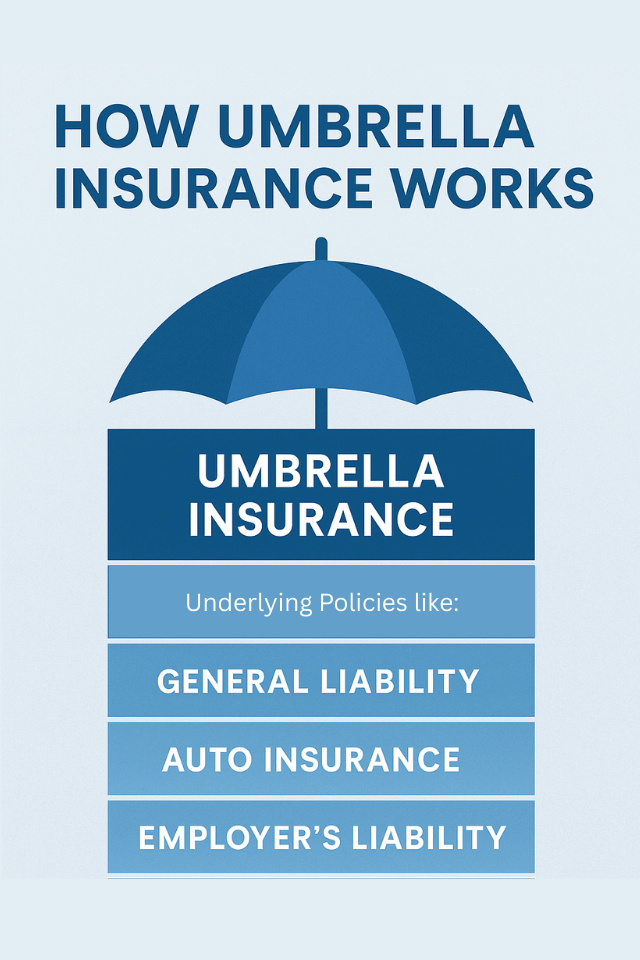
Commercial umbrella insurance is a type of business liability coverage that provides extra limits above certain primary insurance policies. It may respond when the limits of a general liability, commercial auto, or employers liability policy have been used up.
Think of it as a second layer of protection. Your primary policy is the first layer. The umbrella policy sits above it and may pay covered damages, legal fees, and settlements after the first layer reaches its limit.
For example, imagine a customer slips in your store and suffers serious injuries. The court awards $1.5 million, but your commercial general liability policy has a $1 million limit. If the claim qualifies under your umbrella policy, the umbrella may cover the remaining $500,000, subject to its terms.
Commercial umbrella insurance does not replace your primary insurance. In most cases, you must keep the required underlying policies active and maintain their limits. If you cancel a required primary policy, the umbrella insurer may reduce or deny coverage.
How Does Commercial Umbrella Insurance Work?
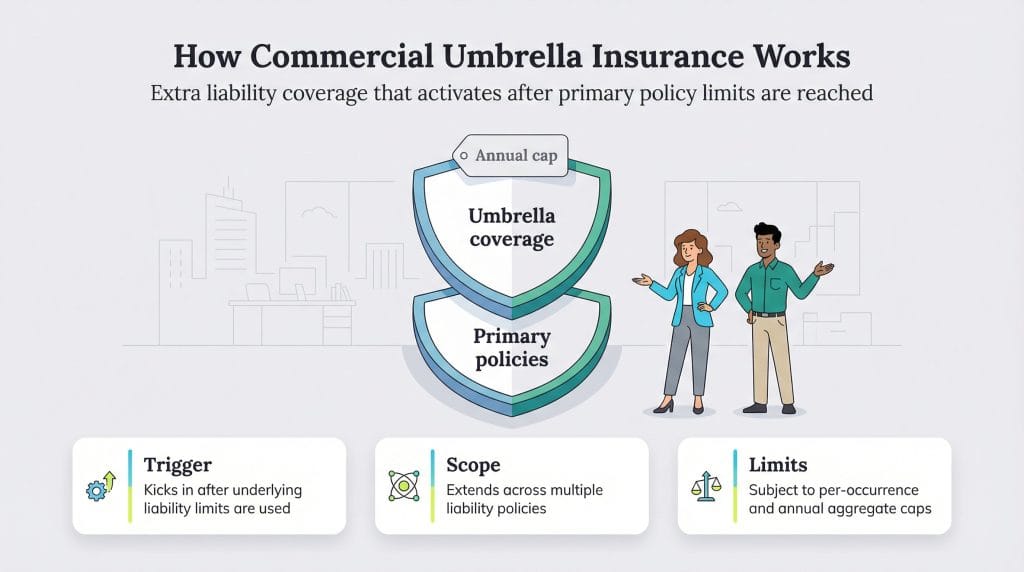
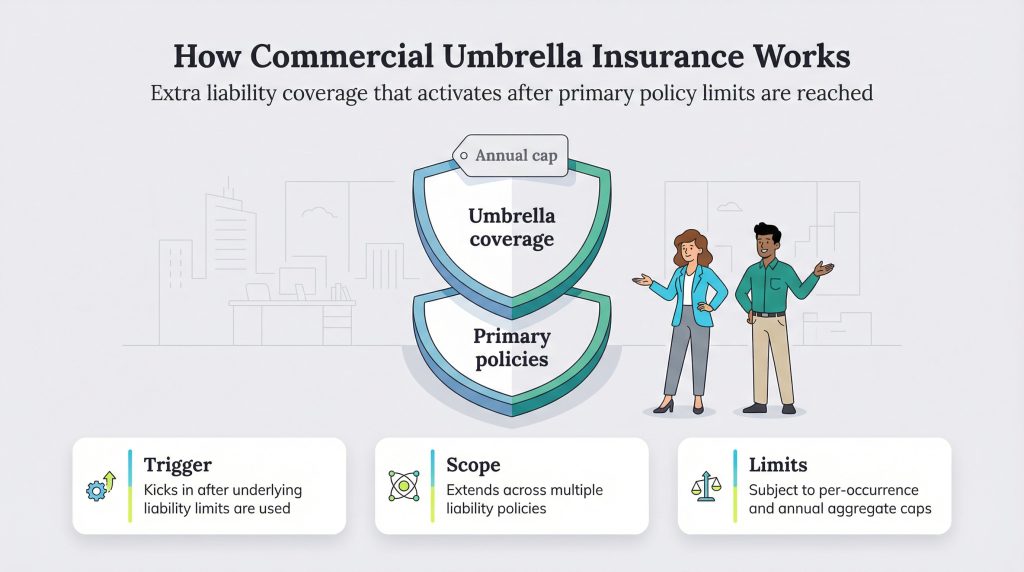
Commercial umbrella insurance works by adding excess liability limits above scheduled primary policies. The primary insurer handles the claim first. Once that policy pays its full limit, the umbrella insurer may take over the remaining covered amount.
A typical policy may include these parts:
• Underlying insurance: The primary policies that respond before the umbrella policy.
• Attachment point: The amount the business or primary insurer must pay before the umbrella responds.
• Umbrella limit: The maximum amount the umbrella insurer may pay during a policy period.
• Retention: An amount the business may need to pay when the umbrella covers a loss not covered by the underlying policy.
• Policy exclusions: Losses the umbrella will not cover.
Here is a simple example:
-
A delivery driver causes a crash.
-
The injured person files a $2 million lawsuit.
-
The commercial auto policy pays its $1 million limit.
-
The commercial umbrella insurance policy may pay the remaining $1 million if the claim is covered.
-
The business may still pay any deductible, retention, uncovered damage, or excluded loss.
This structure answers the basic question, “How does commercial umbrella insurance work?” It provides additional protection, but only within the policy’s terms.
Follow-form and broader coverage
Many commercial umbrella policies use follow-form coverage. This means the umbrella generally follows the terms, conditions, and exclusions of the underlying policy.
Some umbrella policies may offer broader protection than the primary policy. However, broader does not mean unlimited. A difference-in-conditions provision may apply, along with a self-insured retention. Always ask your agent to explain this section in plain language.
What Does Commercial Umbrella Insurance Cover?
The answer depends on the policy wording, scheduled underlying policies, and state law. Many commercial umbrella policies may extend liability protection for claims involving:
• Bodily injury to customers, visitors, or other members of the public
• Property damage caused by business operations
• Personal and advertising injury, such as libel or certain copyright claims
• Commercial auto liability, if the policy lists the required auto coverage
• Products liability claims, if products coverage is included
• Completed operations claims arising from past work
• Employer liability claims, where included and legally permitted
For example, a contractor may face a claim after a completed project causes property damage months later. If the underlying policy covers completed operations and the umbrella lists that policy, commercial umbrella insurance may provide extra limits after the primary coverage ends.
Coverage is not automatic for every risk. Policies often exclude pollution, professional errors, intentional acts, workers’ compensation benefits, cyber losses, and damage to property owned or controlled by the insured.
Some policies also exclude employment practices liability, directors and officers liability, medical malpractice, or liquor liability. A business may need separate policies for these risks.

What Does Commercial Umbrella Insurance Not Cover?
Commercial umbrella insurance is not a universal business protection plan. It usually does not cover every loss that exceeds your primary policy limit.
Common exclusions may include:
• Intentional injury or intentional property damage
• Fines, penalties, and criminal acts
• Damage to your own business property
• Professional mistakes, unless professional liability is scheduled
• Pollution liability, unless specifically added
• Cyber attacks and data breaches, unless cyber coverage is included
• Workers’ compensation benefits
• Employment disputes, unless employment practices coverage applies
• Contract disputes that do not involve a covered liability claim
• Certain aviation, watercraft, or high-risk operations
A key lesson from reviewing business insurance is that many owners focus only on the dollar limit. The policy’s coverage territory, exclusions, definitions, and underlying requirements can matter just as much.
A $5 million umbrella with a narrow scope may offer less useful protection than a $2 million policy that properly matches the company’s real risks.
Commercial Umbrella Insurance vs. Excess Liability Insurance
People often use “umbrella” and “excess liability” as if they mean the same thing. They are related, but the difference can matter.
Excess liability insurance usually increases the limits of one specific underlying policy. For example, a commercial auto excess policy may sit above only the business auto policy.
Commercial umbrella insurance may sit above several primary policies. It may also provide limited coverage that is broader than the underlying policies, depending on the wording.
The main differences include:
• Commercial umbrella insurance may cover multiple liability policies.
• Excess liability insurance often follows one policy more closely.
• An umbrella may include broader terms in certain areas.
• Both products contain exclusions, conditions, and coverage limits.
• Neither policy should be purchased without checking the underlying insurance requirements.
Ask your insurance professional whether the proposed policy is a true umbrella policy or a scheduled excess policy. The label alone does not tell you how the protection works.
How Much Commercial Umbrella Insurance Does a Business Need?
There is no single correct limit for every company. A small office may need less coverage than a trucking firm, manufacturer, hotel, or construction company.
Start with a risk review. Consider:
• The number of customers and visitors your business serves
• Annual sales and payroll
• The number and type of vehicles you own
• Whether employees drive for work
• The value and danger of your products
• Whether you work at customer locations
• Contract requirements from landlords or clients
• Your company’s net worth and available cash
• The possible size of a serious injury claim
• The limits required by lenders, landlords, or business partners
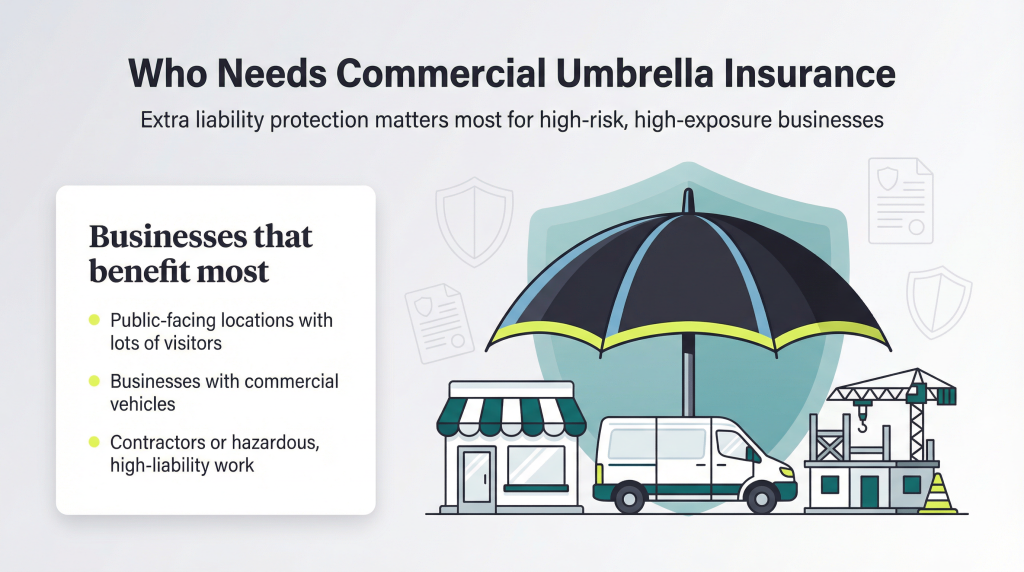
A business with frequent public contact may face more severe liability exposure. A company that owns trucks, transports goods, or sells physical products may also need higher limits.
Many businesses begin by comparing $1 million, $2 million, and $5 million umbrella limits. Larger firms may purchase much more through layered insurance programs. Your agent or broker can model several limits and show the price difference.
Do not select a limit only because it is the cheapest option. A low limit may leave the business exposed during a major claim, while an unnecessarily high limit may waste money.
How Much Does Commercial Umbrella Insurance Cost?
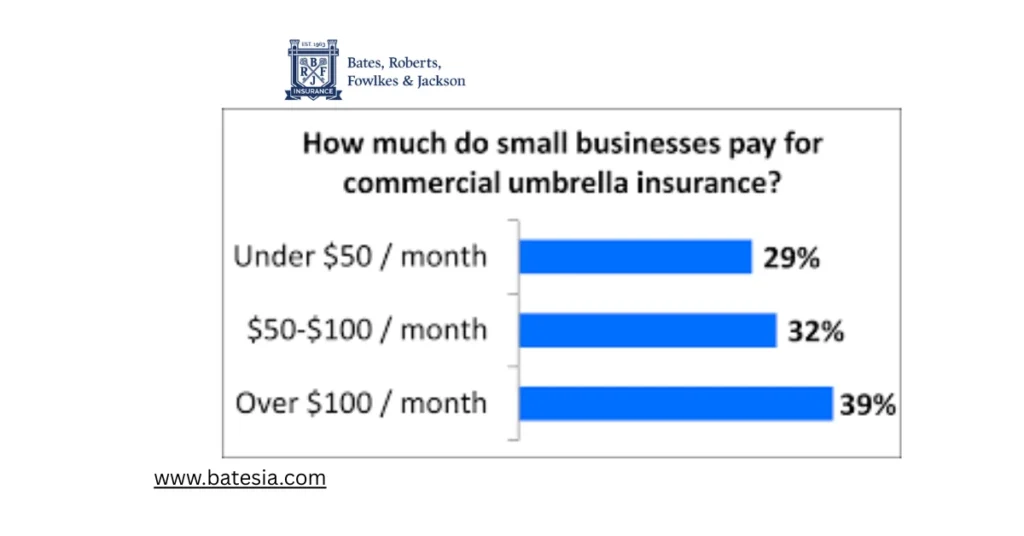
The cost of commercial umbrella insurance varies widely. Small businesses may pay hundreds or a few thousand dollars per year, while high-risk companies may pay far more.
Insurers commonly review:
• Industry and business activities
• Annual revenue and payroll
• Number of employees
• Driving records and vehicle count
• Claims history
• Primary liability limits
• Geographic operating area
• Products and services offered
• Safety controls and written procedures
• Requested umbrella limit
• Deductibles and self-insured retentions
A roofing contractor and an accounting firm may both request a $2 million policy, but their premiums will likely differ. The contractor faces greater physical injury risk, height exposure, vehicle exposure, and completed operations risk.
One practical tip is to request quotes with several limit options. The additional premium for moving from $1 million to $2 million may be reasonable, but the price can rise sharply for high-risk operations or large limits.
Insurance pricing changes over time. Claims trends, court awards, reinsurance costs, inflation, and market conditions can affect premiums. A quote is not a guarantee of future pricing.

How Does a Commercial Umbrella Claim Work?
The claim process usually begins with the primary insurer. You should report the incident promptly to every insurer that may have a role, including the umbrella carrier or broker.
A typical process looks like this:
-
The business reports the incident.
-
The primary insurer investigates the facts.
-
Defense lawyers manage the lawsuit or settlement process.
-
The primary policy pays covered damages and legal costs up to its limit.
-
The insurer warns the business when the limit may be exhausted.
-
The umbrella insurer reviews coverage and takes part in the defense or settlement.
-
The umbrella pays covered amounts above the attachment point, subject to its limit.
Do not wait until a claim becomes large before notifying the umbrella carrier. Late notice can create serious problems, especially when the umbrella insurer needs to participate in legal strategy or settlement talks.
Keep copies of policy declarations, endorsements, claim notices, contracts, incident reports, photos, and communications. Good records can make a stressful claim easier to manage.
A Practical Example of Commercial Umbrella Insurance
Suppose a landscaping company has these policies:
• Commercial general liability limit: $1 million
• Commercial auto liability limit: $1 million
• Commercial umbrella limit: $2 million
An employee causes a serious crash while driving a company vehicle. The injured party files a claim for $2.4 million.
The commercial auto policy may pay the first $1 million. If the umbrella policy lists the auto policy and the claim is covered, commercial umbrella insurance may pay the next $1.4 million.
The company would still need to consider:
• Whether the driver was permitted to use the vehicle
• Whether the auto policy limit met the umbrella requirement
• Whether the claim involved an excluded act
• Whether defense costs reduce the policy limit
• Whether a retention applies
This example shows why policy coordination matters. The umbrella must match the underlying coverage. A gap in the primary insurance can become a gap above it.
Common Mistakes to Avoid
Buying commercial umbrella insurance is important, but buying the wrong policy can create false confidence.
Avoid these mistakes:
• Choosing an umbrella limit without reviewing the company’s real exposure
• Failing to schedule all required underlying policies
• Letting a primary policy lapse during the umbrella term
• Assuming the umbrella covers cyber, errors, or employment claims
• Ignoring defense cost language
• Failing to report serious incidents early
• Using lower primary limits than the umbrella requires
• Overlooking exclusions for specific products or operations
• Renewing without reviewing business changes
• Treating a certificate of insurance as proof of full coverage
Business operations often change faster than insurance policies. A company may add delivery service, open a second location, hire subcontractors, or sell a new product. Each change can affect commercial umbrella insurance.
Review your coverage at least once a year and whenever a major business change occurs.
How to Buy Commercial Umbrella Insurance
A careful buying process can reduce coverage gaps and surprises.
1. List your current policies
Gather your general liability, commercial auto, employers liability, products liability, and other relevant policies. Note each limit, expiration date, exclusion, and deductible.
2. Identify high-severity risks
Look beyond frequent small losses. Ask what event could cause the most serious financial harm. A single vehicle crash, fire caused by a product, or customer injury may create a large claim.
3. Check contract requirements
Many commercial leases, vendor agreements, construction contracts, and government contracts require specific umbrella limits. Confirm the required limits and policy wording before buying.
4. Compare policy forms
Do not compare price alone. Review exclusions, attachment points, defense provisions, territory, coverage for completed operations, and treatment of uninsured underlying coverage.
5. Confirm insurer strength
Consider the insurer’s financial strength, claims service, experience with your industry, and licensing in your state. State insurance departments and financial rating organizations can provide useful checks.
6. Coordinate renewals
Try to align the umbrella renewal with the underlying policies. This makes it easier to maintain matching terms and avoid an accidental lapse.
A knowledgeable independent agent or commercial broker can compare several insurers. Still, the business owner should read the proposal and ask questions before accepting it.
Frequently Asked Questions About How Does Commercial Umbrella Insurance Work
Does commercial umbrella insurance replace general liability insurance?
No. Commercial umbrella insurance normally sits above general liability and other primary policies. You must keep the required underlying coverage active for the umbrella to respond as intended.
Does commercial umbrella insurance cover legal fees?
It may cover defense costs for covered claims, but the exact treatment depends on the policy. Some policies include defense costs within the liability limit, while others may provide separate terms.
Can commercial umbrella insurance cover commercial auto claims?
Yes, many policies can provide excess auto liability coverage. The commercial auto policy must usually be scheduled, and the business must maintain the required underlying limit.
Is commercial umbrella insurance required by law?
Most businesses are not legally required to carry a commercial umbrella policy. However, a landlord, lender, customer, or contract may require it.
Does commercial umbrella insurance cover cyber liability?
Usually, not automatically. Cyber liability often requires a separate policy or a specific endorsement, so review the cyber exclusion carefully.
What happens if the business does not maintain its primary limits?
The umbrella insurer may apply the missing primary limit as if the underlying policy had paid it. This can leave the business responsible for a large gap.
Can a small business buy commercial umbrella insurance?
Yes. Small businesses can buy commercial umbrella insurance when their risks, contracts, or assets justify extra liability protection. Availability and pricing depend on the industry and underwriting details.
Conclusion
Commercial umbrella insurance adds a valuable layer above primary liability policies, but it does not cover every business loss. It works best when the umbrella limit, underlying policies, exclusions, and business operations all fit together.
Review your risks, compare limits, confirm contract requirements, and ask clear questions about exclusions and defense costs. Speak with a licensed commercial insurance professional, then revisit your coverage after major changes. A thoughtful review today can help your business stand stronger after a serious claim.

Zayden Halbrook is a travel enthusiast and gear researcher passionate about making every journey smoother and more enjoyable. With a keen eye for practical travel essentials and real-world tips, he helps readers choose the right gear and travel smarter. When he’s not testing travel kits or exploring new destinations, Zayden shares simple, reliable advice to make every trip stress-free.