Introduction
A luggage scale helps travelers in the United States check a bag’s weight before leaving home. To use one, attach the scale hook or strap to the suitcase handle, lift the bag until it hangs freely, wait for the weight to lock, and compare the result with your airline’s baggage limit.
Most airline fees apply when a checked bag exceeds the limit in the airline’s U.S. baggage policy. Those limits can vary by airline, route, cabin, ticket type, and frequent-flyer status. A home luggage scale cannot replace the airline’s official rules, but it can help you avoid a costly surprise at the airport.

What Is a Luggage Scale?
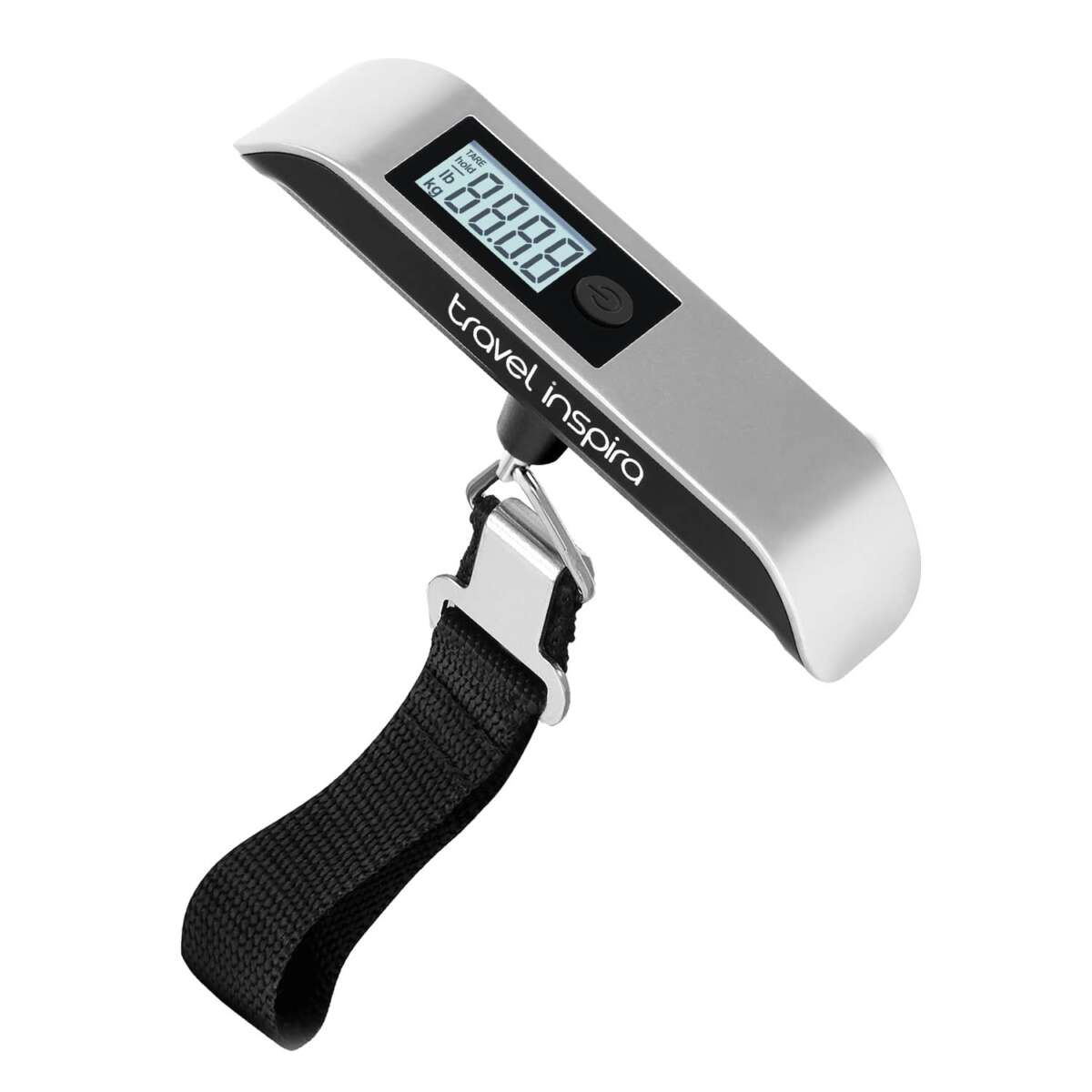
A luggage scale is a small handheld device that measures the weight of a suitcase, duffel bag, backpack, or other travel bag. Most models use a hook, a fabric strap, or both.
Common types include:
- Digital luggage scales: Show the weight on a screen.
- Spring luggage scales: Use a pointer and dial.
- Hanging scales: Hold the bag from a hook or strap while you lift it.
- Portable travel scales: Use batteries and often show both pounds and kilograms.
Digital scales are common because they are small and easy to read. Many have a tare or zero button. This button resets the scale before you weigh the bag.
A luggage scale measures mass, but most travelers call the result “weight.” In the United States, airlines usually list baggage limits in pounds (lb). Many scales also display kilograms (kg) for international travel.
Pounds and kilograms
Use these basic conversions:
- 1 kilogram = 2.205 pounds
- 1 pound = 0.454 kilograms
- 23 kg ≈ 50.7 lb
- 32 kg ≈ 70.5 lb
If your airline limit is 50 pounds, aim for less than 50 pounds. A scale may not match the airport scale exactly.
How to Use a Digital Luggage Scale
Follow these steps for most handheld digital luggage scales.
1. Check the scale before use
Make sure the scale has working batteries. Inspect the hook, strap, handle, and stitching for damage.
Check the maximum capacity printed on the scale. Do not weigh a bag that may exceed that limit. A scale rated for 110 pounds, for example, may not be suitable for a very heavy commercial or equipment case.
2. Turn on the scale
Press the power button. Wait until the display shows zero.
If the screen does not show zero, press the tare, zero, or unit button as directed by the manual. Some models turn on in kilograms, while others start in pounds.
3. Select pounds or kilograms
Choose the unit that matches your airline’s baggage rule.
For most U.S. flights, select lb. For an airline rule listed in kilograms, select kg. Avoid mental conversion when you can use the same unit shown by the airline.
4. Attach the bag
Place the scale’s strap around a strong suitcase handle. If the scale has a metal hook, attach it to the handle or a secure loop.
Keep the scale in line with the bag. Do not attach it to a weak zipper pull, decorative handle, or loose strap. These parts can break under load.
5. Lift the suitcase
hold the scale handle with one hand. Lift the bag slowly with your arm until it hangs freely.
Keep the bag off the floor. Do not drag it across the floor while the scale is measuring. Keep your fingers, feet, and other items clear in case the strap or handle slips.
6. Wait for the reading to stabilize
Hold the bag still. Most digital scales show a stable reading, a lock symbol, or a beep when the measurement is ready.
Do not read the number while the suitcase is swinging. Movement can make the display change.
7. Lower the bag safely
Set the suitcase down before removing the strap or hook. Do not drop a heavy bag while holding the scale.
If your scale has a hold function, record the reading after the display locks. Some models turn off after a short period to save battery power.
8. Repeat the measurement
Weigh the suitcase two or three times. Use the same setup each time.
If the results differ by more than a small amount, check the strap, the battery, and whether the suitcase is touching the floor. A steady setup should give a similar reading.

How to Use a Hanging or Analog Luggage Scale
An analog luggage scale works much like a digital one, but it shows the result on a dial.
- Set the scale to zero if it has an adjustment knob.
- Attach the hook or strap to a strong bag handle.
- Lift the suitcase until it hangs free.
- Keep the bag still.
- Read the pointer at eye level.
- Lower the bag before removing the scale.
Analog scales can be harder to read when the pointer falls between markings. Read the nearest marked value and leave extra room below the airline’s limit.
For example, if the dial appears to show 49.5 pounds and the limit is 50 pounds, treat the bag as too close to the limit. Remove a few items or move them to another bag.
Where to Hold the Scale
Hold the scale by its main handle, not by the strap or hook. Keep your hand above the bag so the suitcase hangs straight down.
Use both hands if the bag is heavy and the scale design allows it. One hand can hold the scale while the other supports the bag during the lift. Do not use your body to add force or jerk the bag upward.
A floor scale can be easier for heavy bags. To use one, place the empty suitcase on the scale and note its weight. Then pack it and weigh it again. Subtract the empty-bag weight from the packed-bag weight if the scale setup requires it.
The handheld method is useful for travel because it is small. The floor-scale method may be easier for people who cannot safely lift a heavy suitcase.

How Much Below the Airline Limit Should Your Bag Be?
Leave a safety margin below the stated limit. A practical target is 2 to 5 pounds below the airline limit, when possible.
This margin helps account for:
- Differences between your scale and the airport scale
- Small items added after weighing
- Measurement changes from movement
- A scale battery that is becoming weak
- Rounding on an analog display
This is a planning suggestion, not an airline rule. The best margin depends on your scale, your bag, and how much extra weight you can remove.
Example calculation
Suppose your airline’s checked-bag limit is 50 pounds.
| Home scale reading | What to do |
|---|---|
| 44 lb | Usually gives useful room for small additions |
| 47 lb | Acceptable for many travelers, but avoid adding much |
| 49–50 lb | Remove items if possible |
| More than 50 lb | Repack before going to the airport |
Do not assume that two bags can share one allowance. Some tickets permit one checked bag, while others permit two. Some airlines use a total-weight rule, while others apply a limit to each bag. Read the baggage terms for your exact trip.

How to Check Your Airline’s Baggage Limit
Look at the airline’s official website or your reservation details. Search for the baggage allowance, checked baggage, or excess baggage section.
Check these details:
- Maximum weight for each checked bag
- Number of checked bags included
- Carry-on weight or size rules, if any
- Oversize and overweight fees
- Rules for domestic and international routes
- Exceptions for military members or loyalty-program members
- Limits for sports gear, musical instruments, and special equipment
The baggage rule may depend on the full itinerary. A connecting flight can involve more than one airline, and the operating airline may apply different procedures.
Do not rely on a general number found in an old travel post. Airline policies can change, and a rule for one route may not apply to another.
How to Know if Your Luggage Scale Is Accurate Enough
A luggage scale is useful for avoiding obvious overweight bags, but it is not a certified airport scale. Small differences are possible.
You can perform a basic home check with an item of known weight:
- Weigh yourself on a bathroom scale.
- Weigh yourself while holding the suitcase.
- Subtract your body-only reading from the combined reading.
- Compare that result with the luggage scale reading.
This method has limits. Bathroom scales may round the result, and holding a bag can affect balance. Use it as a rough comparison, not as a laboratory calibration.
You can also test the luggage scale with a known object, such as a sealed item whose printed weight is reliable. The test should use a weight within the scale’s normal range.
Replace the battery if the display is weak, the scale turns off during lifting, or readings change sharply between repeated tests. A loose strap or damaged hook can also cause poor results.

What to Do if the Reading Seems Wrong
Check the problem in this order:
- Confirm the unit. The scale may show kilograms instead of pounds.
- Reset the scale. Turn it off, turn it on, and set it to zero.
- Check the battery. Install a fresh battery if the display is dim.
- Inspect the attachment point. Use a strong handle, not a zipper pull.
- Lift the bag fully. Make sure it does not touch the floor.
- Stop movement. Wait until the bag hangs still.
- Repeat the test. Take two or three readings.
- Compare with another scale. Use a bathroom scale or a second luggage scale.
If the result remains unstable, do not trust the lower reading. Pack for the higher reading or use another scale.
Do not open a sealed scale or repair a damaged hook while it is carrying a heavy bag. Replace the device if the body, strap, or attachment point shows cracks or stretching.
Common Mistakes When Weighing Luggage
Reading kilograms as pounds
A display of 23 kg does not mean 23 pounds. It is about 50.7 pounds. Always check the unit symbol before packing.
Letting the bag touch the floor
Even light contact can reduce the reading. The suitcase must hang freely.
Weighing only the empty bag
The packed suitcase is what the airline weighs. Weigh it after all clothing, shoes, toiletries, electronics, and gifts are inside.
Using a weak handle
A handle can fail if it is cracked or not fully extended. Attach the scale to a strong, fixed handle.
Adding items after the final check
A pair of shoes, a book, or a full toiletry bag can push a suitcase over the limit. Weigh the bag again after making changes.
Trusting a reading at the exact limit
Your home scale and the airport scale may not show the same number. Leave some room whenever possible.