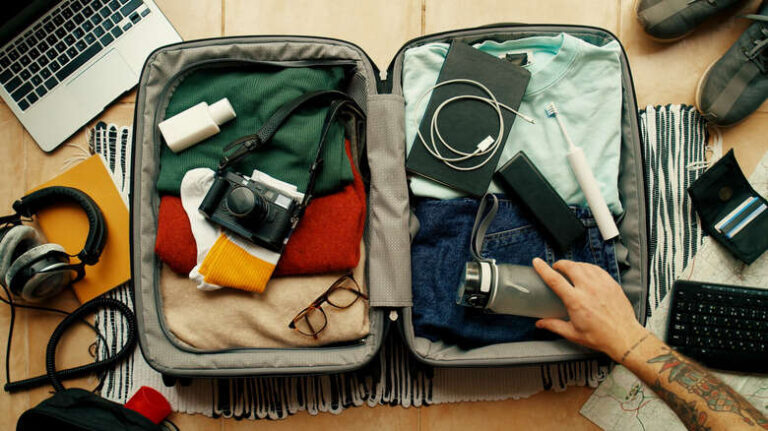
The largest carry-on luggage size is usually 22 x 14 x 9 inches, including wheels and handles.
Knowing what is largest size luggage for carry on can save you from gate-check fees, rushed repacking, and the stress of a bag that will not fit in the sizer. The 22 x 14 x 9-inch rule is common among U.S. airlines, but each carrier sets its own limits, and international airlines may allow less. This guide explains the measurements, airline rules, bag types, packing tips, and mistakes that experienced travelers avoid.

What Is the Largest Size Luggage for Carry On?
For most major U.S. airlines, the largest standard carry-on size is 22 x 14 x 9 inches. These measurements usually include the bag’s wheels, side pockets, top handles, and pull handle.
This size equals 2,772 cubic inches when measured as a simple box. Real bags hold less because of rounded corners, frame parts, wheels, and padding. Still, a well-designed 22 x 14 x 9-inch spinner can hold enough clothing for a short trip.
The phrase what is largest size luggage for carry on does not have one universal answer. Airlines use different limits, and some aircraft have smaller overhead bins. Always check the airline’s current baggage page before you buy a bag or leave for the airport.
Common U.S. carry-on limits include:
• 22 x 14 x 9 inches, used by several large U.S. airlines
• 22 x 14 x 9 inches or 45 linear inches, depending on the carrier
• 22 x 14 x 9 inches for the main cabin, with stricter rules for basic economy
• Smaller limits near 21.5 x 15.5 x 9 inches on some airlines
• About 21.7 x 15.7 x 9 inches on some international carriers
A bag can meet one airline’s size rule and fail another airline’s test. That is why the best answer to what is largest size luggage for carry on is always tied to your exact flight.

Carry-On Size Rules by Airline
Airline rules can change based on the route, aircraft, fare type, and travel region. A ticket on a large domestic jet may offer more overhead space than a low-cost flight on a smaller plane.
Many major U.S. airlines use a maximum near 22 x 14 x 9 inches. Some carriers measure in linear inches, which means length plus width plus height. For example, a bag measuring 22 x 14 x 9 inches has 45 linear inches.
Here are common examples to understand the pattern:
• American Airlines commonly lists 22 x 14 x 9 inches for carry-on bags
• Delta commonly lists 22 x 14 x 9 inches
• United commonly lists 22 x 14 x 9 inches
• Southwest commonly allows a bag up to 24 x 16 x 10 inches
• JetBlue commonly lists 22 x 14 x 9 inches
• Alaska Airlines commonly lists 22 x 14 x 9 inches
These rules can change, so treat this list as a guide rather than a permanent guarantee. Measure your luggage and confirm the rule with the airline operating your flight.
Budget airlines often have stricter policies. Some allow only a small personal item for free and charge extra for a larger cabin bag. Your fare may also decide whether you can use the overhead bin.
When researching what is largest size luggage for carry on, check these details:
• The maximum bag dimensions
• Whether wheels and handles count
• The allowed weight
• Whether a carry-on is included with your fare
• The personal-item size
• Rules for regional or connecting flights
• Fees for gate-checked bags

Why Wheels and Handles Matter
One of the most common luggage mistakes is measuring only the suitcase body. Airlines normally measure the complete outside size. That includes wheels, handles, corner guards, feet, and exterior pockets.
A suitcase advertised as 22 inches may be 24 or 25 inches tall from the floor to the top of the handle housing. It may also become wider when a front pocket is full. Soft luggage can expand in ways that make it fail a metal bag sizer.
Use a tape measure and check three points:
-
Measure from the floor to the highest fixed part of the bag.
-
Measure from the widest side to the opposite side.
-
Measure from the front to the deepest back point.
Keep the telescoping handle closed during measurement. Then measure again with the handle pulled out if you want to understand how much space it needs while moving.
For the safest result, leave a small cushion under the airline limit. A bag that measures exactly 22 x 14 x 9 inches at home may not fit after you fill its outer pocket.
This is a key part of understanding what is largest size luggage for carry on. The advertised size is not always the usable size.

Carry-On Luggage Size Versus Personal Item Size
A carry-on bag goes in the overhead bin. A personal item goes under the seat in front of you. The personal item may be a backpack, purse, briefcase, or small laptop bag.
Personal-item limits vary more than standard carry-on limits. Many airlines use measurements near 18 x 14 x 8 inches, while others allow smaller bags. Low-cost carriers may be strict because personal items take valuable space under the seat.
A good personal item should fit fully under the seat without blocking your feet. Soft backpacks work well because they can compress. Small rolling bags are less useful because wheels and hard frames waste space.
Use the personal item for things you may need during the flight:
• Passport and travel documents
• Medication
• Phone charger and headphones
• Wallet and keys
• Laptop or tablet
• A light sweater
• Snacks and an empty water bottle
If you plan to bring both bags, check that your ticket includes both. Some basic economy fares limit travelers to one personal item, especially on certain routes.

Hard-Side or Soft-Side Carry-On?
The largest carry-on luggage size is not always the best choice if the bag is difficult to fit into a full overhead bin. The material and design can matter as much as the measurements.
Hard-side luggage protects fragile items and often rolls smoothly. It also resists rain and crushing. However, a rigid shell cannot compress if the overhead bin is tight.
Soft-side luggage offers more flexibility. Its outside pockets make it easy to reach a passport, book, or charger. Yet overpacking can stretch the bag beyond its listed dimensions.