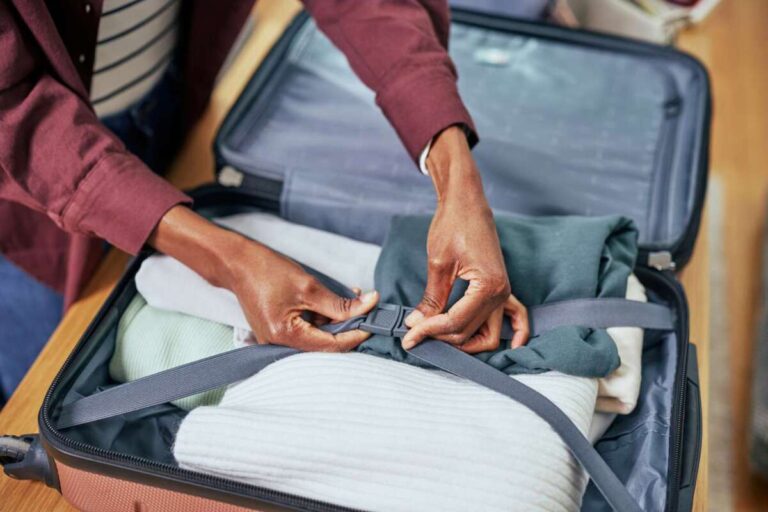
Weigh your suitcase with a luggage scale or bathroom scale, then leave room below your airline’s baggage limit.
Learning how to weigh a suitcase is simple, but doing it well can save you from surprise fees, rushed repacking, and a stressful airport check-in. This guide explains the most accurate methods, common mistakes, airline weight rules, and practical packing tips based on standard travel scales and real-world packing experience.

Why weighing your suitcase matters
Airlines set weight limits for checked bags and sometimes carry-ons. These limits help protect baggage handlers, manage aircraft balance, and control the amount of luggage on each flight.
A suitcase that is only a few pounds over the limit may lead to an overweight baggage fee. Some airlines may also ask you to remove items at the counter. That is never fun when people are waiting behind you.
Knowing how to weigh a suitcase before leaving home gives you time to make changes. You can move items, remove things you do not need, or split the weight between two bags.
Most airlines publish their baggage rules online, but limits vary by airline, route, ticket type, and frequent-flyer status. Always check the current rule for your specific trip.

The best way to weigh a suitcase
A handheld luggage scale is usually the easiest and most useful tool. It is small, affordable, and made for bags with handles.
Follow these steps:
- Turn on the luggage scale and set it to pounds or kilograms.
- Attach the scale’s strap or hook to the suitcase handle.
- Lift the suitcase slowly until it hangs freely.
- Keep the bag still and wait for the number to stop changing.
- Read and record the weight.
- Repeat the test once to confirm the result.
Lift with both hands if the suitcase is heavy. Keep your back straight and bend your knees. A fully packed suitcase can strain your back if you lift it with one quick motion.
For the most useful result, weigh the suitcase after every item is packed. Include shoes, toiletries, gifts, chargers, and anything you may add at the airport.

How to weigh a suitcase without a luggage scale
You can weigh a suitcase with a regular bathroom scale. This method is less convenient, but it works well when you follow the steps carefully.
Method 1: Weigh yourself, then weigh yourself holding the suitcase
- Step on the bathroom scale alone.
- Record your body weight.
- Pick up the suitcase and step on the scale again.
- Record your combined weight.
- Subtract your body weight from the combined weight.
For example:
• Your weight alone: 165 pounds
• Your weight with the suitcase: 208 pounds
• Suitcase weight: 43 pounds
The result may not be perfect if the scale rounds numbers or struggles with movement. Still, it usually gives a close estimate.
Method 2: Use a floor scale
Some home scales can weigh a suitcase directly. Place the suitcase upright or flat on the center of the scale. Make sure no part of the bag touches a wall, table, or nearby object.
If the suitcase is too large for the scale, use the lift-and-subtract method instead. Do not force a large bag onto a small scale because it may tip or give an incorrect reading.

How to weigh a suitcase with a luggage scale
A luggage scale measures the pulling force created when you lift a bag. Most digital models show the weight on a small screen and may lock the result after a few seconds.
To get a reliable reading:
• Attach the scale to the strongest part of the handle.
• Lift the bag straight up, not at an angle.
• Keep the suitcase from touching the floor.
• Wait for the display to settle.
• Use the same unit shown by your airline’s baggage policy.
• Check the battery before your travel day.
Some luggage scales have a tare function. This lets you remove the weight of a strap or other attachment before measuring. Most travelers do not need this feature, but it can improve accuracy for very light bags.
In my own packing tests, the biggest error came from lifting too quickly. The number jumped higher, then dropped as the bag stopped moving. Waiting for a stable reading made a clear difference.

How accurate are luggage scales?
A good luggage scale is often accurate enough for travel, but no home tool is perfect. Small digital scales may vary by a few ounces or more, especially when the battery is weak or the bag swings during lifting.
For extra confidence, follow the three-pound rule. If your airline allows 50 pounds, try to keep the suitcase at 47 pounds or less. This buffer helps account for scale differences, last-minute items, and measurement errors.
You can improve accuracy by:
• Testing the scale with a known weight.
• Comparing it with a bathroom scale.
• Measuring the suitcase twice.
• Replacing an old or weak battery.
• Keeping the bag still while it hangs.
• Avoiding measurement on uneven floors when using a bathroom scale.
A luggage scale is a guide, not a guarantee. The airline’s airport scale is the final measurement that determines whether your bag meets its limit.

How to check your airline’s suitcase weight limit
Before you weigh a suitcase, find the correct weight limit for your booking. Do not rely only on what a friend, travel blog, or older ticket says.
Check:
- Your airline’s baggage policy.
- Your confirmation email.
- Your ticket type and cabin class.
- Your departure and arrival countries.
- Whether the bag is checked or carried on.
- Whether you have elite status or a special allowance.
Many standard checked-bag limits are around 50 pounds in the United States, but this is not universal. Some routes, fare types, and international tickets use different limits.
Carry-on rules often focus on size, but some airlines also set a weight limit. A bag that fits in the overhead bin may still be too heavy under the airline’s policy.
Also check dimensions. Weighing a suitcase does not confirm that it meets the airline’s length, width, and height rules.

How much space should you leave below the limit?
Leave a safety margin instead of packing right up to the maximum. A practical buffer is 2 to 5 pounds, depending on the bag and your travel plans.
For example, if the limit is 50 pounds, aim for about 45 to 48 pounds. This gives you room for:
• A jacket added at the last minute.
• Souvenirs or gifts.
• Slight differences between scales.
• Wet clothing or damp towels.
• Items moved from your carry-on.
• Extra packaging around fragile goods.
A suitcase can also gain weight during a trip. A wet swimsuit, a few books, or small purchases can add more than expected. Leaving space is like leaving room in a glass before carrying it across a crowded room.

What to remove when your suitcase is overweight
If your suitcase weighs too much, start with heavy items that do not affect your trip.
Look for:
• Extra shoes.
• Books and magazines.
• Large bottles of shampoo or lotion.
• Duplicate electronics.
• Heavy jackets.
• Nonessential toiletries.
• Packing cubes or organizers that add weight.
• Items that can fit in a personal item.
Wear your heaviest shoes and jacket during travel if comfortable. Move dense items to another checked bag only if that bag remains under its own limit.
Never place restricted or unsafe items in a bag simply to reduce weight. Review current airport and airline rules for batteries, liquids, medication, sharp items, and sports equipment.
One packing mistake I have seen often is removing several small items while leaving one heavy item untouched. A pair of boots or a large toiletry kit may weigh more than ten small accessories combined.

How to weigh a suitcase for international travel
International trips require extra care because baggage rules can differ by route and ticket. Some airlines use a weight concept, while others use a piece concept.
Under a weight system, the airline gives you a total baggage allowance. Under a piece system, each bag may have its own maximum weight and size.
Before an international flight:
• Check the allowance for every flight segment.
• Confirm whether partner airlines apply different rules.
• Look for limits in kilograms as well as pounds.
• Check whether your connection changes the baggage policy.
• Review rules for fragile, valuable, or unusual items.
• Keep medication and important documents in your personal item.
Use this conversion when needed:
• 1 kilogram equals about 2.2 pounds.
• 50 pounds equals about 22.7 kilograms.
• 23 kilograms equals about 50.7 pounds.
Because airlines may round or enforce limits strictly, avoid packing right at the converted number. A suitcase weighing 23.2 kilograms may be treated as overweight when the limit is 23 kilograms.
Common mistakes when weighing a suitcase
Small errors can produce a misleading result. Avoid these common problems:
Measuring before the suitcase is fully packed
People often weigh an empty or partly packed bag, then add several items later. Always measure the final packed suitcase, including items placed in outer pockets.
Forgetting the suitcase itself
The airline weighs the entire bag. This includes the case, wheels, frame, locks, and packing organizers. A lightweight suitcase can help, but it still contributes to the total.
Using the wrong unit
A display set to kilograms can cause confusion if you expect pounds. Check the unit before reading the result.
Letting the bag touch the floor
A suitcase that rests partly on the floor will appear lighter. The whole bag must hang freely when using a luggage scale.
Trusting one reading
Digital scales can fluctuate. Take two or three readings and use the stable result.
Ignoring outside pockets
Travelers often add chargers, passports, snacks, and small purchases to the front pocket. These items count toward the bag’s total weight.
How to weigh a suitcase at the airport
Many airports have public scales near check-in desks, but availability varies. Some airline counters also have scales that show the bag’s weight before you hand it over.
If you use an airport scale:
- Place the suitcase fully on the platform.
- Keep straps and handles from touching nearby surfaces.
- Wait for the display to settle.
- Check the unit.
- Repack before reaching the counter if needed.
Do not depend on the airport scale as your main plan. You may have limited space, little time, and no easy way to move items once you are in line.
A better approach is to weigh the suitcase at home, then use the airport scale only as a final check.
Packing tips that make suitcase weight easier to manage
Smart packing is often more useful than buying a stronger scale. Start by making a list of what you truly need, then remove items that serve the same purpose.
Try these methods:
• Pack clothing that works in more than one outfit.
• Choose travel-size toiletries.
• Use digital books instead of paper books.
• Wear heavy shoes during the flight.
• Share items with travel companions when practical.
• Pack a foldable tote for light overflow items.
• Keep valuable and essential items in your personal item.
• Weigh the suitcase before adding souvenirs.
• Place dense items near the suitcase wheels for easier handling.
• Use compression bags carefully because they save space, not weight.
Compression bags can make a suitcase look less full while allowing you to add more. That is useful for space, but it can make an overweight suitcase easier to create.
My most reliable habit is weighing the bag two days before departure. That leaves enough time to remove items without making packing feel like a last-minute puzzle.
PAA-style questions about weighing a suitcase
Can I weigh a suitcase with a bathroom scale?
Yes. Weigh yourself, then weigh yourself while holding the suitcase, and subtract the first number from the second. This method may be less precise than a luggage scale, so leave a small weight buffer.
What is the most accurate way to weigh a suitcase at home?
A calibrated luggage scale or large platform scale usually gives the best home measurement. Measure the fully packed bag twice while keeping it still and clear of the floor.
Should I weigh my suitcase in pounds or kilograms?
Use the unit shown in your airline’s baggage policy. In the United States, pounds are common, while many international airlines use kilograms.
Frequently Asked Questions About How to Weigh a Suitcase
How do you weigh a suitcase without lifting it?
Place the suitcase on a large floor scale if the scale can support its size. If it cannot, weigh yourself with and without the bag, then subtract the two readings.
Is a handheld luggage scale worth buying?
For frequent travelers, a handheld luggage scale is usually worth the small cost and space. It helps prevent overweight baggage surprises and can be used before the return flight.
How much should my suitcase weigh for a flight?
Your suitcase should stay below the limit listed for your airline, route, and ticket. Many checked bags have a 50-pound limit, but you should confirm the exact rule for your booking.
Does a suitcase weigh more at the airport?
The suitcase itself does not normally gain weight, but different scales can show slightly different readings. Leave a few pounds of space below the airline limit to reduce this risk.
Do packing cubes add much weight?
Most packing cubes add only a small amount, but several heavy organizers can add up. Weigh the suitcase with the cubes inside because the airline counts every item in the bag.
Can I weigh a suitcase with a kitchen scale?
A kitchen scale is suitable only for small bags or individual items. It usually cannot measure a full suitcase, so use a luggage scale, bathroom scale, or platform scale instead.
Should I weigh my carry-on suitcase?
Yes. Some airlines set carry-on weight limits, and a heavy bag can be difficult or unsafe to lift into an overhead bin. Check both the carry-on size and weight rules before leaving home.
Conclusion
The easiest way to weigh a suitcase is to use a handheld luggage scale and lift the fully packed bag until the reading becomes stable. A bathroom scale can also work by comparing your weight alone with your weight while holding the suitcase.
Check your airline’s current weight and size rules, measure the bag more than once, and leave a small safety margin. These simple steps can prevent fees and make airport travel much calmer.
Weigh your suitcase before your next trip, adjust your packing while you still have time, and share your best luggage tip in the comments.

Zayden Halbrook is a travel enthusiast and gear researcher passionate about making every journey smoother and more enjoyable. With a keen eye for practical travel essentials and real-world tips, he helps readers choose the right gear and travel smarter. When he’s not testing travel kits or exploring new destinations, Zayden shares simple, reliable advice to make every trip stress-free.