
Measure your suitcase with wheels and handles included, then compare its full size with your airline’s baggage rules.
Knowing how to measure suitcase for airlines can save you from surprise fees, forced gate checks, or a bag that will not fit in the airport sizer. Airlines may use different limits for carry on bags, checked luggage, and personal items, so accurate measuring matters. This guide explains the right method, common mistakes, airline size rules, and simple ways to prepare before your trip.

Why suitcase measurements matter
Airlines measure luggage by its outside dimensions. These dimensions usually include the bag’s wheels, handles, side pockets, and other parts that add to its total size.
A suitcase may look small when it is empty. Once you fill it, the fabric can bulge. That extra space can push the bag over the airline’s limit. A soft bag can also become wider or deeper when packed tightly.
Most airlines use three measurements:
• Length: The longest side of the suitcase, usually from the bottom to the top
• Width: The distance from one side to the other
• Depth: The distance from the front of the bag to the back
Airlines may list these measurements as length × width × height. The order can vary, but the numbers describe the same three sides.
For checked bags, airlines often use a total measurement called linear inches. You calculate it by adding the length, width, and depth.
For example:
• Length: 30 inches
• Width: 20 inches
• Depth: 12 inches
• Total: 62 linear inches
Many airlines use 62 linear inches as a common checked baggage limit. However, the exact rule depends on the airline, route, fare, cabin, and loyalty status.

What you need to measure a suitcase
You do not need special travel equipment. A few basic tools can give you a reliable result.
• A flexible tape measure
• A flat floor or table
• A notebook or phone
• A luggage scale
• A straight edge, such as a ruler or book
A flexible tape measure works better than a stiff ruler. It can follow the outside shape of a soft suitcase and reach around curved corners.
Measure the suitcase in its normal travel condition. If you plan to use an expansion zipper, open it before measuring. If you plan to keep it closed, measure it while closed.
Place the suitcase upright on a flat surface. This helps you keep the measurements straight and prevents a tilted bag from appearing smaller than it is.
A luggage scale does not measure size. It only measures weight. You need both tools because a suitcase can meet the size rule but exceed the weight limit.
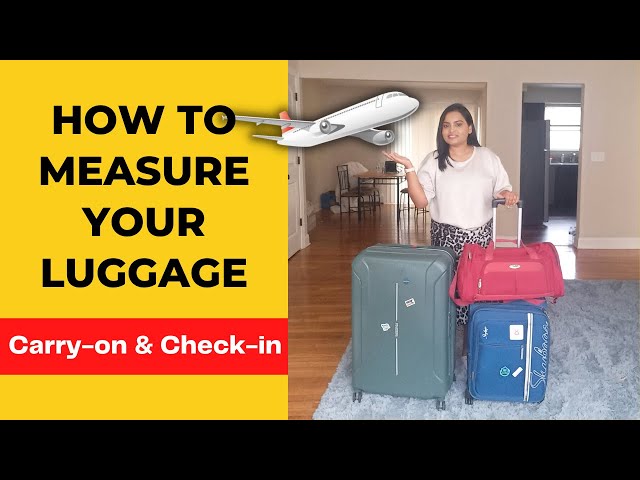
How to measure suitcase for airlines step by step
Follow these steps when learning how to measure suitcase for airlines. Take your time and measure the outermost points.
1. Prepare the suitcase
Pack the suitcase as you would for the flight. Close every zipper and fastener. If the bag has an expansion section, decide whether you will use it during the trip.
Check all pockets. A full front pocket can add depth. A side pocket can add width. Measure the bag in the condition you expect to present at check in or at the gate.
2. Measure the height
Stand the suitcase upright. Measure from the floor to the highest fixed point.
Include:
• The wheels
• The bottom frame
• The main body
• The top carry handle if it sits above the case
Do not include a telescoping handle if the airline measures the bag with that handle lowered. Most airline sizing systems measure the outside case with the pull handle closed, but you should check the carrier’s instructions.
Write down the height to the nearest inch or centimeter. If the result is close to the limit, round up rather than down.
3. Measure the width
Measure across the widest part of the suitcase. This may be the main body, a side pocket, a handle housing, or a wheel structure.
Keep the tape level. Do not press soft fabric inward. Pressing the bag can make it appear smaller than it will be at the airport.
4. Measure the depth
Measure from the front edge to the back edge. Include outside pockets, zippers, handles, and bulges.
For a hard case, measure the widest front to back point. For a soft suitcase, measure it after packing because the depth can change.
5. Add the measurements
For checked luggage, add the three numbers.
Example:
• Height: 30 inches
• Width: 19 inches
• Depth: 13 inches
• Total: 62 linear inches
This suitcase meets a 62 linear inch rule by size. You must still check its weight and the airline’s specific policy.
6. Measure the weight
Place the packed suitcase on a luggage scale. Most checked bag limits range from 50 to 70 pounds, depending on the airline and ticket type.
Lift the bag by hand if you do not own a scale. Then weigh yourself while holding the bag. Subtract your body weight from the combined weight. This method is less precise, but it can help you spot a serious problem.

How to measure a carry on suitcase
Carry on luggage is often judged by height, width, and depth rather than linear inches. Many US airlines use a limit close to 22 × 14 × 9 inches, including wheels and handles. Some airlines allow slightly different sizes.
To measure a carry on suitcase:
-
Place it upright on the floor.
-
Keep the telescoping handle fully closed.
-
Measure from the floor to the highest point.
-
Measure the widest side.