
If you need to send a suitcase from the United States to another country, you can ship it through the U.S. Postal Service, an international courier, or a freight company. The best option depends on the suitcase’s size, weight, destination, delivery time, value, and contents.
For many travelers, shipping is easier than checking an extra bag. However, it is not always cheaper. Before you book, compare the full shipping cost with the airline’s extra-baggage fee and check the import rules for the destination country.
Choose the Best Way to Ship Your Suitcase
The main options are USPS, express couriers, and freight services. Each fits a different type of shipment.
USPS
USPS may suit smaller and lighter suitcases, especially when delivery speed is not the top concern. Depending on the destination, USPS may offer services such as Priority Mail International or Priority Mail Express International.
USPS hands many international parcels to the destination country’s postal system. Delivery times, tracking, customs handling, and final-mile service can vary by country.
Check the current service for your destination with the USPS International Mail Manual. Country rules can change, so do not rely on an old shipping label or a past trip.
Express courier services
Companies such as UPS, FedEx, and DHL offer door-to-door international shipping. They often provide stronger tracking and faster delivery than standard postal services.
Courier pricing usually depends on both actual weight and dimensional weight. Dimensional weight reflects the space the suitcase takes in a delivery vehicle or aircraft.
A courier may be a good fit when:
- You need a delivery date or faster transit.
- You want pickup from your home or hotel.
- The suitcase is valuable.
- You need door-to-door service.
- You want help with customs paperwork.
Review the current destination rules and service terms directly with the carrier. The same carrier may use different services, limits, and customs processes in different countries.
Freight or luggage-shipping services
Freight services can make sense for several suitcases, very large bags, or household goods. A freight shipment may travel by air, ocean, or ground transport after it reaches the destination country.
Freight is often slower and may require more work. The recipient may need to collect the shipment from a terminal, arrange customs clearance, or pay extra delivery fees.
Some luggage-shipping companies resell or manage carrier services. Read the terms carefully. Confirm who handles customs, duties, delivery to the final address, lost-bag claims, and return shipping.
Compare shipping with checking the bag
If you are flying to the same country, compare shipping with the airline’s baggage rules. Checking a suitcase may be simpler because the bag travels with you.
Shipping may be better when:
- You will not fly on the same route.
- You are moving for school or work.
- You need to send the suitcase before you arrive.
- You want to avoid carrying a heavy bag through airports.
- Your airline charges high fees for extra or oversized baggage.
A second checked bag can still be less expensive than international shipping. Compare the final price, not only the advertised base rate.

Prepare the Suitcase Before Packing
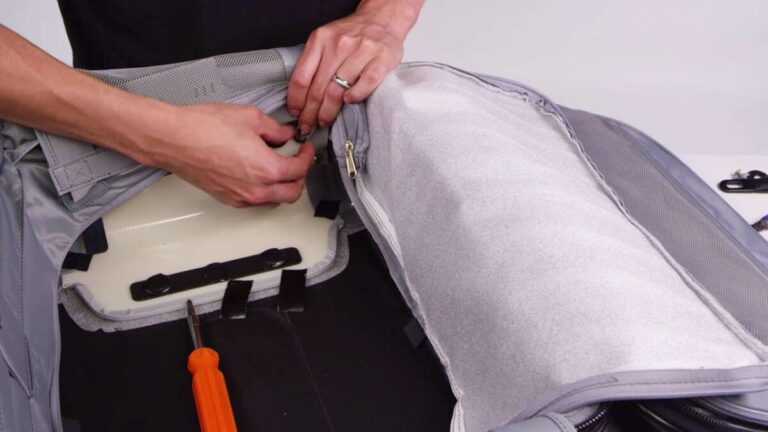
A suitcase should be clean, strong, and easy to inspect before you ship it. Do not assume that a suitcase designed for air travel will meet every courier’s packaging rule.
Inspect the suitcase
Check the following parts:
- Wheels
- Handles
- Zippers
- Locks
- Seams
- Hard shell or fabric panels
- Built-in charging ports
- Identification tags
Remove old airline tags and barcodes. Old labels can confuse automated sorting systems.
If the suitcase has a built-in battery or USB charging port, check whether the battery can be removed. Spare lithium batteries and power banks usually require special handling and generally must not be placed in checked baggage. Shipping rules may also restrict them.
The Federal Aviation Administration provides passenger guidance for batteries and other hazardous items. Carrier rules can be stricter than airline rules.
Decide whether to ship the suitcase inside a box
A suitcase can sometimes ship as its own package. A box usually gives better protection and makes the parcel easier to stack.
Use a strong, new corrugated box that is large enough to leave a small amount of space around the suitcase. Add padding so the suitcase does not move inside the box.
A box can:
- Protect wheels and handles.
- Reduce scuffs and tears.
- Make the parcel easier to label.
- Help prevent straps from catching in sorting equipment.
- Make a weak suitcase safer to transport.
Do not use a box that is crushed, damp, or too weak for the weight. Seal every opening with strong packing tape.
Keep the contents easy to inspect
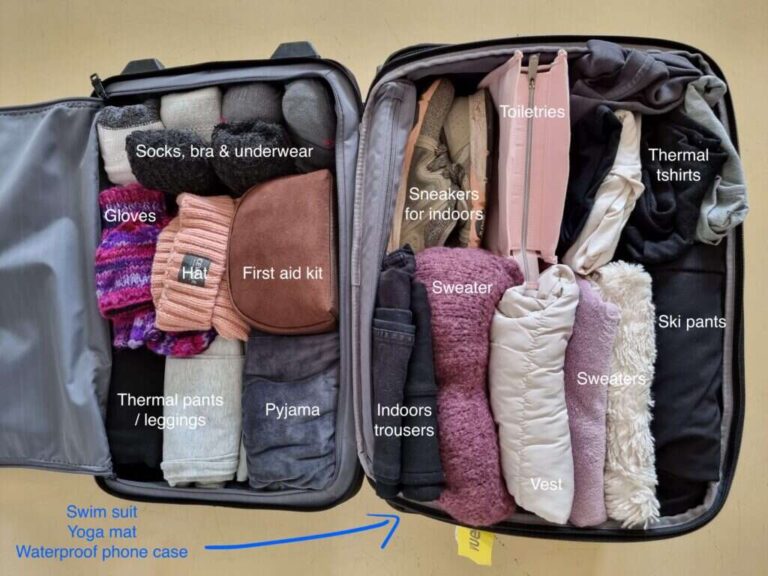
Pack items in a clear and orderly way. Do not hide goods inside false compartments or wrap every item in layers that make inspection difficult.
Make a list of everything inside the suitcase. Include:
- Item description
- Quantity
- Approximate value
- Country of origin, if known
- Intended use
- Weight, when relevant
Do not write only “personal items” on a customs form. Customs officials need enough detail to understand the goods.
Check What You Can and Cannot Ship
International shipments must follow three sets of rules:
- U.S. export and carrier rules.
- The destination country’s import rules.
- Airline, postal, or courier rules for transport.
A carrier may refuse a package even when an item is legal to own. Some items are allowed only under certain packing, labeling, quantity, or documentation rules.
Commonly restricted items
Check the rules before packing items such as:
- Alcohol
- Medicines
- Food
- Plants and seeds
- Animal products
- Cosmetics
- Aerosols
- Cleaning products
- Perfume
- Matches and lighters
- Firearms and ammunition
- Knives and weapons
- Batteries
- Flammable liquids
- Valuable jewelry
- Cash and negotiable instruments
The U.S. Department of Transportation’s hazardous materials guidance and the carrier’s dangerous-goods rules are useful starting points.
Destination countries may also restrict meat, dairy products, fresh food, wood products, soil, and plant material. Agricultural rules are often strict because these goods can carry pests or disease.
Do not ship prohibited items by mistake
Common packing mistakes include leaving a lighter in a pocket, packing aerosol deodorant, or forgetting a power bank in a suitcase. Check every pocket, lining, and accessory compartment.
If you are unsure about an item, leave it out until the carrier confirms that it is allowed. Never describe a restricted item as something else on a customs form.

Measure the Suitcase and Estimate the Price
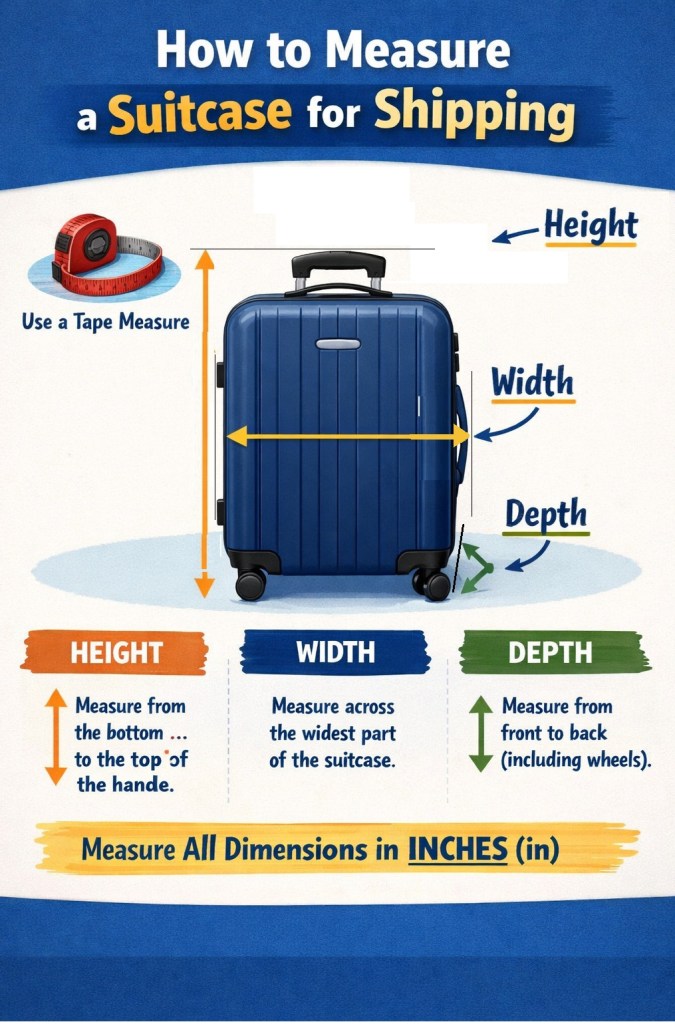
Measure the packed suitcase, not the empty suitcase. Record its length, width, and height in inches, plus its weight in pounds.
Understand dimensional weight
Carriers may calculate dimensional weight with a formula such as:
Dimensional weight = length × width × height ÷ carrier divisor
The carrier then may charge based on the greater of actual weight or dimensional weight. The divisor differs by carrier, service, and transport type.
For example, a hypothetical packed suitcase measures 30 × 20 × 12 inches:
- Volume: 30 × 20 × 12 = 7,200 cubic inches
- If a carrier uses a divisor of 139, dimensional weight is about 52 pounds
- If the actual weight is 38 pounds, the billable weight may be about 52 pounds
This is only an example. Use the divisor shown in the carrier’s current rate tool. Oversize fees may apply even when the billable weight is low.
Get a complete quote
Enter accurate information into the carrier’s calculator:
- Pickup ZIP Code
- Destination address and country
- Packed length, width, and height
- Packed weight
- Declared value
- Service speed
- Residential or commercial delivery
- Customs or brokerage options
Look for charges that may appear after the base quote, including:
- Fuel surcharges
- Remote-area fees
- Residential delivery fees
- Oversize fees
- Customs brokerage fees
- Import duties and taxes
- Address correction charges
- Storage fees
- Failed-delivery fees
- Return shipping
A low base rate does not always produce the lowest final cost.

Complete the Customs Forms Correctly
A customs form tells the destination country what the shipment contains, why it is entering the country, and what it is worth. Incorrect information can cause delays, extra charges, seizure, or return to the sender.
Describe every item clearly
Use plain descriptions such as:
- Two cotton shirts
- One pair of leather shoes
- One used laptop computer
- Three paperback books
- One wool jacket
Avoid vague descriptions such as:
- Personal effects
- Stuff
- Gifts
- Miscellaneous
- Clothes, without a quantity or material
The description should match the actual contents. If the suitcase contains used personal belongings, say so when the form provides that option.
Select the correct shipment purpose
The form may ask whether the goods are:
- Merchandise
- A gift
- Documents
- A return
- A personal shipment
- Personal effects
- Commercial goods
Choose the option that matches the real reason for shipping. A gift label does not automatically eliminate duties or taxes.
Declare a realistic value
Use a reasonable current value for used goods when the form asks for customs value. Do not declare zero simply because the items are old or already owned.
The declared value can affect:
- Import tax assessment
- Customs review
- Carrier liability
- Insurance eligibility
- The amount paid if the shipment is lost
A high declared value may increase duties or fees. A very low value may look inaccurate and can create problems during a claim or customs inspection.
Identify the importer
The recipient may need to provide:
- Full legal name
- Phone number
- Email address
- Government identification or tax number
- Import permit
- Broker information
Requirements differ by country. A business address may require different details than a private home address.