
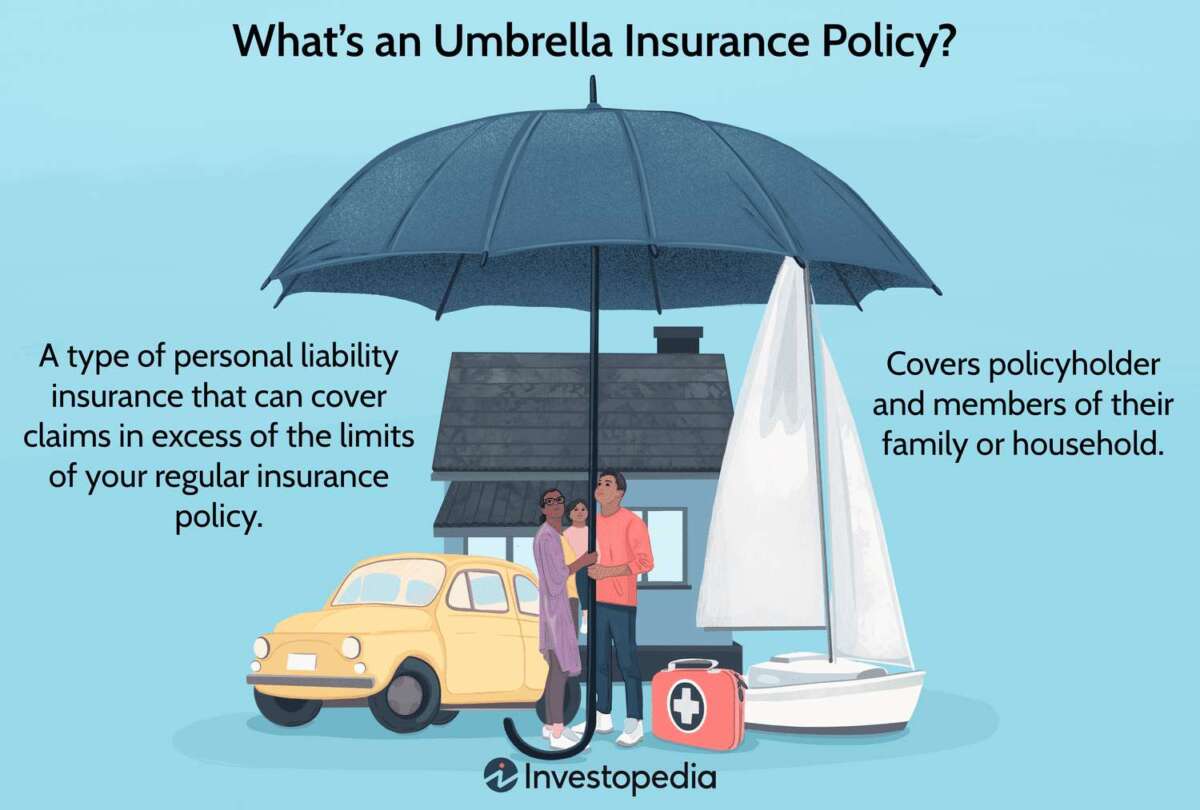
Umbrella insurance is often worth it when your assets, income, or risk of liability exceed your current policy limits.
The answer depends on your net worth, lifestyle, location, and exposure to lawsuits. This guide explains when umbrella insurance makes sense, what it covers, what it costs, and how to decide with confidence.
What Is Umbrella Insurance?
Umbrella insurance is extra liability coverage that sits above your existing auto, homeowners, renters, or boat insurance. It helps pay for covered claims after the liability limits on those policies have been used.
For example, imagine you cause a serious car accident. The injured person needs long-term care, loses income, and files a $900,000 lawsuit. If your auto policy covers only $250,000, you could face a $650,000 gap, plus legal costs. An umbrella policy may cover that gap, subject to its terms and limits.
Umbrella insurance usually covers:
• Bodily injury claims involving other people
• Damage to someone else’s property
• Personal liability lawsuits
• Certain claims involving libel, slander, or defamation
• Legal defense costs for covered claims
• Accidents connected to your home, car, rental property, boat, or other covered risks
A personal umbrella policy is not the same as commercial liability insurance. It is designed mainly for personal risks, not for running a company or protecting business assets.
Is Umbrella Insurance Worth It for Most People?
Umbrella insurance can be worth it because a single serious accident can cost far more than the average person expects. Medical care, lost wages, legal fees, and court awards can quickly reach hundreds of thousands or even millions of dollars.
That does not mean everyone needs a large policy. Someone with few assets, modest income, no teenage drivers, and limited exposure may receive less value from umbrella coverage than a high-net-worth homeowner with several vehicles and rental properties.
A useful way to think about umbrella insurance is as a financial safety net. Your auto and homeowners policies are the first layer. Umbrella coverage is the second layer that protects what sits above those limits.
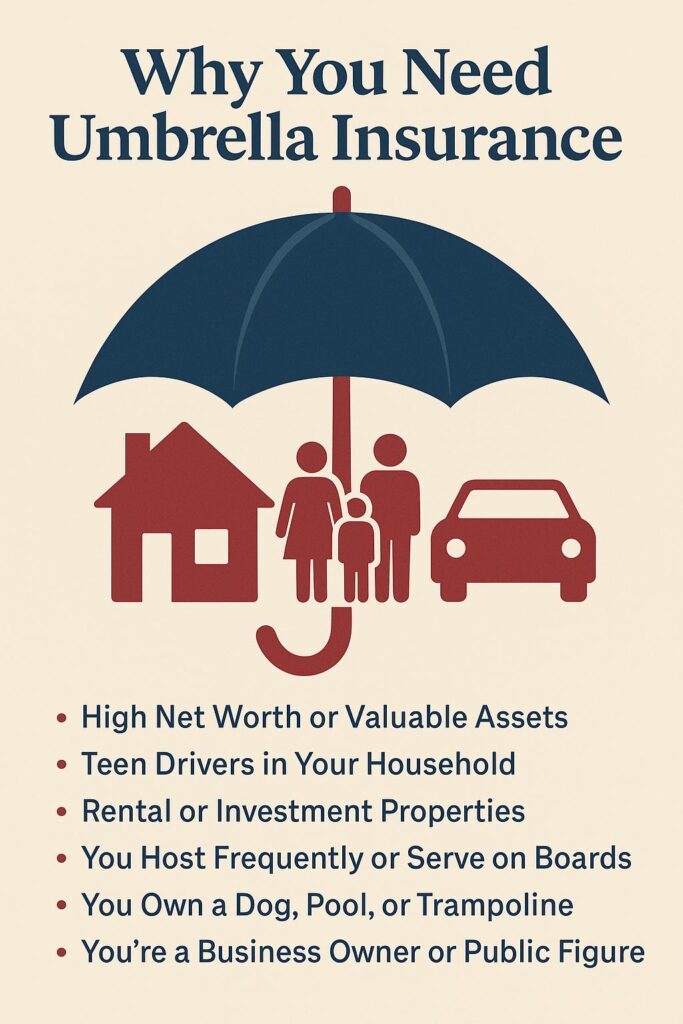
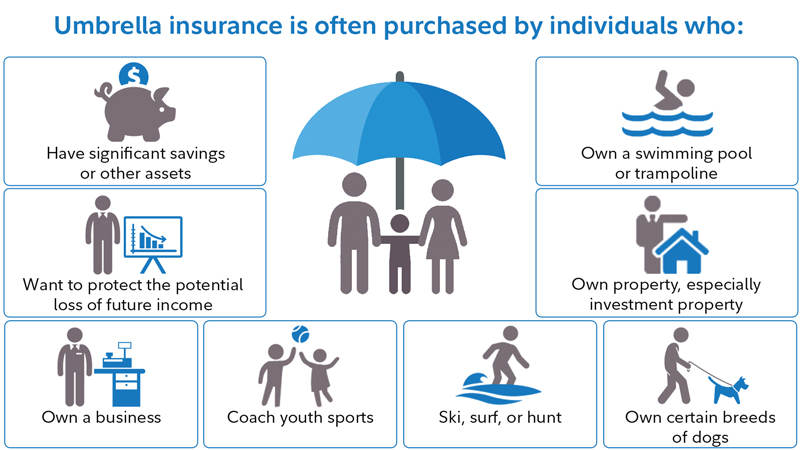
Umbrella insurance may be worth considering if you have:
• Home equity or investment accounts
• Retirement savings that may be exposed under state law
• A high household income
• Teen drivers or inexperienced drivers
• A swimming pool, trampoline, hot tub, or large dog
• Rental homes or other investment property
• A boat, ATV, snowmobile, or recreational vehicle
• Frequent guests at your home
• Public visibility or an online presence
• Savings that would be difficult to replace
• A desire to protect future wages
The key question is not simply, “How much do I own?” It is also, “How much could someone reasonably claim from me after a serious accident?”

How Umbrella Insurance Works
Umbrella insurance usually applies after your underlying insurance has paid up to its policy limit. These underlying policies are often called primary policies.
Suppose your auto insurance has a $250,000 liability limit and your umbrella policy requires $250,000 in underlying coverage. You cause an accident that results in a $700,000 covered judgment.
The process may look like this:
-
Your auto insurer pays the first $250,000.
-
Your umbrella insurer considers the remaining $450,000.
-
The umbrella policy pays the covered amount up to its limit.
-
You may be responsible for anything above the umbrella limit or outside the policy terms.
Umbrella insurance does not replace your home or auto insurance. Most insurers require you to carry certain minimum liability limits before they will issue an umbrella policy.
This is important because lowering your auto liability limits to save money could make your umbrella policy unusable or create a coverage problem. Always ask the insurer to confirm the required underlying limits in writing.
What Does Umbrella Insurance Cover?
Coverage varies by insurer and state, but a personal umbrella policy often provides broader liability protection than standard home or auto insurance.
Bodily Injury Liability
If a guest slips on your property or you cause a serious car crash, you could be responsible for medical bills, rehabilitation, lost income, pain and suffering, and other damages.
Umbrella insurance may help cover these costs after the underlying policy limit is reached. It may also provide legal defense, which can be valuable even when a court ultimately rejects the claim.
Property Damage Liability
Property damage can become expensive when it involves a luxury vehicle, a commercial building, a boat, or several homes. Umbrella coverage may respond when the damage exceeds your auto or homeowners liability limit.
Personal Injury Claims
Some umbrella policies cover personal injury claims such as:
• Libel
• Slander
• Defamation
• False arrest
• Wrongful eviction
• Invasion of privacy
These protections are not identical in every policy. Review the definitions and exclusions before relying on them.
Rental Property Liability
Landlords face risks that ordinary homeowners may not. A tenant or guest could suffer an injury and claim that unsafe conditions caused it.
Umbrella insurance may provide extra liability protection for rental properties, but the property must be listed or accepted under the policy. A personal umbrella may not cover every rental activity, especially if the operation is large or business-like.
Legal Defense
Legal defense can be one of the most useful parts of umbrella insurance. Even an unfounded lawsuit may require attorney fees, court costs, expert witnesses, and time.
Some policies count defense costs outside the liability limit. Others may reduce the available limit as defense costs are paid. Check the policy wording so you know which structure applies.
What Does Umbrella Insurance Not Cover?
Umbrella insurance is not an all-purpose financial shield. It mainly covers liability claims, not every type of loss.
Common exclusions may include:
• Damage to your own home or vehicle
• Your own medical bills
• Intentional injury or intentional property damage
• Criminal acts
• Business activities without proper coverage
• Professional errors or malpractice
• Certain rental or commercial activities
• Pollution-related claims
• War and nuclear events
• Contract disputes
• Sexual abuse claims, depending on the policy
• Certain dog breeds or animal-related risks
• Injuries to employees or household workers
A personal umbrella policy also does not automatically protect your business. If you operate a company, you may need general liability insurance, professional liability insurance, workers’ compensation, or commercial umbrella coverage.
Read the exclusions section carefully. Ask direct questions about risks that apply to your life, such as a rental property, teenage driver, home-based business, or large dog.

How Much Does Umbrella Insurance Cost?
Umbrella insurance is often less expensive than people expect, but the price depends on your risk profile. Many personal umbrella policies start around $150 to $300 per year for $1 million in coverage, though rates can be much higher.
The actual cost may depend on:
• Your location
• Number of drivers in your household
• Driving history
• Number and type of vehicles
• Home value and property features
• Swimming pools, trampolines, or other hazards
• Boats and recreational vehicles
• Rental properties
• Dog ownership
• Coverage limits on underlying policies
• Prior claims
• The amount of umbrella insurance you choose
A $1 million policy may cost less than a few hundred dollars per year, but you should not assume every household will receive that rate. Insurers may charge more for multiple homes, young drivers, watercraft, or frequent claims.
Compare the cost with the amount at risk. If a policy costs $250 per year and protects several hundred thousand dollars of assets and future income, the value may be strong. If you have very few assets and limited exposure, the cost-benefit calculation may be different.
How Much Umbrella Insurance Do You Need?
Many people begin with $1 million of umbrella coverage. Higher limits, such as $2 million, $5 million, or more, may be appropriate for households with greater wealth or risk.
There is no universal formula, but these factors can help:
-
Add your liquid assets, home equity, investments, and other valuable property.
-
Consider your annual income and future earning potential.
-
Review the risks connected to your home, vehicles, rental property, and recreational activities.
-
Check whether state law protects some assets from creditors or lawsuit judgments.
-
Discuss your exposure with an independent insurance professional.
-
Choose a limit that matches your comfort level and budget.
Do not assume that your current net worth is the only amount that matters. A lawsuit may target current assets and future income, depending on the judgment and applicable state law.
A high-income professional with modest savings may still benefit from umbrella insurance. The policy may help protect the income that makes future savings possible.

Who Benefits Most From Umbrella Insurance?
Umbrella insurance tends to provide the greatest value for people with several sources of liability risk.
Homeowners With Significant Equity
Your home may be one of your largest assets. If someone suffers a serious injury on your property, your homeowners liability limit may not be enough.
Home equity protections vary by state. Do not assume your home is fully protected simply because you have a homestead exemption.
Families With Teen Drivers
Teen drivers have less experience and may face a higher risk of accidents. Adding a young driver can increase both auto insurance premiums and the value of extra liability protection.
Set clear driving rules, maintain appropriate auto limits, and ask whether the umbrella insurer has special requirements for teen drivers.
Landlords
Rental property creates ongoing contact with tenants, guests, contractors, and delivery workers. A landlord may face claims involving stairs, walkways, locks, pools, or unsafe conditions.
Umbrella insurance may help, but proper property maintenance and landlord insurance remain essential.
Boat and Recreational Vehicle Owners
Boats, ATVs, motorcycles, and snowmobiles can create serious injury risks. Some umbrella policies cover these assets only if they meet certain size, speed, or usage requirements.
Give your insurer accurate details. Failing to disclose a boat or recreational vehicle may create a coverage dispute.
High-Income Households
A lawsuit may target future wages, not just current savings. A high-income household can face a larger financial impact from a judgment, even when its current net worth seems moderate.
Umbrella insurance may help protect the financial progress you have not yet made.

Who May Not Need Umbrella Insurance?
Umbrella insurance may be less valuable for someone with very few assets, low liability exposure, and limited ability to afford the premium. However, “not needed today” does not always mean “not needed later.”
You may have less need if you:
• Rent a modest home
• Have no vehicle or own only one low-risk vehicle
• Have no valuable assets
• Have no rental property
• Do not own a pool, boat, or recreational vehicle
• Have no high-risk activities
• Have limited income and savings
Even then, basic liability insurance is still important. A lack of assets does not prevent someone from filing a lawsuit.
Your situation can also change quickly. Buying a home, receiving an inheritance, starting a family, or adding a teenage driver may justify a new umbrella insurance review.
Umbrella Insurance vs. Increasing Home and Auto Limits
You may wonder whether to buy umbrella insurance or simply increase your home and auto liability limits. In many cases, the strongest approach is to do both.
Higher underlying limits protect you from more claims before umbrella coverage begins. Umbrella insurance then provides an additional layer for severe losses.
For example, increasing auto liability limits from $100,000 to $250,000 may offer better first-layer protection. Adding a $1 million umbrella policy can then protect against a much larger claim.
Umbrella coverage may also include protections that are not available through higher home or auto limits, such as certain personal injury claims. The exact benefits depend on the contract.
Ask for quotes in both ways:
• Higher home and auto liability limits only
• Higher underlying limits plus umbrella insurance
Compare the total premium, exclusions, required limits, and coverage scope. The lowest price is not always the best value.
Common Mistakes to Avoid
Small policy mistakes can weaken the protection you expect.
Buying an Umbrella Policy With Low Underlying Limits
Many umbrella policies require specific limits on auto and homeowners insurance. If those limits are too low, you may have to pay part of a claim yourself before the umbrella responds.
Forgetting to List Every Vehicle or Property
Tell the insurer about rental homes, boats, motorcycles, ATVs, and other vehicles. Unlisted risks may be excluded or may create underwriting problems.
Assuming Umbrella Insurance Covers Your Business
A personal umbrella policy usually does not replace business liability insurance. Separate coverage may be necessary for consulting, contracting, online sales, or other commercial work.
Choosing a Limit Without Reviewing Net Worth
A $1 million policy may sound large, but it may not be enough for a household with several million dollars in assets or substantial future income.
Ignoring Exclusions
Do not focus only on the coverage limit. A large limit does not help if the claim falls under an exclusion.
Failing to Update the Policy
Review umbrella insurance after major changes, such as:
• Buying property
• Adding a driver
• Purchasing a boat
• Starting a business
• Adopting a dog
• Receiving a large inheritance
• Retiring or changing jobs
A Practical Way to Decide if Umbrella Insurance Is Worth It
Use this simple review before speaking with an insurance agent.
-
List your assets. Include home equity, bank accounts, investments, vehicles, and valuable property.
-
Estimate your liability exposure. Consider driving, property ownership, pets, guests, rentals, and recreation.
-
Review your current liability limits. Check your auto, homeowners, renters, and landlord policies.
-
Identify gaps. Look for risks that are not listed, excluded, or covered at low limits.
-
Request at least two quotes. Compare the policy language, not just the price.
-
Ask about defense costs. Confirm whether legal defense reduces the policy limit.
-
Check required underlying coverage. Make sure your home and auto policies meet the umbrella requirements.
-
Review state-specific asset protections. Laws differ, so consider advice from a qualified attorney for complex situations.
-
Reassess every year. Your risks and assets can change faster than you expect.
One lesson I often share in insurance reviews is that people tend to insure their property more carefully than their liability. They may protect a new car with comprehensive coverage but overlook the financial damage a serious accident could cause. Umbrella insurance addresses that less visible risk.
Real-Life Examples of When Umbrella Insurance Helps
A Serious Auto Accident
A driver causes a crash that injures two people. The total claim reaches $1.1 million, while the auto policy limit is $250,000.
A $1 million umbrella policy could potentially cover the remaining covered amount, subject to its terms and limits.
A Guest Falls at Your Home
A guest falls on an icy walkway and suffers a spinal injury. Medical care and lost income exceed the homeowners liability limit.
Umbrella insurance may provide additional protection after the homeowners policy pays its limit.
A Tenant Claims Negligence
A tenant is injured because of a neglected property condition. The landlord policy pays its limit, but the claim continues.
If the rental property is properly covered under the umbrella policy, the umbrella may respond to the remaining covered liability.
A Defamation Claim
A public social media post leads to a defamation lawsuit. Some personal umbrella policies may cover personal injury claims such as libel or slander.
Coverage depends on the policy language, the facts, and applicable exclusions. Never assume online activity is covered without checking first.
How to Buy Umbrella Insurance
You can often buy umbrella insurance through the company that provides your home or auto coverage. Bundling may make the process easier, but it is still wise to compare coverage and price.
Before buying, prepare:
• Current declarations pages for home, auto, renters, and landlord policies
• A list of vehicles and properties
• Details about boats, ATVs, and other recreational equipment
• Driver information for everyone in your household
• Information about dogs and other animals
• Details about rental or business activities
Ask these questions:
• What underlying limits are required?
• Are defense costs inside or outside the policy limit?
• Are rental properties covered?
• Are boats and recreational vehicles covered?
• Does the policy cover libel and slander?
• Are household employees covered?
• Are incidents outside the United States covered?
• What exclusions apply to my lifestyle?
• Can I increase the limit later?
An independent agent can compare multiple insurers. A captive agent may provide useful service but generally represents one insurance company. Either option can work if you receive clear answers and review the policy carefully.
Tax and Legal Considerations
Umbrella insurance is generally a personal risk management product, not a tax deduction for most households. Premiums for personal coverage usually should not be treated as a business expense unless a qualified tax professional confirms that a specific business arrangement allows it.
Asset protection laws also vary by state. Some retirement accounts, home equity, wages, or other assets may receive partial protection from creditors or judgments. Those protections have limits and may not apply to every type of claim.
Insurance cannot replace sound legal planning. Business owners, landlords, physicians, attorneys, and high-net-worth families may need advice from both an insurance professional and an attorney.
The policy contract controls coverage. Marketing summaries are helpful, but definitions, exclusions, conditions, endorsements, and state-specific forms determine what the insurer must pay.
Frequently Asked Questions About Is Umbrella Insurance Worth It
Is umbrella insurance worth it for a middle-class family?
It can be, especially if the family owns a home, has multiple cars, employs teen drivers, or has meaningful savings. The value comes from protecting against a severe liability claim, not from owning a large fortune.
How much does a $1 million umbrella policy cost?
Many policies begin around $150 to $300 per year, but prices vary by location, drivers, vehicles, properties, claims, and lifestyle risks. Request a personal quote because national averages may not reflect your situation.
Does umbrella insurance cover car accidents?
It may cover the liability portion of a covered car accident after your auto policy reaches its limit. It does not usually pay for damage to your own vehicle or injuries you suffer yourself.
Does umbrella insurance cover my house?
Umbrella insurance may cover liability claims connected to your house, such as a guest injury. It generally does not pay to repair your home after fire, theft, wind, or other property damage.
Can umbrella insurance protect future income?
It may help protect future income from a covered liability judgment, depending on state law and the legal process. It cannot guarantee that all wages or assets will be protected.
Do I need umbrella insurance if I have homeowners insurance?
Homeowners insurance includes liability coverage, but its limit may not be enough for a severe injury claim. Umbrella insurance adds another layer after the homeowners limit is exhausted.
Is umbrella insurance required by law?
No, most people are not legally required to carry a personal umbrella policy. An insurer, lender, marina, or contract may create practical requirements for certain underlying coverage.
Does umbrella insurance cover a rental property?
It may cover a rental property if the insurer accepts and lists it under the policy. Ask about landlord liability, occupancy, property limits, and exclusions before purchasing.
Is umbrella insurance worth it for someone with few assets?
The value may be lower, but a lawsuit can still create financial pressure and legal costs. Review your income, risks, and budget rather than using assets alone to make the decision.
Conclusion
Umbrella insurance is often worth it when a serious liability claim could threaten your savings, home equity, investments, or future income. It offers an extra layer above auto, homeowners, renters, and landlord insurance, often at a modest annual cost.
The best decision depends on your actual risks. Review your assets, drivers, properties, hobbies, pets, and current liability limits. Then compare quotes and read the exclusions before you buy.
Take a fresh look at your insurance protection this year, ask a qualified professional about coverage gaps, and choose limits that fit your financial life.

Zayden Halbrook is a travel enthusiast and gear researcher passionate about making every journey smoother and more enjoyable. With a keen eye for practical travel essentials and real-world tips, he helps readers choose the right gear and travel smarter. When he’s not testing travel kits or exploring new destinations, Zayden shares simple, reliable advice to make every trip stress-free.