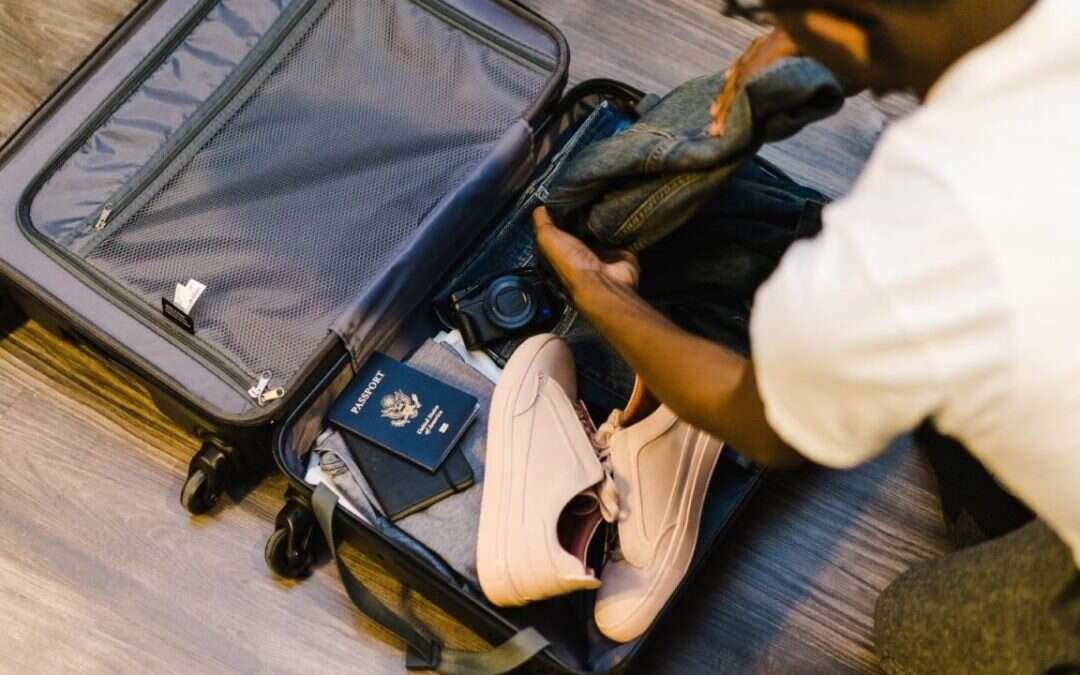
Packing a suitcase for a flight is easier when you start with the rules that apply in the United States. Check your airline’s baggage limits, separate items for TSA screening, and pack heavy items low and near the wheels. Keep valuables, medication, travel documents, and essential electronics in your personal item or carry-on bag.
This guide explains how to pack a suitcase for flying within the U.S. or from a U.S. airport. Airline fees, size limits, and international customs rules can vary, so confirm the details with your airline before you leave home.

Quick answer: How should you pack a suitcase for a flight?
Use this basic order:
- Check your airline’s carry-on and checked-bag rules.
- Make a short packing list based on the trip length and weather.
- Put heavy items at the bottom of a rolling suitcase, near the wheels.
- Roll or fold clothing to reduce wasted space.
- Place shoes in bags along the suitcase edges.
- Keep liquids in a clear, easy-to-reach bag.
- Pack medication, identification, valuables, and essential electronics in your carry-on.
- Leave room for souvenirs and avoid packing to the weight limit.
- Add a name tag and take a photo of your packed bag.
- Weigh and measure the suitcase before going to the airport.
The best packing method is not the one that fits the most items. It is the one that keeps your bag within the airline’s limits and gives you access to what you need during the trip.
Key takeaways
- Pack for the number of days, not every possible event.
- Put items you may need at security or during the flight near the top.
- Keep power banks and spare lithium batteries in your carry-on.
- Do not place valuable or necessary items in checked luggage.
- Use your airline’s current rules as the final authority.
Before you pack: Check the rules and gather what you need
Start with your airline’s baggage policy. Airlines set their own rules for carry-on size, checked-bag weight, personal items, fees, and the number of bags allowed. These rules may also change by ticket type, route, frequent-flyer status, or aircraft.
Check these details on the airline’s website or app:
- Maximum carry-on dimensions
- Personal-item dimensions
- Checked-bag size and weight limits
- Baggage fees
- Rules for sports gear and other large items
- Restrictions for batteries, medical devices, and special equipment
Do not assume that a suitcase accepted by one airline will fit on another. A bag that is slightly too large may need to be checked at the gate.
What you need
Gather these items before you begin:
- Suitcase or travel bag
- Personal item or carry-on bag
- Packing list
- Small bags for shoes and dirty clothes
- Clear toiletry bag
- Luggage scale
- Tape measure
- Identification and travel documents
- Prescription medication and medical supplies
A luggage scale helps prevent a surprise fee at the airport. A tape measure is useful because airlines usually measure the outside of the bag, including wheels and handles.
The Transportation Security Administration, or TSA, controls security screening at U.S. airports. TSA rules apply to what you bring through the checkpoint, while your airline controls baggage size, weight, and fees.
Decide what goes in your carry-on, personal item, and checked bag
Divide your belongings before putting anything in the suitcase. This prevents a common mistake: placing all important items in checked luggage.
Pack these items in your personal item or carry-on
Keep the following with you whenever possible:
- Passport or government-issued identification
- Wallet and cash
- Prescription medication
- Glasses and contact lenses
- Phone, laptop, tablet, and chargers
- Keys
- Jewelry and other small valuables
- Travel documents
- One change of clothes
- Basic toiletries
- Items needed for a delay or missed connection
Your personal item is often a purse, backpack, briefcase, or small laptop bag. Its size limit is usually smaller than a carry-on suitcase, and each airline sets its own dimensions.
If you check your main suitcase, keep one day of essential items in your carry-on. This is especially useful for international flights, long connections, and trips involving small regional aircraft.
Put these items in checked luggage when allowed
Checked luggage may hold:
- Larger containers of shampoo or lotion
- Extra clothing
- Shoes
- Nonessential books
- Bulky personal items
- Sports equipment that cannot fit in your carry-on
Do not pack irreplaceable items in checked baggage. Bags can be delayed, opened for inspection, or damaged.
Important battery rule
The Federal Aviation Administration, or FAA, generally requires spare lithium batteries and power banks to remain in carry-on baggage. Do not place loose spare batteries or a power bank in a checked suitcase.
Devices with installed batteries may have different rules. Turn off devices and protect them from damage. Check the FAA’s current passenger guidance if you are traveling with camera batteries, electric tools, mobility devices, or other battery-powered equipment.

Make a packing list that matches the trip
Pack by activity and weather, not by habit. A short trip does not always need fewer items if it includes formal events, outdoor activities, or changing weather.
Use this simple planning method:
- Write down each day of the trip.
- Add the main activity for each day.
- Check the forecast for the destination.
- Choose clothing that works in more than one outfit.
- Remove items that serve the same purpose.
- Add one backup layer or outfit if the trip allows it.
For many trips, a basic clothing plan may include:
- One top for each day, with a few pieces that can be worn twice
- Two or three bottoms
- Underwear and socks for each day, plus a spare pair
- One sleep outfit
- One warm layer
- One comfortable pair of walking shoes
- One second pair only if the trip requires it
- Weather gear suited to the destination
Choose a simple color plan. Tops and bottoms that work together create more outfits with fewer pieces.
Avoid packing “just in case” items that you can buy easily at your destination. This does not apply to medication, medical supplies, specialty equipment, or items that may be hard to replace.
A simple clothing calculation
For a five-day trip, you might pack:
- Five pairs of underwear
- Five pairs of socks
- Three shirts
- Two bottoms
- One sleep outfit
- One sweater or jacket
- One pair of travel shoes
- One second pair only if needed
This is an example, not a rule. Climate, laundry access, dress codes, and personal needs should change the list.

Pack a suitcase step by step
The order of your items affects weight, space, wrinkles, and access. Use the following method for a rolling suitcase.
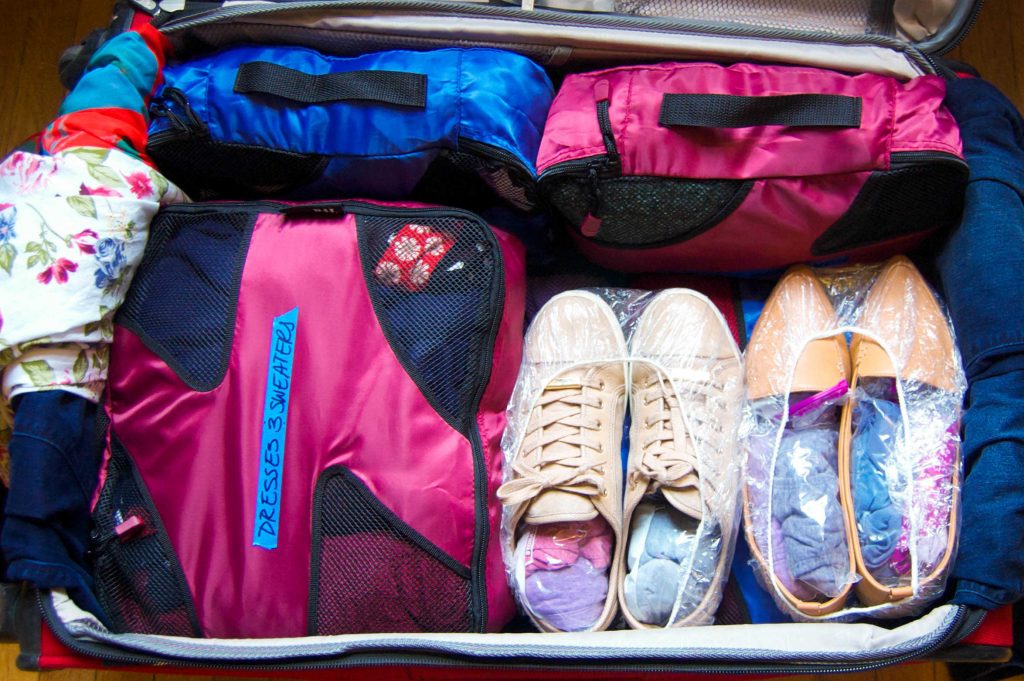
1. Place shoes around the edges
Put shoes in lightweight bags. Place them along the suitcase sides or near the wheels.
Fill the inside of shoes with small items such as socks, belts, or chargers. Do not use shoes to store anything that could be damaged by pressure.
Keep dirty shoe soles away from clean clothing. A shower cap or reusable shoe bag can work as a simple barrier.
2. Pack heavy items near the wheels
Place shoes, toiletry bottles, books, and other heavy items at the wheel end of the suitcase. When the suitcase stands upright, this arrangement helps keep the contents from shifting toward the handle.
Spread weight across the case rather than putting one dense object in the center. Check that the suitcase still closes without force.
3. Roll soft clothing and fold structured pieces
Rolling works well for soft items such as T-shirts, leggings, sleepwear, and casual shorts. Fold structured clothing, such as blazers or dress shirts, to help protect its shape.
A useful approach is:
- Roll small, soft items.
- Fold bulky items flat.
- Place delicate garments near the top.
- Use packing cubes only if they help you organize or compress items.
Packing cubes can make it easier to find clothing, but they do not remove the weight of the clothing. Compression can also make it easy to overpack.
4. Use the gaps
Fill spaces between shoes, along the case edges, and inside corners. Good gap-fillers include:
- Socks
- Belts
- Swimwear
- Small accessories
- Folded undergarments
Avoid filling every gap if you expect to bring items home. Empty space can be more useful than a tightly packed bag.
5. Protect fragile items
Do not place fragile objects directly against the suitcase shell. Wrap them in clothing and put them in the center of the bag, away from corners and edges.
Even with careful packing, checked luggage may receive rough handling. Carry fragile, valuable, or irreplaceable items instead whenever the airline and security rules allow it.
6. Keep a top layer for access
Place items you may need first near the top:
- Light jacket
- Toiletry bag
- Change of clothes
- Book or headphones
- Laundry bag
- Travel documents, if they are not already in your personal item
This keeps you from unpacking the whole suitcase at a hotel or during a delay.
7. Close, weigh, and inspect the bag
Close the suitcase without forcing the zipper. Weigh it while fully packed. Then measure the outside, including wheels and handles, if your airline lists total dimensions.
If the bag is near the maximum weight, remove a few items. A small margin protects you from differences between your home scale and the airport scale.

Pack liquids, medication, and electronics correctly
TSA screening is easier when restricted or commonly inspected items are easy to reach.
Follow the TSA liquids rule
For carry-on bags, TSA’s liquids rule generally limits each liquid, aerosol, gel, cream, or paste container to 3.4 ounces, or 100 milliliters. The containers should fit in one quart-size clear bag, commonly called the 3-1-1 rule.
Examples include:
- Shampoo
- Conditioner
- Toothpaste
- Sunscreen
- Lotion
- Liquid makeup
- Hair gel
- Contact lens solution
Larger containers should usually go in checked baggage. The container size matters, even if only a small amount remains inside.
TSA allows exceptions for some medically necessary liquids and items needed for infants and young children. Tell the TSA officer about these items before screening and check current TSA guidance before your trip.
Keep medication in your carry-on
Pack prescription and essential over-the-counter medication in your personal item or carry-on. Keep medication in its original labeled container when practical.
Bring enough for the trip, plus extra if a delay could cause a problem. Do not place necessary medication in checked baggage.
If you use syringes, refrigerated medication, liquid medication, or medical devices, check the TSA and airline rules before departure. A pharmacist or prescribing clinician can also help you plan for storage and travel needs.
Organize electronics
Keep laptops and larger electronics where you can remove them quickly if TSA asks. TSA screening procedures can vary by airport and checkpoint technology, so follow the officer’s instructions.
Protect screens with a sleeve or soft layer. Keep chargers together in a small pouch. Carry power banks and spare lithium batteries with you, not in checked luggage.

Protect your suitcase and make it easy to identify
A strong suitcase can still be delayed or mistaken for another bag. Simple identification steps reduce confusion.
Add a durable luggage tag with: