Yes, you can mail a suitcase without a box in the United States, but it is not always the safest or cheapest choice. USPS, UPS, and FedEx may accept a suitcase as a shipping container if it is strong, closed, clean, and properly labeled. Each carrier can set its own rules, and acceptance may vary by location.
For most travelers, the safer method is to place the suitcase inside a strong cardboard box. A box protects wheels, handles, zippers, and fabric from damage. It also makes the package easier to stack, measure, and handle.
If you ship the suitcase by itself, remove loose straps, lock or secure every opening, cover exposed parts, and confirm the carrier’s current rules before you pay for postage.
Can You Ship a Suitcase Without a Box?
You can ship a suitcase without a box when the suitcase can withstand normal parcel handling. The carrier must also accept the item in that form.
A hard-shell suitcase is usually a better candidate than a soft-sided bag. Its outer shell can resist rain, scraping, and light pressure. A soft suitcase may tear, stain, or lose its shape as it moves through sorting equipment.
A suitcase shipped without a box is often called an unboxed or 裸 shipment. In practical terms, the suitcase itself acts as the outer package. The shipping label must stay attached to that surface for the full trip.
The carrier may refuse the shipment if:
- The suitcase has a broken wheel, loose handle, or damaged shell.
- The zipper does not close well.
- The bag contains prohibited or restricted items.
- The surface cannot hold a label.
- The suitcase has long straps or parts that could catch on equipment.
- The package exceeds the carrier’s size or weight limits.
- The local shipping center has a stricter handling policy.
A carrier’s acceptance does not mean the suitcase will arrive without marks. Unboxed luggage can collect scratches, dirt, dents, and scuffs.
Should You Mail a Suitcase Without a Box?
Shipping without a box may save the cost and effort of buying packing materials. It can also reduce the parcel’s outside dimensions. However, the trade-off is less protection.
| Shipping method | Main benefit | Main risk | Best use |
|---|---|---|---|
| Suitcase by itself | Less packing work and less material | Scratches, tears, lost labels, broken parts | Strong hard-shell case with low-value contents |
| Suitcase in a box | Better protection and easier labeling | More size, weight, and packing cost | Valuable luggage or long-distance shipping |
| Suitcase in a protective bag | Covers dirt and light scuffs | Little protection from crushing | Short trips and sturdy luggage |
| Luggage shipping service | May offer travel-focused handling | Rules and prices vary | People sending bags ahead of a trip |
A box is usually worth using when the suitcase is new, expensive, fragile, or needed for a specific event. It is also the better choice when the suitcase has a fabric exterior.
Shipping without a box can make sense when the suitcase is already worn, durable, and filled with nonfragile clothing. Even then, protect the bag as if it may be dragged, stacked, or exposed to weather.
A simple decision rule
Use the suitcase alone only if all of these conditions are true:
- The suitcase is in good condition.
- The shell or fabric can handle rough handling.
- The contents are not fragile.
- The wheels and handles can be protected.
- The carrier confirms that unboxed luggage is acceptable.
- You can attach a backup label inside the suitcase.
If one of these conditions fails, use a box or a luggage shipping service.
How to Mail a Suitcase Without a Box
Follow these steps before taking the suitcase to a USPS, UPS, or FedEx location.
1. Check the carrier’s rules first
Ask the shipping counter whether the carrier will accept the suitcase without an outer box. Do this before packing it or buying postage.
Rules can vary by:
- Carrier
- Service type
- Destination
- Size and weight
- Local acceptance practices
- Whether the item enters an automated sorting system
USPS publishes packaging and mailing standards in its Domestic Mail Manual. UPS and FedEx also publish packaging guidance for parcels. Those rules can change, so check the official carrier website or ask the shipping location on the day you ship.
2. Empty the suitcase completely
Do not ship items that are illegal, hazardous, or restricted. Check every pocket, lining, and accessory compartment.
Common items that may cause problems include:
- Aerosol cans
- Fuels and lighter fluid
- Fireworks
- Ammunition and firearms
- Loose lithium batteries
- Chemical cleaners
- Perishable food
- Alcohol
- Certain medicines
- Valuable documents and cash
Rules for batteries, electronics, medicines, and other regulated goods can depend on the shipping service and destination. The safest approach is to check the carrier’s prohibited-items page before packing.
3. Protect the contents
Wrap fragile items in cushioning and place them in the center of the suitcase. Fill empty space so items do not shift during transit.
Use clothing as light padding, but do not rely on clothing alone for glass, electronics, or other breakable goods. A suitcase can be dropped or placed under heavy parcels.
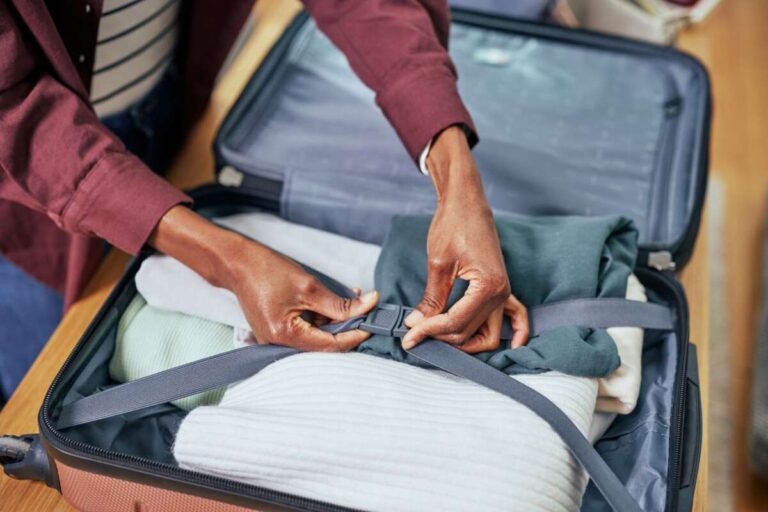
Do not overfill the suitcase. Pressure on the zipper can cause it to split. The case should close without force.
4. Secure the suitcase
Close all zippers and locks. If the suitcase has a built-in lock, secure it without making the key or combination unavailable to the carrier.
Use stretch wrap, packing film, or a luggage cover around the outside. This layer can help keep the case clean and hold the zippers in place. It will not prevent crushing or protect a weak shell.
Avoid tape over wheels or handles if the tape could come loose and create a snag. If you use tape, press it down firmly and trim loose ends.
5. Protect wheels and handles
Wheels and handles are common weak points. Retract telescoping handles. If possible, place cardboard, foam, or a firm protective sleeve over exposed wheels and handles.
Do not permanently block a carrier’s ability to inspect the suitcase. A carrier may need to open or examine the parcel under its security and acceptance rules.
6. Add labels in more than one place
Attach the shipping label to a flat, clean area. Do not place it over a zipper, wheel, handle, or curved corner.
Add a second address label inside the suitcase. Include:
- Sender’s name and address
- Recipient’s name and address
- Phone number
- Email address, if useful
- Tracking number
An outside label can be torn off. An inside label gives the carrier a better chance of identifying the suitcase if that happens.
Remove old barcodes and address labels. Old labels can send the parcel to the wrong location or confuse automated scanners.
7. Measure and weigh the packed suitcase
Measure the suitcase after all wrapping is complete. Use the carrier’s instructions for length, width, height, and weight.
For many parcel services, dimensional weight may affect the price. A common calculation is:
Dimensional weight = length × width × height ÷ carrier divisor
The divisor differs by carrier, service, and account terms. The carrier may charge based on the greater of actual weight or dimensional weight.
For example, a hypothetical suitcase measuring 30 × 20 × 12 inches has a volume of 7,200 cubic inches. The final dimensional weight depends on the carrier’s current divisor. Do not use an old divisor to estimate the price.
8. Take photos before handing it over
Photograph the suitcase, the label, and the contents before shipping. Keep the receipt and tracking number.
These photos can help document the suitcase’s condition if it arrives damaged. They can also help identify the parcel if the label is lost.
How USPS, UPS, and FedEx Treat Unboxed Suitcases
The major US carriers do not use one universal rule for every suitcase. The safest plan is to check the carrier’s packaging rules and confirm acceptance at the selected location.
USPS
USPS may accept durable luggage as a mailpiece when the item is properly prepared and meets size, weight, marking, and packaging standards. A post office can refuse a suitcase if it is unsafe, poorly secured, or likely to fail in transit.
USPS service prices and limits depend on the service selected. Priority Mail, Ground Advantage, and other services can have different requirements. USPS may also apply special handling rules to unusual shapes or oversized parcels.
Use the official USPS Domestic Mail Manual and USPS prohibited-items guidance as your starting points.
UPS
UPS generally expects packages to be prepared for normal parcel handling. A bare suitcase may be accepted, but the decision can depend on its condition, size, and the local shipping counter.
UPS packaging guidance emphasizes a strong outer container, secure closure, and protection for the contents. If you ship an unboxed suitcase, the suitcase must serve those functions as well as it can.
UPS may charge additional fees for large, heavy, or irregular packages. Confirm the complete price after the suitcase is measured.
FedEx
FedEx also evaluates packages based on size, weight, condition, and handling needs. A suitcase without a box may be accepted at one location and declined at another if the employee believes it could be damaged or cause a handling problem.
FedEx packaging guidance generally favors a sturdy outer package and internal cushioning. If the suitcase itself is the outer package, protect its weak points and make sure the label can be scanned.
FedEx may apply additional charges for oversized or unusually shaped shipments. Ask for the total rate before you ship.
What if the counter refuses it?
Do not argue with the employee or send the suitcase through a different location without checking the rules. Ask whether you can:
- Buy a suitable shipping box
- Use a protective luggage carton
- Wrap the suitcase in an approved outer covering
- Choose a different service
- Ship it through a luggage-focused provider
Acceptance decisions often protect both the parcel and the carrier’s equipment.
How Much Does It Cost to Mail a Suitcase?
The cost depends on the packed suitcase’s actual weight, dimensional weight, distance, service speed, insurance, and extra fees. There is no single nationwide price for mailing a suitcase.
The main price factors are:
- Origin ZIP Code
- Destination ZIP Code
- Packed weight
- Length, width, and height
- Delivery speed
- Fuel or residential surcharges
- Oversize or additional handling fees
- Declared value or insurance
- Pickup or drop-off method
A large but light suitcase can cost more than a small, heavy parcel because of dimensional weight. A box may increase both the size and weight, but it can reduce damage risk.
Get quotes using the suitcase’s final packed measurements. Do not estimate from the empty case’s label or manufacturer dimensions.
Shipping insurance and declared value
Carrier liability is not the same as full insurance. Some services limit reimbursement for loss or damage, while others exclude certain items or types of damage.