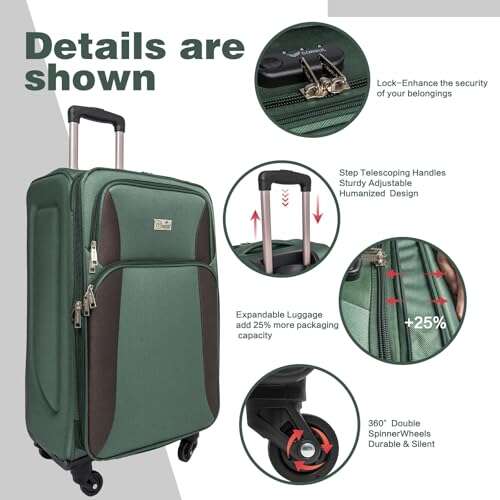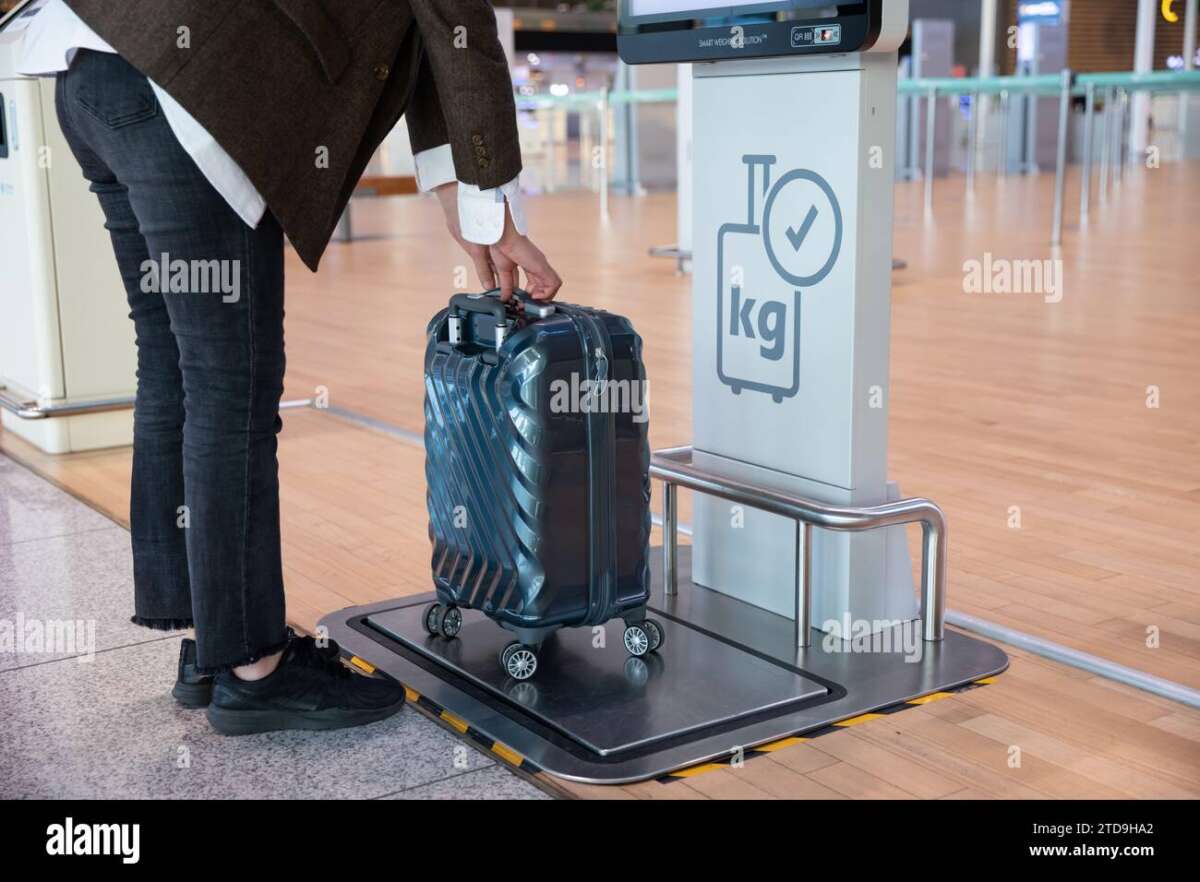
If you are flying from a U.S. airport, you can weigh your luggage at the airline check-in counter, a hotel front desk, a shipping store, or at home with a luggage scale. The most reliable choice is to weigh your bag at home before you leave, then check it again at the airport if needed.
Airlines set their own baggage limits. The Transportation Security Administration (TSA) does not set the weight limit for checked bags. Your airline, ticket type, route, and frequent-flyer status determine the rules.
Where can I weigh my luggage?
The best place depends on how much accuracy and convenience you need.
| Place | Best for | Cost | Main limit |
|---|---|---|---|
| Your home | Planning before travel | Free if you own a scale | A bathroom scale may be less precise |
| Airline check-in area | Final check before bag drop | Usually free | You may already be at the airport |
| Hotel or airport hotel | Travelers away from home | Often free or low cost | Not every property has a luggage scale |
| Shipping store | A precise public scale | May be free or low cost | Staff may not weigh personal luggage |
| Post office or pack-and-ship shop | Checking a heavy bag | Varies | A postal scale may have size limits |
| Travel goods store | Buying a scale or checking weight | Varies | Store policy differs |
| Friend, gym, or apartment office | A quick local check | Usually free | The scale may not be calibrated for luggage |
1. Weigh your bag at home
Home is usually the easiest place to weigh luggage. A small hanging luggage scale works well because you can lift the bag by its handle and read the weight.
You can also use a bathroom scale:
- Weigh yourself without the bag.
- Weigh yourself while holding the bag.
- Subtract your weight from the combined weight.
For example:
- Your weight: 170 pounds
- Your weight while holding the suitcase: 214 pounds
- Estimated suitcase weight: 44 pounds
This method works best when you can stand still and hold the bag safely. It may be less accurate for a very heavy suitcase or a scale with a small display.
2. Use the airline scale at the airport
Airlines normally weigh checked bags at the check-in counter or self-service bag-drop area. This is the final measurement that matters for your flight.
Ask an airline agent if you want to weigh your bag before checking it. Some airports have a public scale near the airline desks, but many do not. Do not assume that every airport has one.
The airport scale may show a different number from your home scale. A small difference can come from calibration, the way the bag sits on the platform, or the weight of a luggage tag. If your bag is close to the airline limit, leave a margin rather than packing to the exact maximum.
3. Ask your hotel front desk
Many hotels in the United States keep a luggage scale for guests. This is more likely at large hotels, airport hotels, and properties with frequent business travelers.
Call the front desk before bringing down your bags. Ask:
“Do you have a scale that guests can use to weigh checked luggage?”
A hotel bathroom scale may not be large enough for a suitcase. A hanging luggage scale or platform scale is more useful.
4. Visit a shipping or packing store
Pack-and-ship stores often have scales for boxes and freight. Examples include local shipping shops and national chains such as UPS Store or FedEx Office locations. Availability and policy vary by store, so call first.
A shipping scale may measure weight accurately, but it may not be designed for a large suitcase. Ask whether the store can weigh a personal bag and whether a fee applies.
Do not assume that a shipping quote equals an airline baggage weight. Shipping systems may use dimensional weight, which considers the size of a box as well as its actual weight. Airlines generally use the bag’s actual measured weight for checked baggage limits, although oversized baggage rules are separate.
5. Check at a nearby post office
Some U.S. post offices have scales, but public access differs by location. Postal scales may also be built for parcels rather than suitcases.
Call the location before you go. If you use a postal scale, place the bag fully on the platform and make sure no part of it touches the floor or counter.

What weight limit does my airline allow?
Your airline’s baggage policy determines whether your bag is within the limit. Many U.S. airlines use a 50-pound limit for standard checked bags on many routes, but that number is not universal.
The limit may change based on:
- Airline
- Domestic or international route
- Cabin class
- Fare type
- Frequent-flyer status
- Military baggage benefits
- Number of checked bags
- Partner-airline rules
- Aircraft or airport restrictions
A bag that weighs 51 pounds may trigger an overweight fee even if it looks only slightly heavier than the limit. Some airlines accept heavier bags for a higher fee. Others set a maximum weight above which they will not accept the bag as checked luggage.
Check the airline’s current baggage page
Look for the airline’s official baggage calculator or checked-bag policy. Use the airline that operates the flight, not only the company that sold the ticket.
This matters for codeshare flights. A ticket may show one airline’s flight number while another airline operates the aircraft. The baggage rules may depend on the itinerary and the operating carrier.
Useful official pages include:
- TSA: Traveling with luggage
- U.S. Department of Transportation: Airline customer service dashboard
- Your airline’s official “Baggage,” “Checked bags,” or “Bag calculator” page
The TSA page explains security screening rules. It does not replace your airline’s baggage policy.
Leave a safety margin
If your limit is 50 pounds, aim for about 47 to 49 pounds at home. This gives you room for:
- A different airport scale
- A heavy luggage tag
- Last-minute items
- Small scale differences
- Moisture or dirt on the bag
- Items moved from your carry-on
A 2- to 3-pound margin is not a formal airline rule. It is a practical buffer that can reduce stress at check-in.
What if your bag is overweight?
If the scale shows too much weight, you have several choices:
- Remove heavy items.
- Move permitted items to another bag.
- Put small items in your personal item, if they fit under the airline’s rules.
- Wear heavier clothing or shoes.
- Pay the airline’s overweight fee.
- Use a second checked bag if that costs less than an overweight charge.
Do not move liquids, sharp items, or restricted goods into a carry-on just to lower the checked-bag weight. Check TSA rules before rearranging your luggage.
How to weigh luggage accurately at home
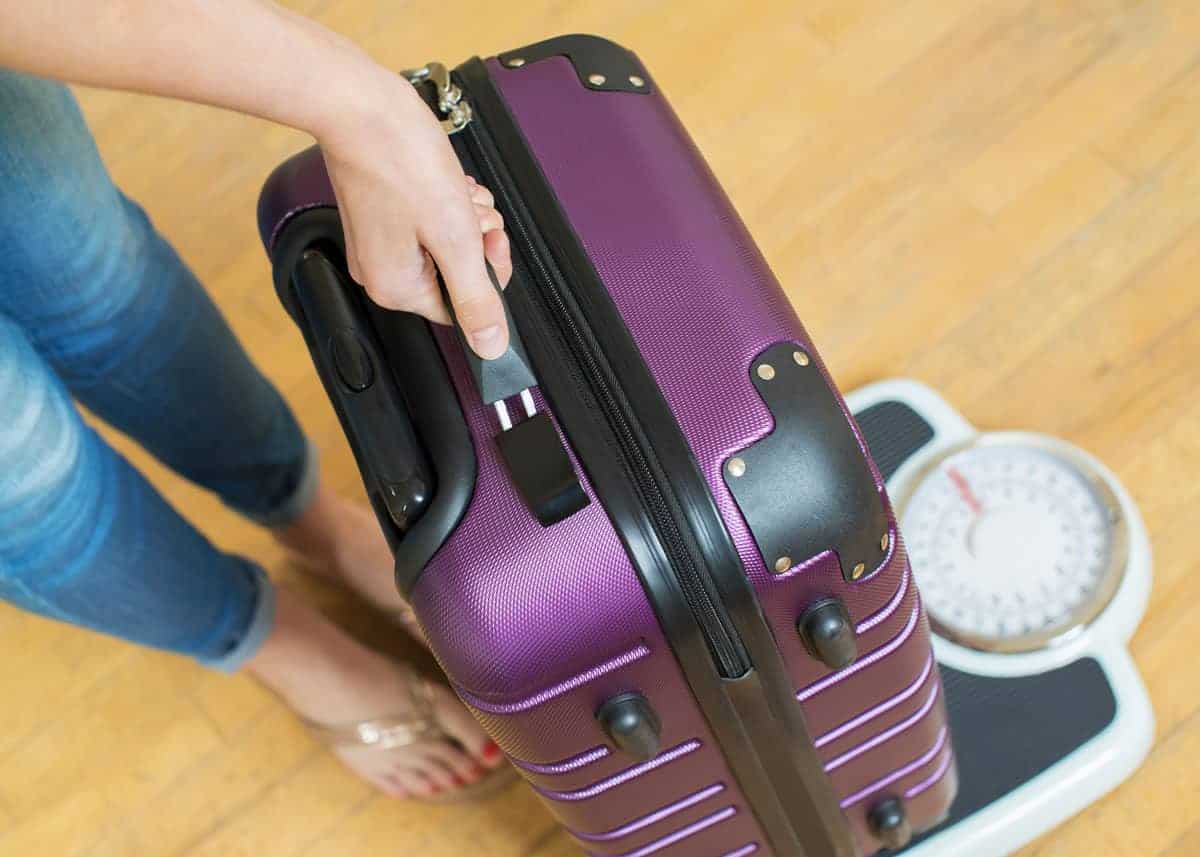
A luggage scale gives the clearest answer when used correctly. It measures the entire bag, including wheels, handles, straps, and anything attached to it.
Using a hanging luggage scale
Follow these steps:
- Turn on the scale and select pounds, if needed.
- Attach the strap to the suitcase handle.
- Lift the bag slowly until it hangs freely.
- Keep the bag still.
- Wait for the reading to settle.
- Record the weight.
- Repeat the measurement once.
The scale should support the full bag. Do not lift a heavy suitcase above shoulder height. If it is too heavy to lift safely, use a platform scale instead.
Using a bathroom scale
A bathroom scale can estimate luggage weight without lifting the suitcase high.
- Place the scale on a hard, level floor.
- Check your weight.
- Step off the scale.
- Hold the suitcase close to your body.
- Step back on the scale.
- Subtract your body weight from the combined weight.
Do not use a soft rug. Carpet can affect some scales. Keep both readings close in time, and stay still during each reading.
Using a platform or parcel scale
A platform scale is often the easiest choice for a very heavy suitcase. Place the entire bag on the platform. Make sure:
- No wheel hangs over the edge.
- The handle is not resting on a wall.
- The strap does not pull against another object.
- The display shows a stable reading.
If the bag is larger than the platform, ask the staff whether the scale can measure it safely. Do not balance a large suitcase in a way that could make it fall.
Pounds versus kilograms
U.S. airports usually display baggage weight in pounds, but some scales show kilograms.
Use these approximate conversions:
- 1 kilogram = 2.205 pounds
- 50 pounds = 22.7 kilograms
- 23 kilograms = 50.7 pounds
If your airline limit is 50 pounds, 23 kilograms may be slightly above that limit. Check which unit your airline uses and do not round down.

What should I do if no luggage scale is available?
You can still make a useful estimate with a household scale or by comparing the bag with known weights.
A large bag of pet food, a dumbbell, or a boxed item with a printed weight can help you judge whether the suitcase is far above the limit. This is only an estimate, not a substitute for a scale.
If you are already at the airport, go to the airline counter early. Extra time lets you repack, remove items, or pay a fee without rushing to security.
Repack near the airport
Many U.S. airports have seating, counters, or open areas near check-in where travelers can rearrange bags. Keep personal items together, and do not leave luggage unattended.
If you need to discard something, use a proper trash or recycling bin. Do not leave belongings beside a check-in counter or security line.
Weigh each checked bag separately
Airlines usually apply weight limits to each checked bag, not only to the combined weight of all bags. For example, two bags weighing 30 pounds and 70 pounds may not meet a 50-pound-per-bag rule, even though the total is 100 pounds.
Some airline programs allow a different distribution of weight. Check the exact policy instead of assuming that a light bag offsets a heavy one.
Weigh carry-ons too
A carry-on may have a weight limit, even when the airline does not always weigh it. Some airlines and routes enforce both size and weight rules.
Measure the carry-on as well as the checked bag. Include:
- Wheels
- Handles
- Outside pockets
- Laptop compartments
- Attached straps
A bag can meet the weight limit and still fail the airline’s size limit.

Common luggage-weighing mistakes
Small errors can lead to surprise charges or a rushed repack. Avoid these common problems.
Packing to exactly 50 pounds
Your home scale and the airport scale may not match perfectly. Pack below the limit when possible.
Weighing an empty suitcase
The airline weighs the suitcase with its contents. A light suitcase can still exceed the limit after shoes, books, and toiletries go in.
Forgetting the personal item
Moving items into a backpack may solve a checked-bag problem, but the backpack still has to meet the airline’s personal-item rules.
Using the wrong airline policy
The baggage policy for one airline may not apply to a partner flight. Check the itinerary and the operating carrier.
Confusing size and weight
Weight is only one part of baggage rules. Airlines may also limit linear dimensions. Linear dimensions mean length plus width plus height.