

Most people need $1 million to $5 million in umbrella insurance, based on assets, income, and personal risk.
Knowing how much umbrella insurance do I need is less about picking a random round number and more about protecting what you could lose in a serious liability claim. The right limit should reflect your assets, future income, home and auto risks, business exposure, and comfort with risk.
What is umbrella insurance?
Umbrella insurance is extra liability coverage that sits above your home, renters, condo, and auto insurance. It helps pay for covered claims after the liability limits on those policies are used up.
For example, suppose you cause a serious car accident. The injured person has $700,000 in medical bills and lost income, but your auto policy has only $300,000 of bodily injury liability coverage. Your umbrella policy may help cover the remaining $400,000, subject to its terms and limits.
Umbrella insurance may help with:
- Bodily injury claims
- Property damage claims
- Personal liability lawsuits
- Libel and slander claims
- False arrest or wrongful eviction claims
- Legal defense costs for covered claims
It does not replace your home or auto insurance. Instead, it acts like a second safety net. Your primary policy pays first, and the umbrella policy may respond after that coverage runs out.
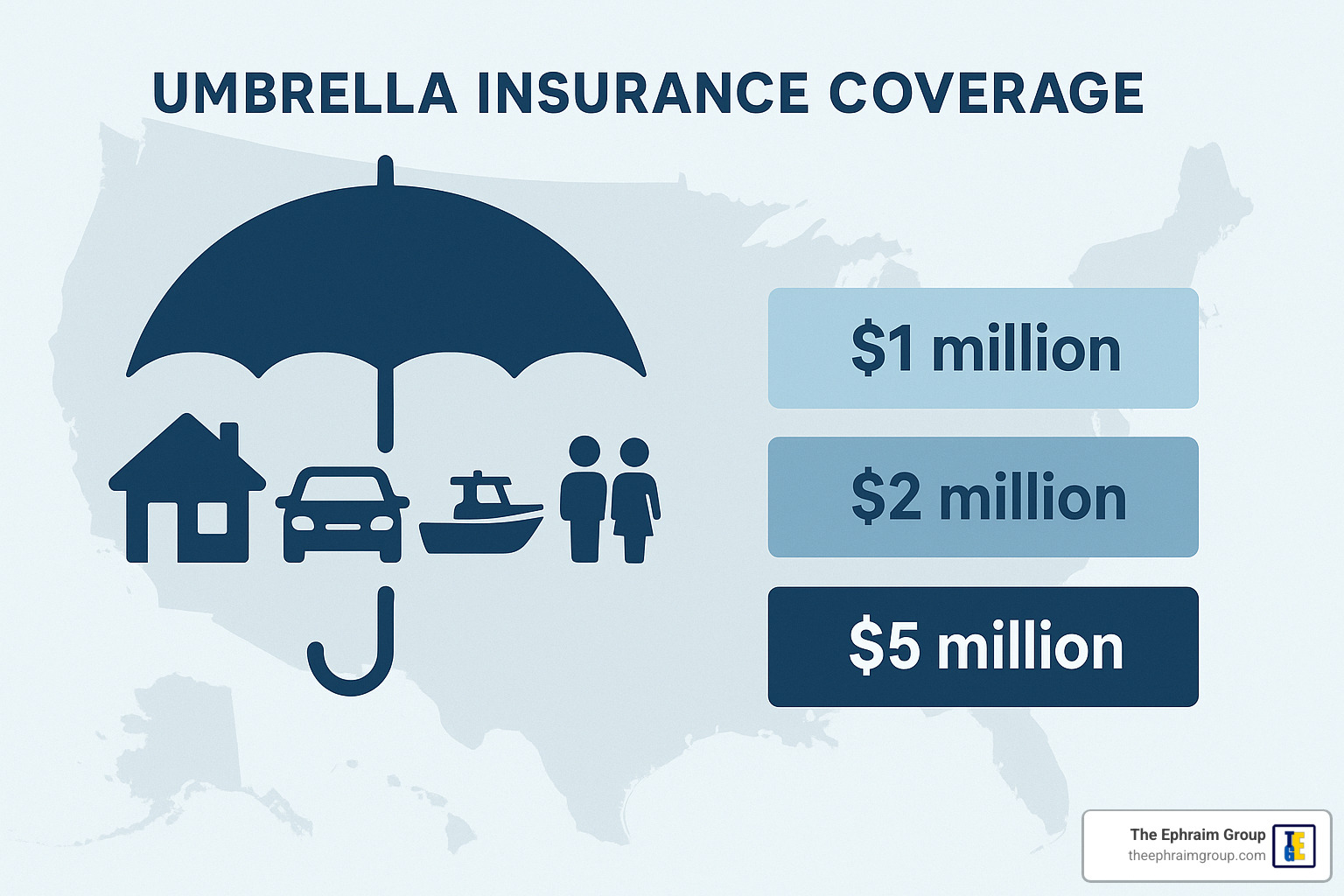
Most umbrella policies provide liability coverage from $1 million to $5 million. Some insurers offer higher limits for people with significant wealth, high incomes, or unusual risks.

How much umbrella insurance do I need?
For many households, $1 million is a reasonable starting point. However, how much umbrella insurance do I need depends on more than your bank balance.
A practical estimate should consider the following:
- The value of your assets
- Your annual income and future earning power
- Your home and other real estate
- Your auto, boat, and recreational vehicle risks
- Your number of drivers and vehicles
- Your rental properties
- Your business interests
- Your public profile
- Your risk of hosting guests or large events
A common rule is to buy enough umbrella insurance to cover your net worth plus the value of future income that could be exposed to a lawsuit. This is not a perfect formula, because state laws differ and some assets receive special protection.
Here is a simple example:
- Home equity: $250,000
- Savings and investments: $300,000
- Other property and assets: $100,000
- Estimated exposed future income: $350,000
- Total potential exposure: $1 million
In this example, a $1 million umbrella policy may be a sensible starting point. A $2 million limit could make more sense if the person owns a rental property, has teenage drivers, or regularly hosts large gatherings.
The goal is not to insure every dollar you own with exact precision. The goal is to create a strong financial buffer against a large, covered liability claim.

A simple formula for choosing your umbrella limit
You can use this basic process to estimate how much umbrella insurance do I need:
- Add your exposed assets.
- Estimate your future income at risk.
- Review your personal liability risks.
- Check your existing liability limits.
- Round up to the next available umbrella limit.
- Recheck the amount after major life changes.
Step 1: Add your exposed assets
List assets that a creditor or lawsuit might reach under your state’s laws. These may include:
- Home equity
- Bank accounts
- Brokerage accounts
- Investment property
- Vacation property
- Business interests
- Valuable collections
- Recreational vehicles
- Cash value in some life insurance policies
Do not assume every asset is equally exposed. Retirement accounts, certain trusts, and other property may have legal protection. The rules vary by state, so ask a qualified attorney for advice about asset protection.
Step 2: Consider future income
A lawsuit may affect more than what you own today. In some situations, a judgment can reach future wages or income.
Future income matters more when you:
- Have a high salary
- Work in a visible profession
- Expect many years of employment
- Own a profitable business
- Receive bonuses or commissions
- Have a professional reputation to protect
You do not need to insure your full lifetime income in every case. Still, ignoring future earnings can leave a major gap in your liability plan.
Step 3: Review your personal risk
Two people with the same net worth may need different umbrella limits. A homeowner with no car and few visitors has a different risk profile from a person with three cars, a pool, a boat, and a rental home.
Think about the activities that could increase the chance or size of a claim. Risk often grows when more people, vehicles, properties, or animals are involved.
Step 4: Round up
Umbrella policies commonly come in $1 million increments. If your estimated exposure is about $1.2 million, a $2 million umbrella policy may be more suitable than a $1 million policy.
Extra limits are often less expensive than people expect, but pricing depends on your location, driving record, property, claims history, and insurer.

How much umbrella insurance do I need based on my net worth?
A person with a net worth below $500,000 may still consider a $1 million umbrella policy. A person with $1 million to $3 million in assets may need $2 million or more.
These ranges are only starting points:
| Approximate financial position | Possible starting limit |
|---|---|
| Limited assets and low-risk lifestyle | $1 million |
| $500,000 to $1 million in exposed assets | $1 million to $2 million |
| $1 million to $3 million in exposed assets | $2 million to $5 million |
| More than $3 million in exposed assets | $5 million or more |
| High-profile or high-risk household | Custom review |
Net worth alone does not determine how much umbrella insurance do I need. A family with modest savings but several young drivers may face more auto risk than a retired couple with substantial assets and no drivers under age 25.
Also, do not count every asset without checking its legal status. A home may have homestead protection. Retirement accounts may have federal or state safeguards. These protections can be complex and may not apply in every situation.
A financial planner can help estimate your balance sheet. An insurance professional can explain coverage limits. An attorney can discuss creditor protection. Each professional answers a different part of the question.

How underlying insurance limits affect umbrella coverage
Umbrella insurers usually require minimum liability limits on your underlying policies. These are sometimes called required underlying insurance limits.
For example, an insurer may require:
- Auto liability limits of $250,000 per person and $500,000 per accident
- Property damage liability of $100,000
- Homeowners liability of $300,000
- Rental property liability of a specified amount
- Boat or recreational vehicle liability coverage, when applicable
Your umbrella policy may not cover a claim if you fail to maintain the required underlying limits. This is one of the most important details to check before buying a policy.
Imagine that your umbrella insurer requires $300,000 of auto liability coverage, but you carry only $100,000. If a covered auto claim exceeds $100,000, you might have to pay the gap before the umbrella policy responds.
Ask the insurer for written confirmation of:
- Required home liability limits
- Required auto liability limits
- Required coverage for boats and recreational vehicles
- Whether all household drivers must be listed
- Whether rental properties need separate policies
- Whether uninsured and underinsured motorist coverage is included
Increasing your primary liability limits may raise your premium, but it can make your overall coverage more dependable.

When should you consider $2 million or more?
A $2 million or larger umbrella policy may be appropriate when your liability exposure is above average. This does not mean you must be wealthy to need more coverage.
Consider a higher limit if you:
- Own a high-value home
- Have substantial home equity
- Own rental property
- Have multiple teenage drivers
- Drive luxury or high-performance vehicles
- Own a boat, jet ski, or recreational vehicle
- Employ household workers
- Host frequent parties or events
- Have a trampoline, pool, or other attractive nuisance
- Own a dog with a bite history
- Serve on a nonprofit or business board
- Have a public-facing career
- Own a business or valuable professional practice
A person with a $2 million home and a pool may face a different claim risk than someone with a small home and no recreational equipment. A landlord may also need more coverage because tenants and visitors can create additional liability concerns.
People with substantial wealth sometimes buy $5 million or more. Very high limits may require specialty insurers and a detailed review of assets, activities, and underlying policies.

Common situations that change your umbrella insurance needs
Your answer to how much umbrella insurance do I need can change after a major life event. Review your coverage at least once a year and whenever your financial or personal situation changes.
Buying a home
A larger home often means more equity, more visitors, and more property-related risks. Update your umbrella limit and confirm that your homeowners liability limit meets the umbrella insurer’s requirements.
Adding a teenage driver
Teen drivers have less experience and may create higher auto liability exposure. Ask whether the umbrella insurer covers all household drivers and whether it has age or vehicle restrictions.
Buying a rental property
A rental home creates risks involving tenants, guests, maintenance, and shared areas. Your regular homeowners policy may not cover a property used as a rental, so you may need a landlord policy plus umbrella coverage.
Getting married
Marriage combines assets, vehicles, drivers, and financial goals. Review both partners’ policies and disclose all residences, vehicles, businesses, and recreational equipment.
Starting a business
A personal umbrella policy often excludes business liability. You may need commercial general liability insurance, professional liability insurance, or a business umbrella policy.
Hosting a pool or large event
Pools, parties, and gatherings can increase the chance of injury. Good safety practices matter, but they do not replace liability insurance.
What umbrella insurance does not cover
Umbrella insurance is broad, but it is not all-purpose insurance. Policies usually exclude or limit certain types of losses.
Common exclusions may include:
- Intentional injury or intentional property damage
- Damage to your own property
- Business activities, unless specifically covered
- Professional errors or malpractice
- Workers’ compensation claims
- Flood or earthquake damage
- Certain contract disputes
- Criminal acts
- War or nuclear events
- Pollution-related claims
- Some injuries involving household employees
Coverage wording varies by insurer. One company may include protection that another excludes. Some policies also offer optional coverage for risks such as rental property, watercraft, or overseas incidents.
Read the exclusions before you buy. A low price does not help if the policy excludes the risk most likely to affect you.
Umbrella insurance also does not prevent a lawsuit. It may provide legal defense for covered claims, but the insurer controls the claim process according to the policy terms. You should report incidents promptly and cooperate with the insurer.

Does umbrella insurance cover legal fees?
Many umbrella policies cover legal defense costs for covered claims. In some policies, defense costs are paid outside the liability limit. In others, defense costs may reduce the amount available to pay a judgment.
This difference matters. A long legal case can create substantial expenses even when the final settlement is modest.
Ask these questions before purchasing:
- Are defense costs inside or outside the policy limit?
- Does the insurer choose the attorney?
- Is there a deductible or self-insured retention?
- Does the policy cover legal defense for libel or slander?
- Does coverage apply outside the United States?
- Does the policy provide defense when a claim is groundless?
Do not assume that every umbrella policy works the same way. Ask for a sample policy or full policy wording, not just a summary page.
How much does umbrella insurance cost?
Many households pay roughly $150 to $500 per year for the first $1 million of umbrella coverage. The actual price can be higher or lower.
Premiums may depend on:
- Your state
- Number of homes
- Number of vehicles
- Number and age of drivers
- Driving records
- Claims history
- Dogs, pools, boats, and other risks
- Rental properties
- Desired liability limit
- Required underlying coverage
The cost of extra coverage often decreases on a per-million basis. For example, the second million may cost less than the first, but this is not guaranteed.
Get quotes from several insurers. Bundling home, auto, and umbrella insurance with one company may simplify claims and sometimes reduce the total cost. Still, compare coverage, exclusions, and service rather than choosing only the lowest premium.
A cheap umbrella policy with strict exclusions may offer less value than a slightly more expensive policy with better protection for your actual risks.
How to buy the right umbrella policy
Use this process to make a careful choice:
- Create a personal asset list.
- Review your home, auto, rental, boat, and other policies.
- Check your required underlying liability limits.
- Identify special risks in your household.
- Ask at least three insurers for quotes.
- Compare exclusions and defense-cost rules.
- Confirm every household member and property is listed.
- Review the policy once a year.
Give the insurer complete information. Mention rental properties, young drivers, boats, business ownership, household employees, and regular travel.
A common mistake is buying umbrella insurance and then forgetting to update it. If you buy another home or add a driver, your insurer needs to know. Failure to disclose a material risk can create coverage problems.
Another mistake is focusing only on assets you own today. Income, reputation, and future wealth can also matter. A short policy review each year can help keep your protection aligned with your life.
Lessons from real-world liability claims
Large liability claims often begin with ordinary events: a traffic accident, a guest slipping on a walkway, or a recreational vehicle collision. The event may feel unlikely, but the financial result can be severe.
A useful lesson from reviewing insurance decisions is that people often underestimate the size of medical and legal costs. Emergency care, surgery, rehabilitation, lost wages, and long-term care can quickly exceed standard liability limits.
Another common mistake is assuming that a friendly settlement will end the issue. Serious injuries may involve years of treatment and legal negotiation. A strong umbrella policy can give your primary insurance more room to respond while protecting your savings from a covered excess claim.
The practical lesson is simple: do not wait until after a claim to discover that your underlying limits were too low or your umbrella policy excluded the activity involved.
Frequently Asked Questions About How Much Umbrella Insurance Do I Need
Is $1 million in umbrella insurance enough?
For many households, $1 million provides a useful layer of extra liability protection. It may not be enough if you have substantial assets, high future income, rental properties, teenage drivers, or several high-risk activities.
How much umbrella insurance do I need if I have a net worth of $1 million?
You may consider at least $1 million to $2 million in umbrella coverage, depending on your assets, income, and risks. Ask an insurance professional to review which assets are legally exposed in your state.
Do I need umbrella insurance if I do not have many assets?
You may still benefit from umbrella insurance because future income and legal defense costs can be important. A $1 million policy may offer affordable protection, but the decision depends on your personal risk and budget.
Does umbrella insurance cover my business?
A personal umbrella policy often excludes business activities or provides only limited coverage. Business owners should ask about commercial general liability, professional liability, and a commercial umbrella policy.
Does umbrella insurance cover an auto accident?
It may cover the part of a covered auto liability claim that exceeds your auto policy limit. You must maintain the insurer’s required auto liability limits and follow the policy’s terms.
Can umbrella insurance protect my rental property?
Some umbrella policies cover rental property liability, while others restrict or exclude it. Tell the insurer about every rental property and confirm the required landlord liability limits.
Is umbrella insurance tax deductible?
Personal umbrella insurance is generally not deductible for most individuals. Business-related liability coverage may receive different tax treatment, so consult a qualified tax professional.
Can I buy umbrella insurance from a different company than my home insurer?
Some insurers allow this, but the umbrella company must approve your underlying policies and limits. Keeping policies with one insurer may simplify administration, but comparison shopping can help you find better coverage.
Conclusion
How much umbrella insurance do I need depends on your exposed assets, future income, household risks, and existing liability limits. For many people, $1 million is a sensible starting point, while families with greater wealth or higher risk may need $2 million, $5 million, or more.
Review your policies, raise underlying liability limits when required, and compare exclusions before choosing a policy. Speak with a licensed insurance professional, and consider legal advice when asset protection is complex. Take a few minutes today to list your assets and risks, then request quotes that match your real life.

Zayden Halbrook is a travel enthusiast and gear researcher passionate about making every journey smoother and more enjoyable. With a keen eye for practical travel essentials and real-world tips, he helps readers choose the right gear and travel smarter. When he’s not testing travel kits or exploring new destinations, Zayden shares simple, reliable advice to make every trip stress-free.
