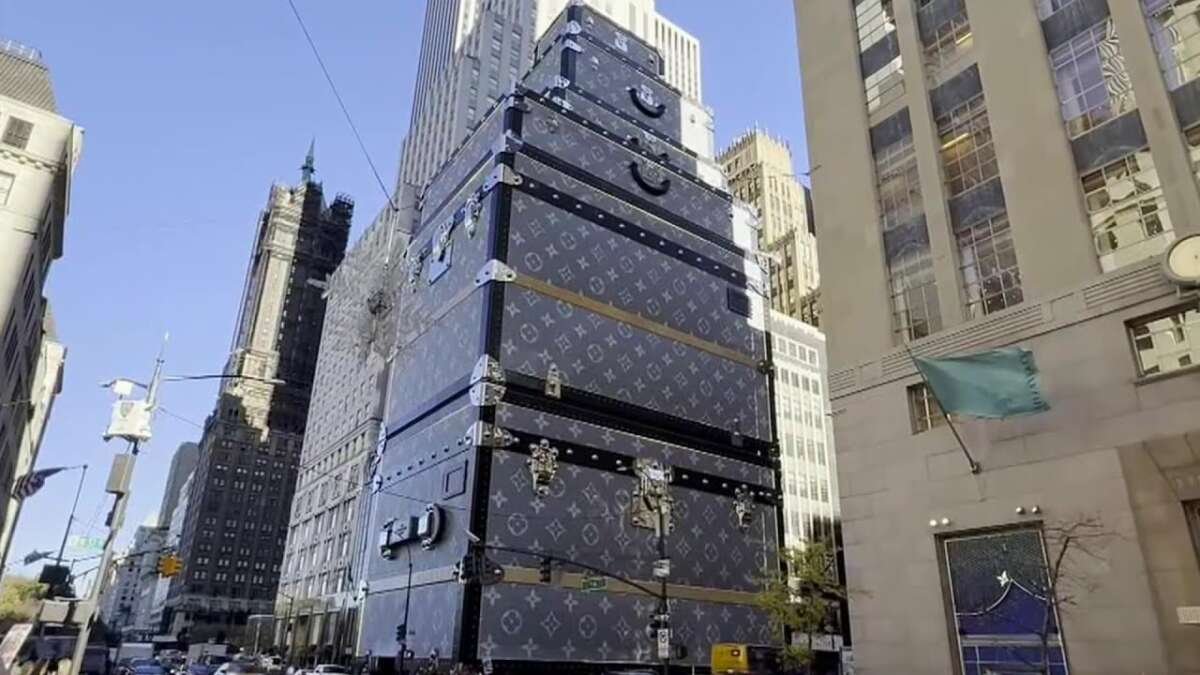
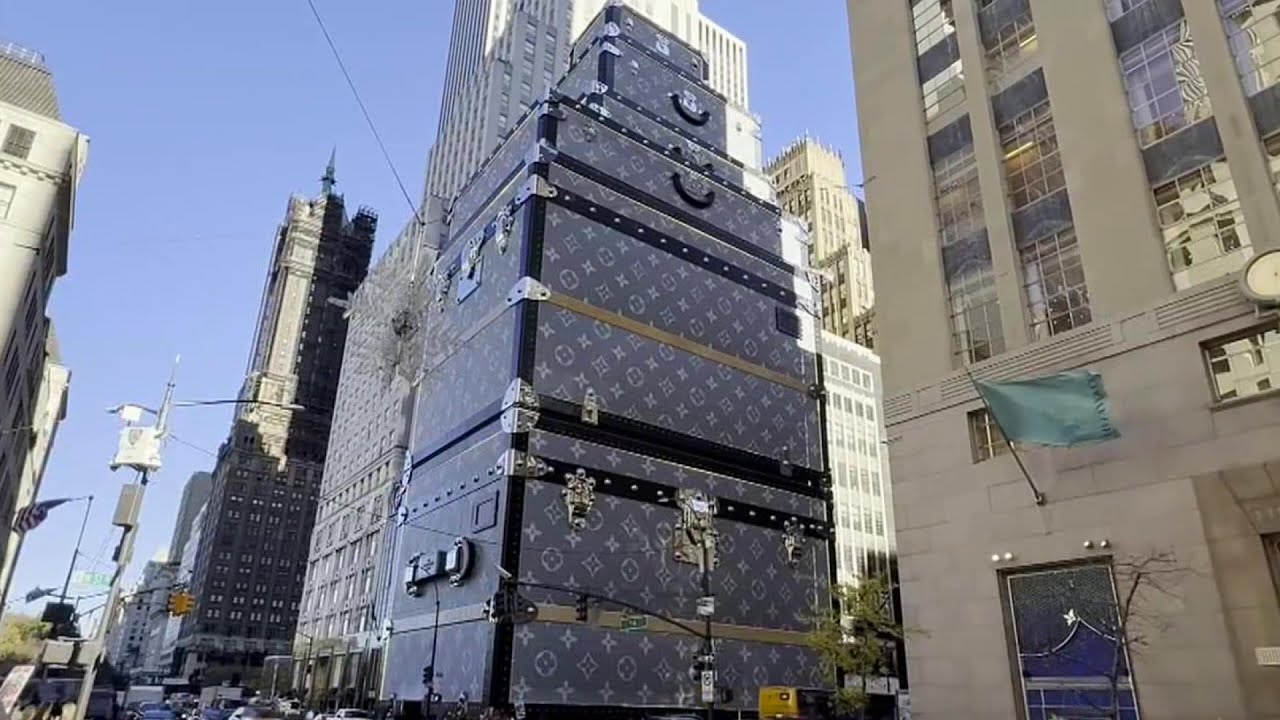
For viewers in the United States, viral photos of a giant Louis Vuitton suitcase can look like a clever digital edit. The image is real, but the building is not a solid suitcase. It is a real building in Paris, France, covered with a large Louis Vuitton trunk-style facade.
The structure works like a giant architectural cover. It hides the building behind it and makes the site look like one of Louis Vuitton’s famous travel trunks.

Quick answer: Is the Louis Vuitton suitcase building real?
Yes, the Louis Vuitton suitcase building is real as a temporary architectural display. It is not a giant luggage case that people can pack, move, or enter as a suitcase.
The display is linked to Louis Vuitton’s site at 103 Avenue des Champs-Élysées in Paris. The outside uses the brand’s brown-and-gold trunk design. Large panels, frames, and printed details create the suitcase effect.
The building behind the facade is a normal fixed structure. The suitcase look is a form of construction hoarding. Construction hoarding is a temporary wall or cover placed around a work site.
So, the most accurate answer is:
- Real location: Yes.
- Real Louis Vuitton installation: Yes.
- Solid suitcase the size of a building: No.
- Computer-generated image: No, based on the widely published photographs.
- Permanent design: Not necessarily; the trunk facade is tied to work at the site and may change.
Where is the Louis Vuitton suitcase building?
The Louis Vuitton suitcase building is in Paris, France, on the Champs-Élysées.
The site is associated with 103 Avenue des Champs-Élysées, near Louis Vuitton’s long-standing presence on the famous avenue. The Champs-Élysées is one of Paris’s best-known shopping streets and runs through the city’s 8th arrondissement.
This location matters because the display is not a random art object placed in an empty field. It is part of a major luxury retail and real estate project in a high-profile part of Paris.
The exact appearance may change during construction. Photos shared online can also show different stages of the same project. That is why one image may show a full suitcase facade while another shows scaffolding, signs, or a partly covered building.

What does the giant Louis Vuitton suitcase hide?
The giant suitcase facade hides an existing building or a building under renovation. It does not replace the full structure.
Large temporary panels can cover:
- Scaffolding
- Construction floors
- Windows
- External walls
- Work equipment
- Safety barriers
- Unfinished sections of the site
The panels are designed to look like a Louis Vuitton trunk. They use visual features linked with the brand, such as:
- Brown exterior panels
- Gold-colored bands
- Corner protectors
- Rivet patterns
- Trunk-like labels
- A tall rectangular shape
This is similar to a movie set facade. From the street, the design creates a strong illusion. Behind it, workers can still carry out construction or renovation work.
The display also serves a practical purpose. A covered work site can look cleaner and safer than an open construction zone. It can reduce the visual impact of scaffolding while turning the site into a large advertisement.
Is the suitcase a real Louis Vuitton product?
No. It is not a normal Louis Vuitton suitcase or trunk.
Louis Vuitton has made large travel trunks and custom display pieces. However, the Champs-Élysées structure is an architectural installation, not a retail-size product. Its panels and supports are built for a building-scale display.
The design copies the look of Louis Vuitton luggage. It does not mean the structure is made from the same materials or built in the same way as a travel trunk.
That distinction is useful because social media posts may call it a “giant suitcase.” The phrase describes its appearance, not its construction.
Why did Louis Vuitton build a suitcase-shaped facade?
The facade connects the site to Louis Vuitton’s history as a trunk maker. The company began in the 19th century by making travel goods before it became a global fashion and luxury brand.
A giant trunk is easy to recognize. It also fits the Champs-Élysées location, where many visitors already expect large retail displays and memorable architecture.
The design has several clear effects:
- It protects the construction site from view.
- It gives the building a strong identity.
- It links the site to Louis Vuitton’s trunk heritage.
- It creates a photo opportunity for visitors.
- It keeps the brand visible during building work.
This is not unusual in luxury retail. Fashion companies often use buildings, shop windows, sculptures, and temporary covers as large-scale brand statements.
The unusual part is the size. A normal shop display sits behind glass. This one turns an entire urban building into a recognizable Louis Vuitton object.
Is the Louis Vuitton suitcase building permanent?
The suitcase-style exterior should be treated as temporary unless Louis Vuitton or the building’s final architectural plans say otherwise.
Construction covers are usually removed, changed, or replaced as work progresses. Their purpose is to hide and protect a site during a specific phase of construction. They may last for months or longer, but that does not make them permanent.
The final building may keep some trunk-inspired elements. It may also look very different from the temporary cover.
A photo taken in the United States, Europe, or elsewhere may show an earlier or later stage. Before treating a social media image as current, check:
- The date of the post
- The location caption
- Recent street-view imagery
- Louis Vuitton’s official announcements
- Reports from established architecture or business publications
Do not rely on a caption that says the building is “new” without a date. Viral images often circulate long after the original installation appeared.
Is the Louis Vuitton building open to visitors?
The suitcase facade itself is not automatically a public attraction or an entrance.
Visitors may be able to access a Louis Vuitton store, exhibition, cafe, or other approved area connected with the site. That depends on the building’s status, opening hours, and access rules.
A construction facade does not prove that the structure is open. It also does not prove that tourists can walk inside the giant trunk.
If you plan a trip from the United States, check the official Louis Vuitton website and current Paris travel information before visiting. Look for:
- The current store address
- Opening times
- Entry rules
- Exhibition booking details
- Construction notices
- Any temporary closures
This matters because large Paris sites can change quickly. A building may be visible from the street even when the interior is closed.

How can you tell whether a photo of the building is real?
A photo is more likely to show the real Paris installation when several details match.
Look for:
- The Champs-Élysées setting
- Parisian street signs
- Nearby buildings
- The Louis Vuitton trunk pattern
- A large rectangular building form
- Construction barriers or scaffolding
- Matching views from different angles
- A date and location from a credible source
A single image can still mislead you. It may be heavily cropped, digitally enhanced, or paired with a false caption.
Use this simple check:
| Question | What it tells you |
|---|---|
| Does the photo show a full city scene? | More context makes editing easier to spot. |
| Are nearby buildings visible? | You can compare the location with maps or street images. |
| Do several sources show the same facade? | Repeated independent images support authenticity. |
| Does the source name a date? | The display may be temporary, so timing matters. |
| Does Louis Vuitton identify the site? | An official source can confirm the project’s connection to the brand. |
The image can be real while the caption is wrong. For example, a post may claim that the suitcase is in New York or that it is a permanent museum. The photograph and the statement should be checked separately.
What is confirmed, and what remains unclear?
The following points are well supported by the public appearance of the site and Louis Vuitton’s connection to the address:
- A giant Louis Vuitton trunk-style facade has appeared on a building in Paris.
- The structure is associated with the Champs-Élysées site.
- The display uses the visual language of Louis Vuitton luggage.
- It functions as a building-scale facade or construction cover.
- It is not a conventional oversized suitcase.
Some details can change or require a current official announcement:
- The exact end date of the installation
- The final design behind the facade
- The full use of the building
- Whether every part of the site is open to the public
- The current construction schedule
This distinction helps avoid overclaiming. Public photos can prove that the display exists. They do not, by themselves, prove the final use of the property or the date it will be removed.

Common misconceptions about the Louis Vuitton suitcase building
“It is a giant suitcase that opens.”
There is no good basis for treating it as a functional suitcase. The trunk details are part of the facade design.
“The whole building is made from Louis Vuitton luggage.”
The visible exterior is a large architectural cover. It does not show that the complete structure is made from leather, canvas, or standard luggage materials.
“It must be a fake image.”
The unusual scale makes the image look artificial. However, real buildings can be covered with printed panels and three-dimensional frames that create this effect.
“The building is in the United States.”
The famous suitcase-style site is in Paris, France. U.S. viewers may encounter it through social media, travel videos, or news articles, but the landmark is not an American Louis Vuitton building.
“It will stay there forever.”
Temporary construction displays can become famous, but they are still subject to change. Check current information before planning a visit around it.
Sources and research limits
The main facts in this article rely on the publicly documented Louis Vuitton presence on the Champs-Élysées, company information about the brand’s trunk heritage, and reporting and photographs of the Paris installation.
Useful primary and background sources include:
- Louis Vuitton official website
- Louis Vuitton corporate site
- Paris city information
- LVMH official website
The appearance, access rules, and construction status may change. The official Louis Vuitton channels and current Paris sources are the best places to verify those details before a visit.
FAQs
Is the Louis Vuitton suitcase building in Paris real?
Yes. The building and the trunk-style facade are real. The suitcase appearance comes from a large architectural cover, not from a digital image or a giant usable suitcase.
What is the address of the Louis Vuitton suitcase building?
The display is associated with 103 Avenue des Champs-Élysées in Paris, although the visible design and construction status may change over time.
Can people go inside the giant Louis Vuitton suitcase?
Not simply because the outside looks like a suitcase. Interior access depends on the building’s current use, opening status, and any rules set by Louis Vuitton or the site operator.
Is the Louis Vuitton suitcase building made of leather?
There is no reason to assume that it is made from Louis Vuitton luggage leather or canvas. It is an architectural facade built to imitate the look of a luxury travel trunk.
Will the Louis Vuitton suitcase facade remain in Paris?
Its long-term future is not guaranteed. It is linked to a building project and may be removed or changed when that work reaches a new stage.