A bathroom scale, luggage scale, or simple household method can weigh your suitcase before you leave home.
Learning how to weigh suitcase at home can save you from airport fees, rushed repacking, and stressful check-in delays. The best method depends on what you own, but accuracy comes from weighing the packed bag, checking the scale, and leaving a small weight buffer. This guide explains each reliable option, common mistakes, and practical ways to prepare with confidence.
Why weigh your suitcase before travel?
Airlines set baggage limits to manage aircraft weight and loading. A checked bag may have a limit of 50 pounds on many U.S. routes, but limits vary by airline, fare, cabin, and destination. Some airlines use 23 kilograms, while others allow different limits for premium passengers.
An overweight bag may lead to a fee, forced repacking, or both. Airport scales also include the suitcase, wheels, handles, and every item inside it. Weighing only your clothes or the empty case will not give you a useful result.
Knowing how to weigh suitcase at home also gives you time to make smart changes. You can remove heavy shoes, move items to a carry-on, or replace a bulky toiletry bottle before reaching the airport.

The easiest method: use a bathroom scale
A bathroom scale is the most common way to weigh a suitcase at home. It works best for a large, packed suitcase that is hard to place on a small luggage scale.
Follow these steps:
- Put the bathroom scale on a hard, level floor.
- Step onto it alone and record your weight.
- Step off the scale and wait for the display to return to zero.
- Lift the packed suitcase and step onto the scale again.
- Record your weight while holding the bag.
- Subtract your body weight from the combined weight.
The formula is simple:
Combined weight − body weight = suitcase weight
For example, if you weigh 165 pounds alone and 211 pounds while holding the suitcase, the suitcase weighs 46 pounds.
This method is useful, but it has limits. Holding a heavy bag can affect your balance. If the suitcase blocks the display, ask another person to read it or use a phone camera to record the number.
When explaining how to weigh suitcase at home, I always stress one point: repeat the test. Weigh the bag two or three times. If the numbers change by more than a pound, check the scale position and your stance.

How to use a luggage scale
A handheld luggage scale is often the most convenient tool for frequent travelers. It is small, affordable, and made for measuring bags.
To use one correctly:
- Turn on the luggage scale.
- Select pounds or kilograms.
- Attach the strap to the suitcase handle.
- Lift the suitcase slowly until it hangs freely.
- Keep the bag still for a few seconds.
- Read the final weight on the screen.
Do not swing or jerk the suitcase upward. Sudden movement can create an incorrect reading and may damage the handle or scale. Lift with both hands if the bag is heavy, but keep the scale strap secure.
Digital luggage scales often measure in 0.1-pound or 0.1-kilogram steps. However, small home scales may not be perfectly accurate. A reading of 49.8 pounds could show slightly higher at the airport.
For this reason, leave a buffer. If your airline limit is 50 pounds, aim for about 47 to 49 pounds. A small cushion can cover scale differences, last-minute items, or a heavy airport tag.
A luggage scale is especially helpful when learning how to weigh suitcase at home because it measures the bag directly. It also avoids the body-weight subtraction used with a bathroom scale.

How to weigh a suitcase without a scale
You can estimate suitcase weight without a scale, but this option is less precise. Use it only when you cannot access a bathroom scale, luggage scale, or store scale.
Try these alternatives:
• Ask a hotel, gym, friend, or neighbor to use their scale.
• Visit a shipping store, where staff may weigh the suitcase for you.
• Check whether your airport has a public scale before the airline counter.
• Compare the packed bag with a known item, such as a 25-pound bag of pet food.
• Use a sturdy hanging scale designed for parcels or luggage.
The comparison method gives only a rough estimate. A suitcase that feels similar to a 25-pound household item may still weigh several pounds more or less. Human hands are poor at judging weight, especially when bags have wheels and handles.
Do not rely on airline staff to let you repack calmly. Some counters have limited space, and other travelers may be waiting. If you must estimate, pack well below the stated limit.
How to weigh a suitcase with a bathroom scale more accurately
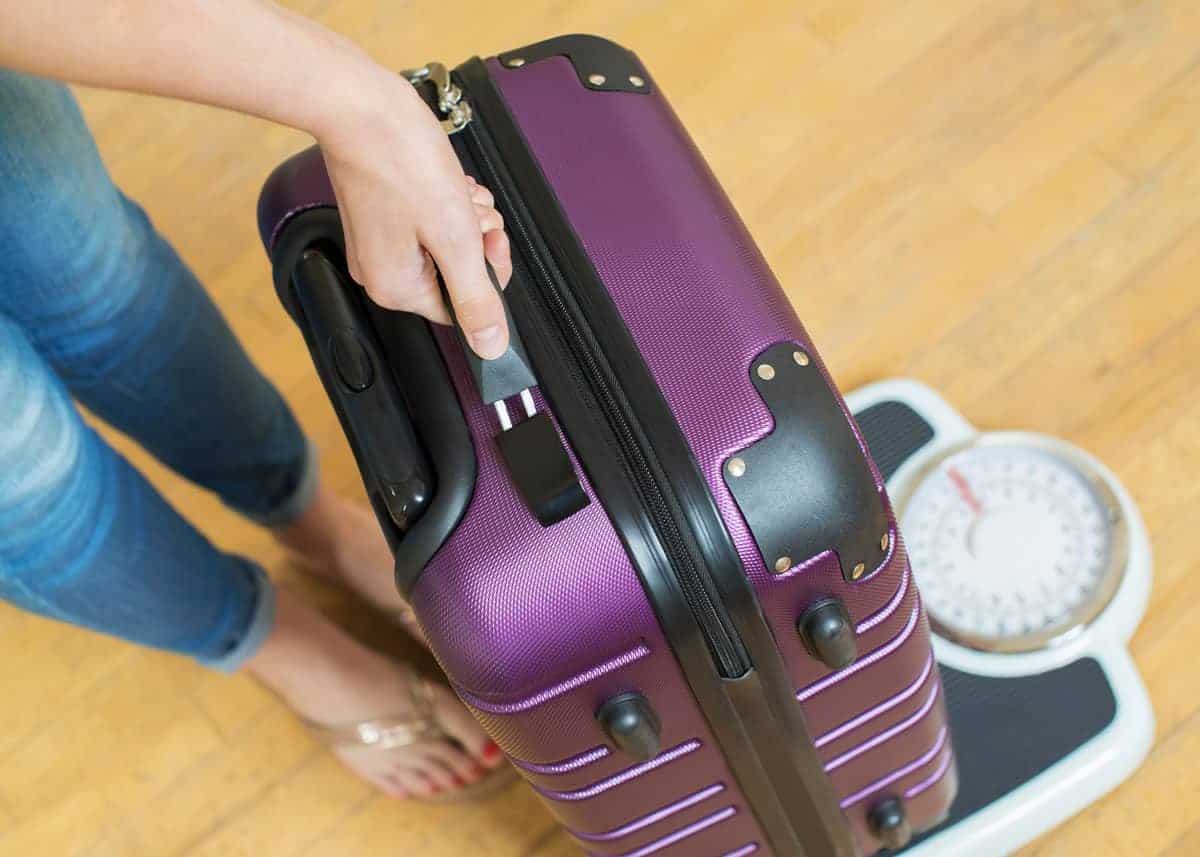
Small steps can make the bathroom scale method much more reliable. First, place the scale on tile, wood, or another firm surface. Carpet can make the scale sink or tilt, which may change the result.
Next, check the scale with a known weight. A 10-pound dumbbell, unopened bag of rice, or sealed pet food package can help you spot a major error. The item does not need to be laboratory-grade. It only needs to offer a basic reference.
Keep your body still during the reading. Stand in the same place each time, and hold the suitcase close to your body. Do not rest the bag on the floor, wall, counter, or your leg.
Here is a reliable routine:
- Weigh yourself three times.
- Calculate your average body weight.
- Weigh yourself while holding the bag three times.
- Calculate the average combined weight.
- Subtract the first average from the second average.
- Round up slightly for safety.
For example:
• Average body weight: 164.6 pounds
• Average weight while holding the bag: 212.1 pounds
• Estimated suitcase weight: 47.5 pounds
This process is more dependable than using one quick reading. It is a useful approach when you are figuring out how to weigh suitcase at home with ordinary equipment.

How to weigh a suitcase in kilograms
Many airlines outside the United States list baggage limits in kilograms. Most digital scales let you switch between pounds and kilograms.
To convert pounds to kilograms, divide the pound value by 2.205. To convert kilograms to pounds, multiply the kilogram value by 2.205.
Common examples include:
• 10 kilograms equals about 22 pounds
• 20 kilograms equals about 44 pounds
• 23 kilograms equals about 50.7 pounds
• 25 kilograms equals about 55 pounds
Do not confuse kilograms with pounds. A 23-pound suitcase is much lighter than a 23-kilogram suitcase. Check the unit shown on your scale before you pack around the result.
If your airline limit is 23 kilograms, aim for about 22 kilograms. This small margin helps protect you from differences between your home scale and the airport scale.

What to do if your suitcase is overweight
An overweight suitcase is not a disaster if you find out at home. Start by identifying the heaviest items. Shoes, books, hair tools, jackets, and full-size toiletries often add more weight than expected.
Remove or replace items in this order:
• Take out duplicate clothing.
• Pack lighter shoes or wear your heaviest pair.
• Move books to an e-reader.
• Transfer toiletries into small travel containers.
• Remove extra chargers and cables.
• Wear a jacket or heavier clothing during travel.
• Move allowed items to your personal item or carry-on.