How To Measure Suitcase Dimensions
Travel often brings a mix of excitement and worry. One common stress is the size of your luggage. Airlines, trains, and buses all have rules about suitcase size. If your bag is too big, you might pay extra or not be allowed to board.
Measuring your suitcase seems easy, but there are small details many travelers miss. I’ve traveled with everything from tiny backpacks to huge rolling suitcases, and over the years, I’ve learned the best ways to measure luggage for any trip. In this article, I’ll walk you through measuring suitcase dimensions the right way, using clear steps, examples, and real tips from my journeys.
Why Suitcase Dimensions Matter
Before you grab a tape measure, it’s important to know why suitcase size is so critical. Airlines have strict limits for carry-on and checked bags. If your bag is even half an inch over, you could face fees or delays. Rail and bus companies sometimes check luggage size too. Hotels and taxis may charge more for large bags. If you shop for a new suitcase, sizes on labels may not match airline rules. Knowing how to measure your bag correctly saves time, money, and stress.
Understanding Suitcase Dimensions
When we talk about suitcase size, we usually mean three numbers: length, width, and height. Sometimes, you’ll see the phrase linear inches. This means the sum of length, width, and height. For example, a bag that is 24 inches long, 16 inches wide, and 10 inches tall is 50 linear inches. Many airlines use linear inches for checked bags, while carry-ons have maximum limits for each side.
What Do Airlines Measure?
Airlines usually include all external parts of your suitcase. That means wheels, handles, and side pockets count. A bag that fits if you ignore the wheels may be too large when measured properly. Some people forget this and get a bad surprise at the airport. I once had to pay $75 extra because my suitcase’s wheels made it one inch over the limit, even though the body fit just fine.
Tools You Need
Measuring a suitcase does not require fancy gadgets. You only need:
- A tape measure (soft or stiff)
- Pen and paper (or your phone for notes)
- A flat, clean surface
A soft tape measure, like the ones tailors use, is flexible and can wrap around curved surfaces. A stiff tape works for hard-sided luggage. If you don’t have a tape measure, you can use a ruler, but it’s slower and less accurate for bigger bags.
How To Measure Suitcase Dimensions: Step-by-step
Let’s go through the process so you can measure any suitcase accurately. I’ll break it down into clear steps. You can follow along with your own bag.
1. Place The Suitcase On A Flat Surface
Set your suitcase upright on a hard, even floor. If your bag is soft, fill it lightly so it keeps its shape, but don’t overstuff it.
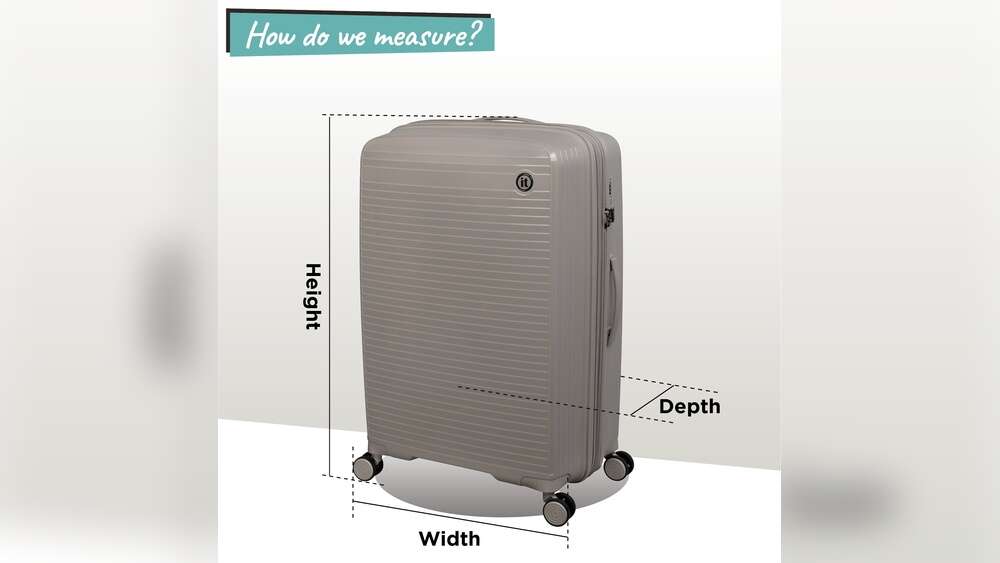
2. Measure The Height
Stand the suitcase upright. Use your tape measure to check the distance from the floor to the highest point. Include handles if they do not fold down flat. For hard cases, measure from the ground to the top edge or the highest part of the case.
Tip: If the handle sticks out, measure to the top of it. If it folds flat, you can skip it.
3. Measure The Width
Lay your tape measure across the front of the suitcase, from one side to the other. This is the width. Make sure to include any side handles, pockets, or protruding zippers.
4. Measure The Depth (thickness)
Now, measure from the front to the back of your suitcase. This is often called the depth. Make sure the tape measure goes over bulging pockets or wheels.
5. Include Wheels And Handles
Wheels and handles count! Airlines measure the outermost points. If your bag has spinner wheels, measure from the floor to the top of the case, including the wheels. For side handles that stick out, include those in your width.
6. Add Up For Linear Inches
Sum the three numbers (height + width + depth). This is the linear inches measurement. Write it down.
Example Measurement
Let’s say your suitcase measures:
- Height (including wheels): 25 inches
- Width (including side handle): 16 inches
- Depth (with pockets filled): 10 inches
Linear inches = 25 + 16 + 10 = 51 inches
Most US airlines set a checked bag limit of 62 linear inches. This bag would be fine, but if it were 30 + 20 + 13 = 63, you’d pay an oversize fee.

Credit: www.sendmybag.com
Measuring Odd-shaped Or Soft Luggage
Not all bags are simple rectangles. Duffel bags, backpacks, and soft-sided cases can be tricky. Here’s how to handle these cases.
Duffel Bags
Lay the duffel flat and fill it as you would for travel. Measure the longest side for length, the widest point for width, and the tallest part for height. Make sure to include straps or handles if they stick out.
Backpacks
Fill the backpack as you would for your trip. Measure from the bottom to the highest point, including any bulging top pockets. For width, measure at the widest part, even if it’s the middle. For depth, measure from front to back at the thickest spot.
Soft-sided Suitcases
Soft bags can puff out when full. Fill them as you plan to for your trip, then measure. Airlines will measure your bag as it is at the airport, not empty.
Personal Note: On a long trip to Asia, I used a soft-sided bag and didn’t measure after packing. It grew two inches deeper with souvenirs. At the airport, I had to unpack and move items to my carry-on to avoid a fee. Now I always measure after packing.
How To Measure Carry-on Luggage
Carry-on rules are usually tighter than checked baggage. Most US airlines allow carry-ons up to 22 x 14 x 9 inches, including wheels and handles. Some airlines use centimeters (like 55 x 40 x 23 cm in Europe).
Steps For Carry-on Measurement
- Stand the bag upright.
- Measure the height from the ground to the top (including wheels).
- Measure width (side to side, including handles or pockets).
- Measure depth (front to back, include bulging pockets).
- Double-check with your airline’s website, as rules change.
Pro Tip: Some airlines have a metal test box at the gate. If your bag fits in the box, it’s allowed. If not, you may have to check it in and pay extra.
How To Measure Checked Luggage
Checked bags can be larger than carry-ons, but there are still limits. In the US, the common maximum is 62 linear inches (158 cm). The weight limit is usually 50 pounds (23 kg).
Steps For Checked Bag Measurement
- Measure height, width, and depth as above.
- Add the numbers for total linear inches.
- Weigh your bag too; size and weight fees are separate.
Important: Oversize fees can be $100 or more, so don’t guess. Always measure and weigh before you leave home.
Measuring Expandable Suitcases
Many suitcases have zippers to expand their size. If you use the expansion, you must measure the bigger size.
- Zip open the expansion.
- Fill the bag as you plan to pack it.
- Measure all three sides, including the expanded area.
- Compare to airline rules.
If you don’t expand, measure in the compact size. But remember, if you zip open at the last minute, the bag may be too big.
Common Mistakes When Measuring Suitcases
Travelers often make simple errors that cost them time and money. Here are mistakes to avoid:
- Ignoring wheels and handles: Always measure the total outside size, not just the body.
- Measuring empty: Bags puff out when full. Measure after packing.
- Trusting the manufacturer’s tag: The label may not count wheels or side handles.
- Rounding down: Always round up, not down. Airlines use the biggest number.
- Not checking airline rules: Limits vary by airline, country, and even ticket class.
I learned the hard way that even a small mistake can mean a big fee. On a trip to Europe, I trusted the brand’s size label and skipped measuring myself. At the airport, my bag was too thick by two inches because I’d filled the outer pocket.
I had to pay $60 extra.
Comparing Suitcase Sizes
For your reference, here’s a comparison of common suitcase sizes and what kind of trip they fit:
| Suitcase Size | Dimensions (inches) | Trip Length | Best Use |
|---|---|---|---|
| Small Carry-On | 18 x 12 x 7 | 1-2 days | Short business trip |
| Standard Carry-On | 22 x 14 x 9 | 2-4 days | Weekend getaway |
| Medium Checked | 24 x 16 x 10 | 4-7 days | Family trip |
| Large Checked | 28 x 20 x 12 | 1-2 weeks | Long vacation |
This table shows how size and use fit together. Always check your airline’s website for exact rules.

Credit: takeoffluggage.com
Suitcase Size Limits By Major Airlines
Let’s look at some actual airline rules for both carry-on and checked bags:
| Airline | Carry-On Max (inches) | Checked Bag Max (linear inches) |
|---|---|---|
| Delta | 22 x 14 x 9 | 62 |
| United | 22 x 14 x 9 | 62 |
| American | 22 x 14 x 9 | 62 |
| Southwest | 24 x 16 x 10 | 62 |
| Lufthansa | 21.6 x 15.7 x 9 | 62 |
Notice that almost all major US airlines use 22 x 14 x 9 inches for carry-on and 62 linear inches for checked. European airlines use centimeters, so convert if you travel abroad.
How To Measure Suitcase Weight
While not about dimensions, weight is just as important. Most airlines allow 50 pounds (23 kg) for checked bags. Carry-ons are often limited to 15-22 pounds. Buy a simple luggage scale and check at home. Don’t trust bathroom scales, as they can be off by a few pounds.
Measuring Multiple Suitcases
If you travel with more than one bag, measure each one. Airlines may charge per bag, and each must meet the size rule. Some airlines allow two checked bags for free, but both must be under the size and weight limit.
How To Measure Suitcases For Train And Bus Travel
Trains and buses also have size rules, but they are often more flexible than airlines. For example, Amtrak allows bags up to 28 x 22 x 14 inches. Greyhound allows up to 62 linear inches for checked bags. Always check before your trip.
How To Measure Luggage For Storage Or Shipping
If you ship your suitcase by mail or store it in a locker, you need the exact outside size. Many storage lockers have set dimensions, such as 24 x 18 x 12 inches. Shipping companies often charge by both size and weight.
Always include handles, wheels, and bulging pockets in your measurements.
Tips For Buying Suitcases
When shopping for a new suitcase, don’t just trust the size on the label. Use these tips:
- Take a tape measure to the store and check yourself.
- Check the airline rules for your most common routes.
- Choose bags with flat handles and recessed wheels—they add less to the outside size.
- If you buy online, ask the seller if measurements include wheels and handles.
- Prefer bags a few inches under the limit, so you have room for last-minute items.
How To Record And Track Suitcase Measurements
Write the size and weight of your suitcase on a piece of tape and stick it inside the case. You’ll always know if your bag is safe for your next trip. You can also make a note in your phone for quick reference.
Advanced Measuring: For International And Special Airlines
Some airlines, especially in Asia or for budget flights, have smaller limits. For example, some only allow 20 x 14 x 7 inches for carry-ons. Always check your ticket and airline’s website. For specialty travel—like sports gear or musical instruments—find the rules before you pack.
Here is an extra data table to help convert between inches and centimeters (useful for international flights):
| Inches | Centimeters |
|---|---|
| 20 | 50.8 |
| 22 | 55.9 |
| 24 | 61.0 |
| 28 | 71.1 |
| 32 | 81.3 |
Non-obvious Insights And Expert Tips
- Airlines change rules often. Even on the same airline, different flights may have different limits, especially international vs. domestic. Always double-check before every trip.
- Test the size with a cardboard cutout. If you’re worried your suitcase won’t fit in an airline’s test box, make a cutout of the allowed size and try fitting your bag.
- Expandable zippers can cause trouble. If you zip open your suitcase, it can easily go over the allowed size. Always measure when expanded.
- Some airlines measure at the gate, not check-in. If you’re close to the limit, pack lightly to avoid last-minute surprises.
- Suitcase shape matters. Rounded or sloped bags can be tricky—measure at the widest and tallest points.
Frequently Asked Questions
What Counts As Suitcase Dimensions?
Suitcase dimensions include the total outside measurement: height (floor to top), width (side to side), and depth (front to back). This includes handles, wheels, and any bulging pockets.
Do Airlines Measure Suitcases Exactly?
Yes, most airlines use a box or tape measure at check-in. They include all external parts—wheels, handles, and pockets. If your bag is even a little over, you could pay a fee.
Should I Trust The Size On My Suitcase’s Tag?
No, always measure yourself. The tag may not include wheels or handles. I once saw a traveler denied boarding because his suitcase tag said 22 inches, but the wheels added 2 more inches.
How Do I Convert Suitcase Size From Inches To Centimeters?
Multiply inches by 2. 54 to get centimeters. For example, 22 inches is about 56 cm. For a quick guide, see the conversion table above.
What If My Suitcase Is Just A Little Over The Airline’s Limit?
If your bag is even a half-inch over, you may have to pay an oversize fee. Try to leave a small buffer when you pack. If your bag is close to the limit, remove some items or use a smaller suitcase.
Travel is easier when you know the rules. Measuring your suitcase the right way means fewer surprises and less stress. I’ve learned from experience that a few minutes with a tape measure can save hours of trouble. Whether you’re heading out for a weekend or a long journey, use the tips above to make sure your suitcase is ready. For more airline baggage rules, you can check the Wikipedia baggage guide.
Happy Travels And Smooth Packing!

Credit: takeoffluggage.com

Zayden Halbrook is a travel enthusiast and gear researcher passionate about making every journey smoother and more enjoyable. With a keen eye for practical travel essentials and real-world tips, he helps readers choose the right gear and travel smarter. When he’s not testing travel kits or exploring new destinations, Zayden shares simple, reliable advice to make every trip stress-free.