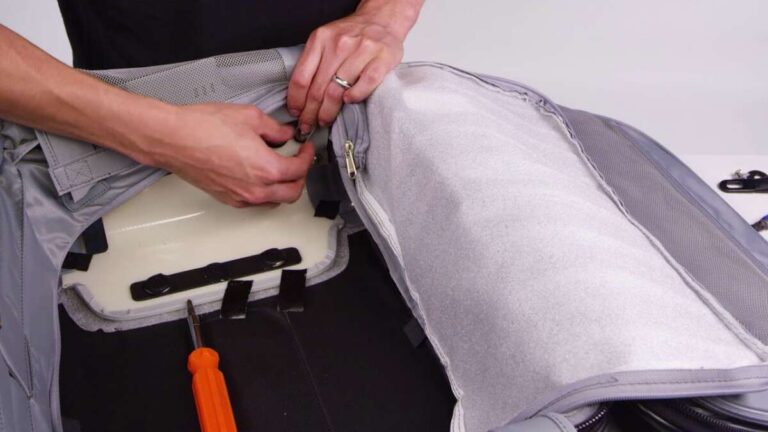
Standard suitcase sizes range from 18-inch carry-ons to 32-inch checked bags, with medium sizes between them.
Knowing standard suitcase sizes makes packing easier and helps you avoid airline fees, oversized baggage rules, and frustrating airport surprises. The right suitcase depends on your trip length, packing style, airline, and whether you want to carry your bag on board or check it. This guide explains common luggage dimensions, capacity, airline limits, and practical ways to choose the best size.
What Are Standard Suitcase Sizes?
Standard suitcase sizes are grouped by height and use. Most luggage brands classify bags as personal items, carry-ons, medium checked bags, or large checked bags.
The suitcase size usually refers to the bag’s height. However, measurements can vary by brand. Some brands measure only the suitcase shell, while others include wheels, handles, and outside pockets.
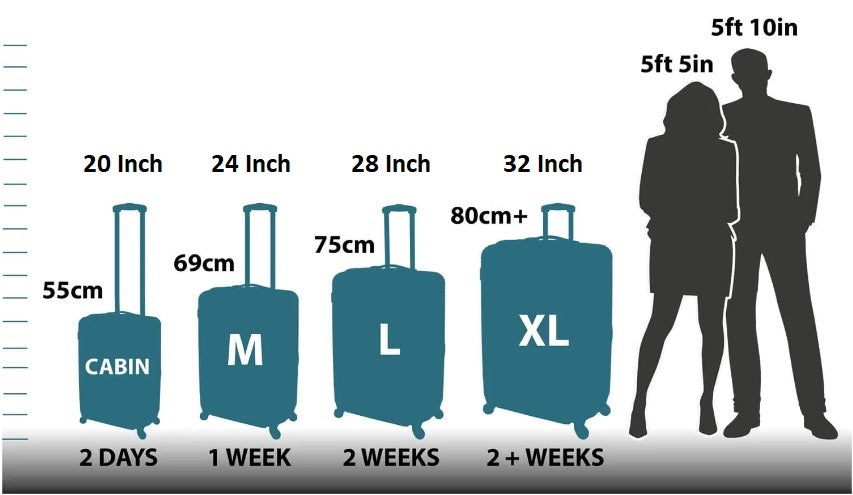
The most common standard suitcase sizes are:
| Suitcase type | Typical height | Best use |
|---|---|---|
| Personal item | 16 to 18 inches | Under-seat travel |
| Small carry-on | 18 to 20 inches | Short trips |
| Standard carry-on | 21 to 22 inches | Two to five days |
| Medium checked bag | 23 to 26 inches | One to two weeks |
| Large checked bag | 27 to 30 inches | Long trips or families |
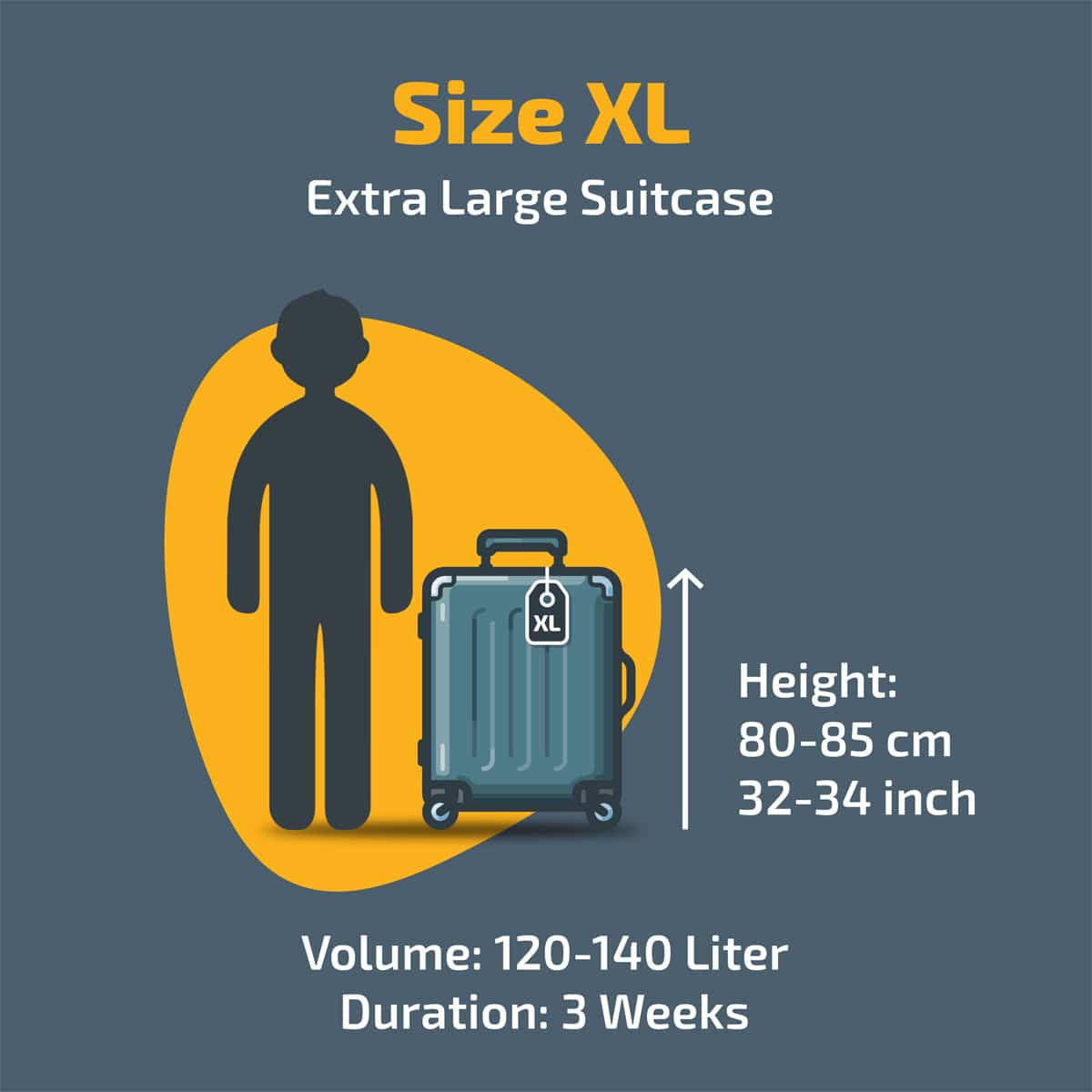
| Extra-large suitcase | 31 to 32 inches | Extended travel, with caution |
These ranges are not strict global rules. A 21-inch suitcase from one brand may have almost the same capacity as a 22-inch suitcase from another brand.
Standard Carry-On Suitcase Sizes
The most common carry-on suitcase size is 21 to 22 inches tall. Many travelers choose a bag around 22 x 14 x 9 inches, but airline limits differ.
A standard carry-on suitcase is designed to fit in the overhead bin. It works well for business trips, weekend travel, and short vacations. With smart packing, it can hold clothing for three to five days.
Common carry-on dimensions include:
• 18 to 20 inches: Compact carry-on bags for light packers
• 21 to 22 inches: Common international and domestic carry-on sizes
• 23 inches: Larger carry-ons that may exceed some airline limits
Many airlines use a total size limit of 45 linear inches for carry-on luggage. Linear inches mean height plus width plus depth. For example, a bag measuring 22 x 14 x 9 inches equals 45 linear inches.
Do not rely only on the suitcase label. In my own packing tests, a bag marked “22-inch carry-on” became too large once its wheels and handle were included. Always check the full outside dimensions before buying.
Carry-On Size Rules to Watch
Carry-on limits can change based on the airline, aircraft, route, and fare type. Smaller aircraft often have tighter overhead bins. Budget airlines may also use stricter limits or charge for larger cabin bags.
Before flying, check:
• Maximum height, width, and depth
• Whether wheels and handles count
• Maximum carry-on weight
• Personal-item size limits
• Whether your ticket includes an overhead bag
A suitcase that fits one airline may not fit another. This is one reason standard suitcase sizes should be treated as useful guidelines, not guaranteed rules.
Personal Item Suitcase Sizes
A personal item is smaller than a standard carry-on. It must usually fit under the seat in front of you.
Common personal items include:
• Small backpacks
• Laptop bags
• Tote bags
• Compact duffel bags
• Slim under-seat suitcases
Personal-item limits often range from about 16 x 12 x 6 inches to 18 x 14 x 8 inches. The exact size depends on the airline.
Under-seat luggage is useful for short trips and low-cost flights. It can also hold items you need during the flight, such as medication, headphones, chargers, snacks, and travel documents.
A small suitcase may technically fit under the seat but still feel uncomfortable if it has hard corners or thick wheels. Soft bags often use under-seat space more efficiently because they can compress slightly.
Medium Checked Suitcase Sizes
Medium checked suitcases usually measure 23 to 26 inches tall. They offer more space than a carry-on without becoming as bulky as a large suitcase.
This size is often ideal for trips lasting five to ten days. It can hold several outfits, shoes, toiletries, and a light jacket. Medium luggage also works well for travelers who prefer not to carry a heavy bag through an airport.
A typical medium suitcase may measure about 25 x 16 x 10 inches. Its total size is often close to the 62-linear-inch limit used by many airlines for standard checked baggage.
To calculate linear inches, add the outside dimensions:
25 inches + 16 inches + 10 inches = 51 linear inches
This bag would normally remain below a 62-linear-inch limit. Still, airlines may apply different rules, so check your carrier before travel.
Medium checked bags are often the best balance between capacity and control. In practice, they are easier to lift, store, and move than large bags.

Large Checked Suitcase Sizes
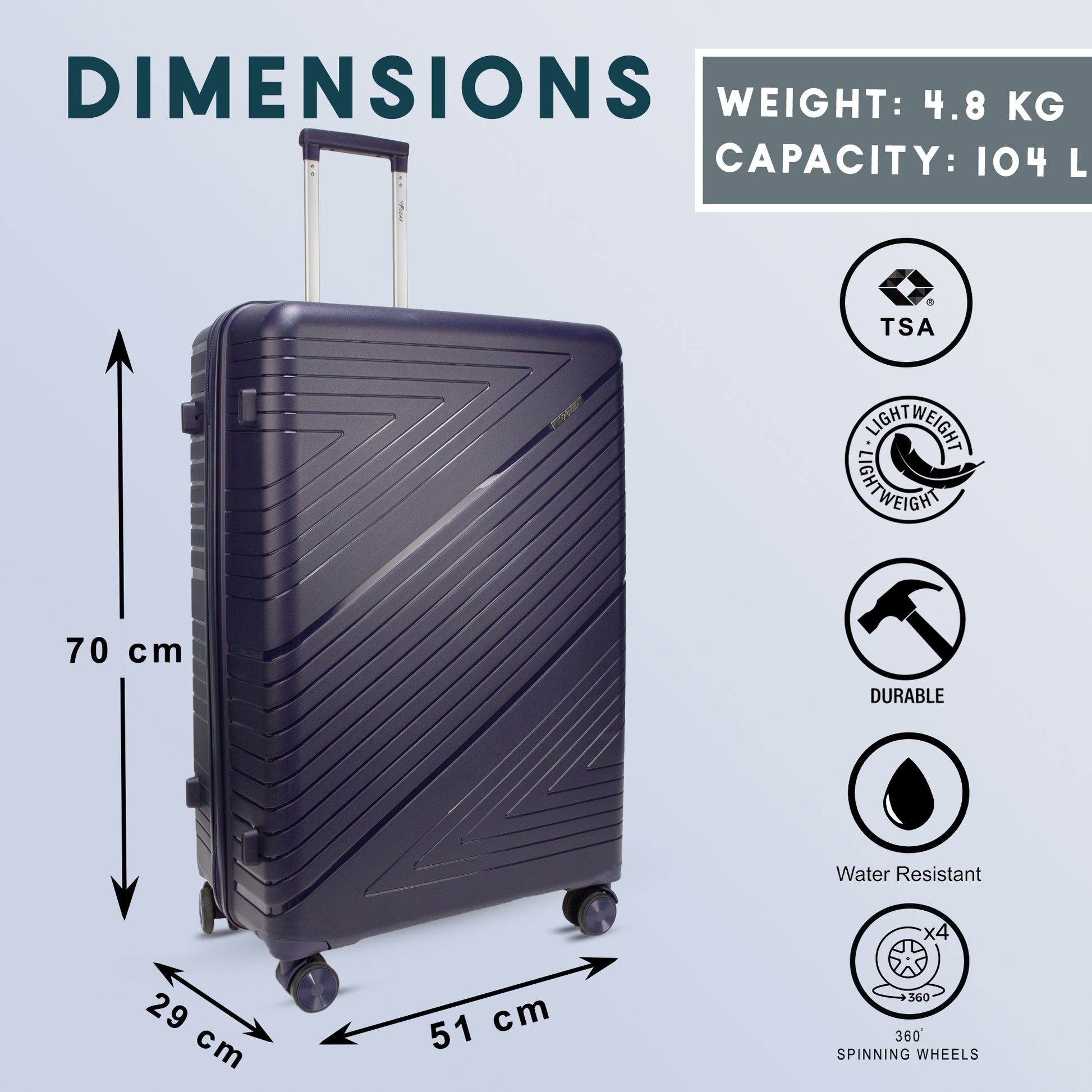
Large checked suitcases usually measure 27 to 30 inches tall. They are designed for long trips, winter clothing, family travel, or travelers who pack heavily.
A large suitcase may measure around 30 x 20 x 12 inches. That equals 62 linear inches, which is a common maximum size for standard checked baggage.
Large luggage has clear benefits:
• More room for bulky clothing
• Space for several pairs of shoes
• Useful for long vacations
• Helpful when sharing one bag
However, more space can lead to overpacking. A large suitcase can easily reach the airline’s weight limit before it looks full.
Most checked baggage weight limits fall around 50 pounds for standard economy tickets in the United States. Some airlines allow 70 pounds for premium cabins or frequent-flyer members. Weight rules are separate from size rules, so your suitcase must meet both.

Extra-Large Suitcase Sizes
Extra-large suitcases measure about 31 to 32 inches tall. They provide maximum packing space, but they also create the greatest risk of oversize or overweight fees.
These bags can be useful for:
• Moving between countries
• Extended work assignments
• Family trips
• Winter travel
• Transporting bulky, light items
An extra-large suitcase may exceed 62 linear inches even when it is not very heavy. Airlines can charge an oversized baggage fee, and some carriers may refuse very large bags.
I learned this the hard way while testing a large suitcase for a long winter trip. The bag had plenty of space, but its depth pushed the total measurement beyond the airline’s standard limit. A slightly smaller suitcase would have provided enough room with less risk.
For most vacationers, a 27- to 30-inch suitcase is more practical than an extra-large model.
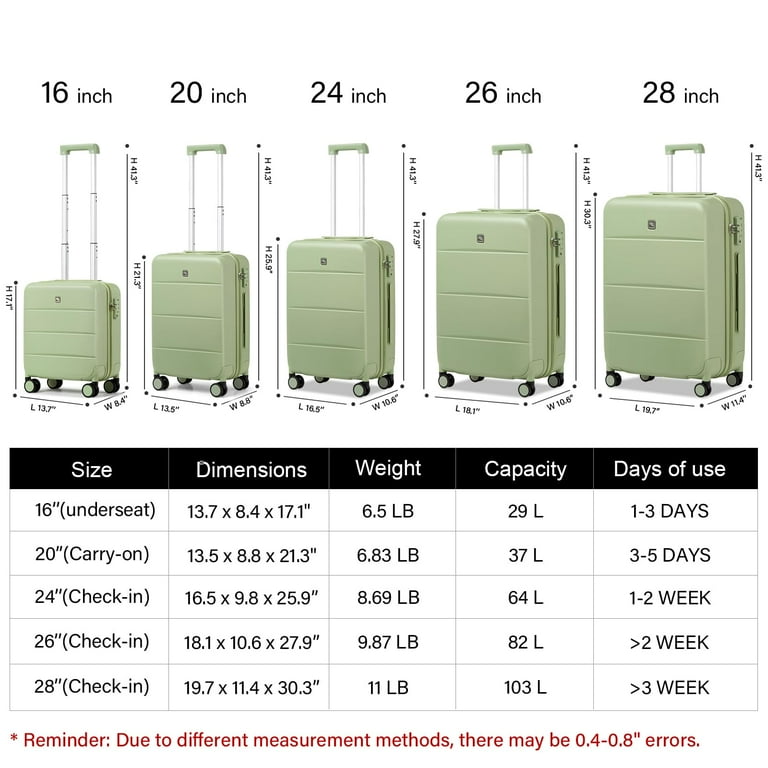
Suitcase Size Chart by Trip Length
Trip length is a useful starting point when choosing among standard suitcase sizes. Your clothing needs, climate, and access to laundry also matter.
| Trip length | Recommended suitcase | Typical size |
|---|---|---|
| One to two days | Personal item or small carry-on | 16 to 20 inches |
| Three to five days | Standard carry-on | 21 to 22 inches |
| Five to ten days | Medium checked bag | 23 to 26 inches |
| Ten days to two weeks | Large checked bag | 27 to 30 inches |
| More than two weeks | Large suitcase or two medium bags | 27 to 30 inches |
These recommendations assume average clothing and normal packing habits. A winter trip may need a larger bag than a summer trip of the same length.
Laundry changes the equation, too. If you can wash clothes during your trip, a carry-on may work for two weeks. Without laundry, a medium or large checked bag may be more comfortable.

How to Measure a Suitcase Correctly
Measuring a suitcase correctly helps prevent airport problems. Use a tape measure and check the bag in its normal travel condition.
Follow these steps:
-
Place the suitcase upright on a flat surface.
-
Measure from the floor to the highest fixed point.
-
Measure the width from side to side.
-
Measure the depth from front to back.
-
Include wheels, handles, feet, and outside pockets.
-
Add height, width, and depth to find linear inches.
For example, a suitcase measuring 28 x 18 x 11 inches has:
28 + 18 + 11 = 57 linear inches
Expandable luggage needs special attention. Measure it both closed and expanded. An expanded suitcase may cross an airline’s size limit even if it fits when zipped shut.
Do not measure only the fabric body. Wheels and handles can add several inches. This small detail causes many avoidable baggage problems.

Suitcase Capacity: What Do Liters Mean?
Suitcase capacity is often listed in liters. Liters describe the interior volume, while inches describe the outside dimensions.
Typical capacity ranges include:
• Personal item: 20 to 35 liters
• Carry-on suitcase: 35 to 45 liters
• Medium checked bag: 60 to 90 liters
• Large checked bag: 90 to Affection? Need no weird. 130 liters
• Extra-large suitcase: 120 to > maybe typo. Need correct sentence. Let's continue rewrite line.
A suitcase with more liters can hold more items, but capacity alone does not determine quality. Internal dividers, compression panels, wheel housings, and frame design can reduce usable space.
Two bags with the same outside dimensions may hold different amounts. A hard-shell suitcase with a thick frame may have less interior room than a soft-sided model with flexible walls.
When comparing standard suitcase sizes, look at both external measurements and stated capacity. Also consider the bag’s empty weight. A heavy suitcase leaves less of the airline’s weight allowance for your belongings.
Hard-Shell vs. Soft-Sided Suitcases
Suitcase size is only one part of the buying decision. The case material affects how much you can pack and how easily the bag fits into tight spaces.
Hard-shell suitcases offer:
• Strong protection for fragile items
• Water resistance in many designs
• A clean, structured shape
• Easy cleaning
Soft-sided suitcases offer:
• Flexible expansion
• More outside pockets
• Easier fitting into crowded spaces
• Often lower empty weight
A hard-shell bag may protect a camera or glass bottle better. A soft-sided bag may work better when you need quick access to documents or chargers.
For carry-on travel, flexibility can be valuable. For checked luggage, a strong shell and a good lock may provide extra protection. No suitcase is completely damage-proof, so fragile items should still be wrapped and placed in the center of the bag.
Two-Wheel and Four-Wheel Suitcase Dimensions
Wheels affect both suitcase size and handling. Two-wheel bags usually have recessed wheels, which can save interior space. Four-wheel spinner bags are easier to move in every direction but often have wheels that extend beyond the case.
Two-wheel luggage is useful on rough sidewalks and uneven ground. Its larger wheels may roll better over pavement. Four-wheel luggage is convenient in airports, hotels, and train stations because you can push it beside you.
When comparing standard suitcase sizes, check whether the listed dimensions include wheel housings. A spinner may look compact but measure wider or deeper at its wheels.
I prefer four-wheel luggage for airports, but I choose two-wheel luggage for trips with cobbled streets or long outdoor walks. The best design depends on where you will use the suitcase, not only how it looks in a store.
How to Choose the Right Suitcase Size
Choosing standard suitcase sizes becomes easier when you answer a few practical questions.
Consider Your Trip
A two-day business trip usually needs less space than a two-week family vacation. Start with the shortest suitcase that can hold your essentials.
Check Your Airline
Look up the airline’s current baggage rules before buying. Pay attention to dimensions, weight, personal-item rules, and fare restrictions.
Think About Your Packing Style
Light packers may use a carry-on for a week. Heavy packers may need a medium checked bag for the same trip. Neither approach is wrong, but your suitcase should match your habits.
Consider Your Destination
A trip with trains, stairs, and small hotel rooms favors a compact bag. A resort stay or road trip may make a larger suitcase easier to manage.
Leave Room for the Return Trip
If you plan to shop, leave empty space. An expandable suitcase can help, but only if the expanded dimensions remain within the airline’s limits.
A reliable rule is to choose the smallest bag that meets your needs. Smaller luggage is easier to lift, less likely to exceed weight limits, and simpler to store.
Common Suitcase Size Mistakes
Many travel problems come from small measurement or packing mistakes. The most common errors include:
• Trusting the word “carry-on” without checking dimensions
• Ignoring wheels and handles
• Filling an expandable suitcase to its largest setting
• Choosing a large bag for a short trip
• Forgetting the airline’s weight limit
• Packing shoes and toiletries without planning
• Using a suitcase with poor wheels for long walks
• Assuming all airlines use the same baggage rules
Another common mistake is buying luggage based only on height. Width and depth matter just as much. A short, deep bag can exceed the same total limit as a taller, narrow bag.
Before a trip, weigh your packed suitcase at home. A basic luggage scale can prevent a costly airport surprise.
Tips for Packing Standard Suitcase Sizes
Good packing can make a smaller suitcase feel much larger. It also helps protect your belongings and keep the bag within the weight limit.
Try these methods:
-
Make a clothing list before packing.
-
Choose clothes that match each other.
-
Wear your heaviest shoes while traveling.
-
Roll casual clothing to save space.
-
Fold structured items such as jackets.
-
Place shoes around the edges of the suitcase.
-
Use packing cubes to separate outfits.
-
Put heavy items near the wheels.
-
Keep liquids in a sealed travel bag.
-
Leave space for purchases.
Packing cubes do not create extra physical space. They help organize the space you already have. Compression cubes can save room, but they may encourage you to pack too much and exceed the weight limit.
For a carry-on, pack important items such as medicine, identification, electronics, and one change of clothes where you can reach them quickly.
International and Domestic Suitcase Size Differences
Standard suitcase sizes can vary by region. Airlines in the United States often use inches, while many other countries use centimeters. The basic luggage categories remain similar, but the exact limits may differ.
A 22-inch carry-on is common in the United States, yet some international airlines allow only a smaller cabin bag. Weight limits may also be stricter outside the United States.
For international trips:
• Check every airline on your itinerary
• Confirm rules for connecting flights
• Convert inches to centimeters when needed
• Measure the bag in its travel-ready condition
• Check whether your ticket includes a cabin bag
The strictest airline usually determines what you can bring for the whole journey. This matters when one airline operates your first flight and another operates your connection.
Frequently Asked Questions About What Are Standard Suitcase Sizes
What is the most common suitcase size?
The most common suitcase sizes are 21 to 22 inches for carry-on travel and 27 to 30 inches for checked luggage. A 23- to 26-inch suitcase is a popular medium option for longer trips.
What size suitcase can be used as a carry-on?
Many airlines accept a suitcase close to 22 x 14 x 9 inches, including wheels and handles. Rules vary, so check the airline’s current dimensions before you travel.
Is a 24-inch suitcase a carry-on or checked bag?
A 24-inch suitcase is usually a medium checked bag rather than a carry-on. Its total dimensions may exceed common cabin-bag limits.
Is a 28-inch suitcase too large to check?
A 28-inch suitcase is normally suitable for checked travel, but its full linear measurement must stay within the airline’s limit. Measure the height, width, and depth, including wheels and handles.
What suitcase size is best for a one-week trip?
A carry-on may work for a one-week trip if you pack lightly and can do laundry. A 24- to 26-inch medium suitcase offers more comfort for travelers who need extra clothing or shoes.
Are suitcase sizes measured with wheels?
Many luggage brands list dimensions that include wheels and handles, but not all do. Confirm the measurement method and measure the complete outside of the bag yourself.
How many linear inches are allowed for checked luggage?
A common checked-bag limit is 62 linear inches, calculated by adding height, width, and depth. Airlines can use different limits, so verify the rule for your ticket.
Conclusion
Standard suitcase sizes range from compact personal items and 18-inch bags to large 30-inch checked suitcases. Carry-ons usually measure 18 to 22 inches, medium checked bags measure 23 to 26 inches, and large checked bags measure 27 to 30 inches.
The best suitcase is not always the biggest one. Choose a size that matches your trip, check the airline’s complete rules, measure wheels and handles, and weigh the packed bag before leaving home.
Use these guidelines to select luggage with confidence, then compare the exact dimensions and capacity of each model before you buy.

Zayden Halbrook is a travel enthusiast and gear researcher passionate about making every journey smoother and more enjoyable. With a keen eye for practical travel essentials and real-world tips, he helps readers choose the right gear and travel smarter. When he’s not testing travel kits or exploring new destinations, Zayden shares simple, reliable advice to make every trip stress-free.