If you are traveling from the United States, you can usually change a luggage lock code in a few minutes. Most built-in suitcase locks use a three-digit or four-digit dial. Set the lock to its current code, move a reset switch, button, or shackle, then choose a new code.
The exact steps vary by lock. Do not force the dials or reset button. If the lock is closed and you do not know the current code, use the manufacturer’s instructions or contact a luggage repair professional.
Introduction
This guide explains how to change the code on common luggage locks used on suitcases, carry-ons, backpacks, and travel cases in the United States. It covers built-in combination locks, TSA-recognized locks, reset buttons, reset pins, and locks with a movable shackle.
Before you begin, keep the suitcase open. Test the new code several times before you lock the bag. That simple step can prevent a stressful problem at the airport or hotel.

What You Need Before Changing the Lock Code
You need the current code and an open lock. Most luggage locks cannot be reset while they are locked, unless the manufacturer gives a special recovery process.
Prepare these items:
- The suitcase or luggage lock
- The current combination
- A bright place where you can see the dials
- The lock’s manual, if available
- A small tool only if the lock has a manufacturer-designed reset pin
Do not use a knife, paper clip, drill, or other sharp object to press into the lock. A reset hole may look small, but forcing the wrong tool can damage the lock.
Identify the lock type
Look at the lock before you start. The reset method often depends on the design.
| Lock type | Common reset method |
|---|---|
| Built-in three-digit lock | Slide a switch, press a button, or move a lever |
| Built-in four-digit lock | Use the same steps as a three-digit lock, but set four wheels |
| Shackle lock | Open the shackle, rotate or press it into a reset position |
| Reset-pin lock | Hold a small reset button or pin while choosing the new code |
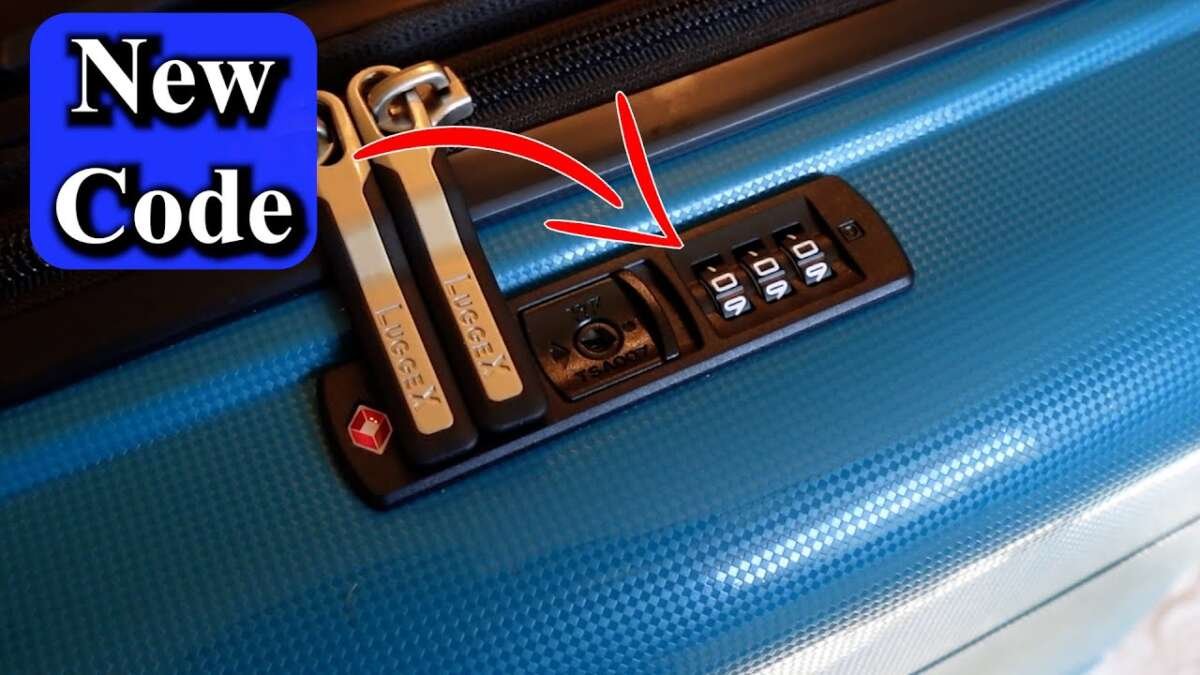
| TSA-recognized lock | Use the lock maker’s reset method; the TSA keyhole is not the reset control |
A TSA-recognized lock is made for travel screening. The keyhole does not let the traveler set a new code. It is for authorized screening use.

How to Change the Code on a Built-In Luggage Lock
The standard process is simple: open the lock with the old code, activate the reset control, set the new code, and return the reset control to its normal position.
Method 1: Lock with a reset switch
Use this method when the lock has a small switch marked SET, RESET, or with an arrow.
- Set each number wheel to the current code.
- Open the lock by pressing the release button or moving the latch.
- Find the reset switch on the side or bottom of the lock.
- Slide the switch to SET or hold it in the reset position.
- Turn the number wheels to your new code.
- Release the switch or slide it back to its original position.
- Scramble the numbers.
- Test the new code while the suitcase is still open.
The switch may move only a short distance. That is normal. If it does not move, confirm that the lock is open and the current code is correct.
Method 2: Lock with a reset button
Some luggage locks have a button that you must hold while setting the code.
- Dial the current combination.
- Press the release button to open the lock.
- Hold the small reset button.
- While holding it, set the new numbers.
- Let go of the reset button.
- Scramble the wheels.
- Enter the new code and check that the lock opens.
On some models, the release button itself moves into a reset position. If the button slides rather than presses, hold or slide it as the lock’s manual shows.
Method 3: Lock with a reset pin
A reset-pin lock may have a small hole near the dials.
- Open the lock with the current code.
- Insert the supplied reset pin, if one came with the lock.
- Press until the pin stays in place or the lock enters reset mode.
- Set the new code.
- Remove the pin.
- Scramble the wheels.
- Test the new code.
Never assume that every small hole is a reset hole. Some holes are part of the lock’s internal mechanism. Check the manual when the purpose is unclear.
Method 4: Lock with a movable shackle
This method applies to many separate combination padlocks.
- Set the current code.
- Pull the shackle up to open the lock.
- Turn the shackle, often by 90 or 180 degrees, according to the instructions.
- Press the shackle down.
- Hold it in the reset position.
- Set the new code.
- Release the shackle and return it to its normal position.
- Close the shackle and test the new code.
The shackle should move easily. If it will not turn, do not twist it with force. The lock may use a different reset position.

How to Choose a Luggage Lock Code
Choose a code you can recall without writing it on the suitcase. Avoid easy guesses such as 000, 123, a birth year, or the last digits of a phone number.
A good travel code should be:
- Easy for you to remember
- Hard for another person to guess
- Different from codes used for your phone or bank account
- Not printed on the luggage tag
For a three-digit lock, you have 1,000 possible combinations, from 000 through 999. For a four-digit lock, you have 10,000 possible combinations, from 0000 through 9999. These numbers describe the available combinations, not a guarantee that the lock can resist every attack.
A luggage lock mainly discourages casual access. It is not a high-security vault. Someone with time, tools, or access to the bag may still defeat a small travel lock.
How to Confirm the New Code Works
Test the lock before you close the suitcase. This is the most important step after changing the code.
Use this check:
- Leave the suitcase open.
- Set the new code.
- Open and close the lock two or three times.
- Scramble the wheels after each test.
- Confirm that the old code no longer opens the lock.
- Check that the zipper pulls or latch fit correctly.
- Close the suitcase only after the new code works.
If the lock has two zipper openings, check both sides. Some cases have separate locks, and each lock may need its own code.
Write the code in a secure password manager or another private place. Do not store it on a label attached to the suitcase.

What to Do If the New Code Does Not Work
If the lock will not open after the reset, stop and check the simple causes first.
The wheels may not be centered
Each number must sit directly in the viewing window or marker line. A wheel that is slightly between numbers may prevent the lock from opening.
Reset all wheels carefully. Use good light and line up each digit.
The reset control may still be active
Some locks remain in reset mode until you release a button or return a switch. If the lock does not respond, move the switch back to its original position and try the new code again.
The lock may need light pressure
A zipper pull or latch can put tension on the lock. With the correct code set, gently move the release button while easing pressure from the zipper pulls.
Do not yank the zipper or press the button with a tool. Excess force can bend the latch.
The code may not have saved
Some locks save the new combination only when the reset switch is released or the shackle is returned. Repeat the process from the start while the lock is open.
The lock may be damaged
A stuck wheel, loose button, cracked housing, or bent shackle can stop the lock from working. At this point, contact the luggage maker, a repair shop, or a locksmith.

What to Do If You Forgot the Current Code
You normally need the current code to reset a luggage lock. The correct next step is to identify the lock and follow the maker’s recovery guidance.
Try these options:
- Check the suitcase manual.
- Look for the lock brand and model.
- Visit the manufacturer’s official support page.
- Contact the luggage maker with proof of ownership.
- Ask a luggage repair shop or locksmith for help.
- Contact the airline only if the problem involves an active baggage inspection.
Avoid online “master code” lists. A code that works for one model may damage another or may not be legitimate. Do not try to bypass a lock on a bag that does not belong to you.
If the suitcase is open, some manufacturers provide a reset procedure. If it is closed, professional help may be needed. A locksmith may be able to remove or replace the lock with less damage than a forced entry.
TSA Locks and U.S. Airport Travel
A TSA-recognized lock is still reset by the owner through its normal combination process. The TSA keyhole does not reset the code.
For U.S. air travel, remember these points:
- A lock marked for TSA use may be opened by authorized screening staff when needed.
- A TSA-recognized lock does not guarantee that the bag will not be opened.
- Security officers may remove or damage a lock if inspection requires it and the lock cannot be opened.
- Keep valuables, medicine, identification, and critical items in your carry-on when airline and security rules allow.
- Check the current Transportation Security Administration guidance before travel because screening rules can change.
A TSA lock can help protect a checked bag from casual opening while allowing authorized access in some screening situations. It cannot prevent all baggage inspection or theft.

Built-In Lock or Separate Padlock: Which Is Better?
A built-in lock is convenient because it is part of the suitcase. It is less likely to snag on belts or get lost. However, replacing it may require a luggage repair service if the mechanism fails.
A separate padlock is easy to move between bags. You can replace it without replacing part of the suitcase. It can also be harder to use on some zipper designs.
| Feature | Built-in lock | Separate padlock |
|---|---|---|
| Convenience | Fast and always attached | Must be carried separately |
| Replacement | May require repair | Usually simple to replace |
| Compatibility | Designed for that case | Depends on zipper holes or hasp size |
| Lost-lock risk | Low | Higher |
| Travel use | Often neat and compact | Can work on many bags |
The best choice depends on the luggage design. A lock that does not fit the zipper pulls can create more trouble than it solves.
Common Mistakes to Avoid
The most common mistake is changing the code and closing the suitcase without testing it. Keep the bag open until you have confirmed the new code several times.
Also avoid these errors:
- Starting without knowing the current code
- Moving the reset control before opening the lock
- Setting a code and forgetting to release the reset button
- Reading the numbers at an angle
- Using the TSA keyhole as a reset point
- Forcing a stiff wheel or button
- Writing the code on the outside of the luggage
- Assuming two locks on one suitcase share the same code
- Testing the lock only once
If the lock feels rough, apply only care recommended by the manufacturer. Some locks should not receive oil because lubricant can collect dust or affect the internal parts.

Quick Troubleshooting Table
Use this table to match the symptom with the safest first check.
| Problem | Likely cause | First step |
|---|---|---|
| Reset switch will not move | Lock is closed or code is wrong | Set the current code and open the lock |
| New code does not work | Reset control was not released | Repeat the reset process |
| Button will not press | Zipper tension or misaligned latch | Ease pressure and align the pulls |
| One wheel will not turn | Dirt or internal damage | Do not force it; seek repair |
| Lock opens with old code | New code was not saved | Reset again while open |
| Code is forgotten | Current code is unknown | Check the manual or contact the maker |
| Lock is damaged at the airport | Inspection or impact | Photograph the damage and contact the airline or maker |
Frequently Asked Questions
Can I change a luggage lock code without the old code?
Usually, no. Most resettable luggage locks require the current code and an open lock. If you forgot the code, check the manufacturer’s instructions or ask a locksmith for help.
How often should I change my luggage lock code?
Change it when someone else has learned it, when you used it on shared luggage, or when you think it may have been seen. There is no need to change it after every trip if the code remains private.
Is a TSA lock safer than a regular luggage lock?
A TSA-recognized lock may be more suitable for checked luggage because authorized screening staff can use approved tools when inspection is required. It is not theft-proof and does not provide stronger protection in every situation.
Can I use the same code on several luggage locks?
Yes, but one shared code is easier to remember and easier for another person to guess if it becomes known. Separate codes offer better privacy, while one code is more convenient.
What should I do if my luggage lock breaks?
Do not force the lock while the bag is packed with fragile items. Contact the luggage maker, a luggage repair shop, or a locksmith. If the damage happened during airline handling, document it and contact the airline as soon as possible.