suitcases sold in the United States usually range from small personal-item bags to large 32-inch checked bags. The most common sizes are 20- to 22-inch carry-ons, 24- to 28-inch checked suitcases, and 30- to 32-inch extra-large suitcases.
The right size depends on your airline, trip length, packing style, and whether you want to check a bag. Airlines measure luggage by its outside dimensions, so wheels, handles, and side pockets often count.
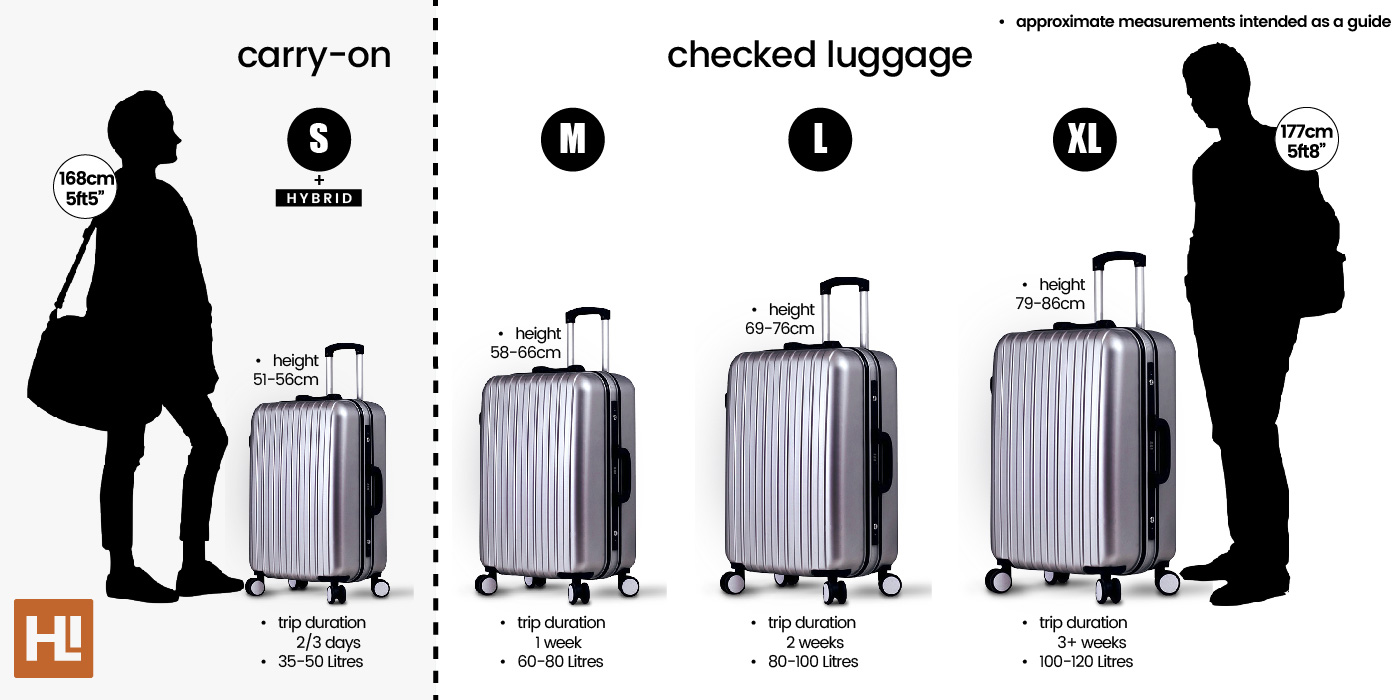
Common suitcase sizes
Suitcase sizes are usually based on the height of the case, not its total capacity. A “20-inch suitcase,” for example, may measure about 22 inches tall from the floor to the top of its handle housing.
| Suitcase size | Common outside size | Usual use | Typical trip length |
|---|---|---|---|
| Personal item | About 18 x 14 x 8 inches or less | Under-seat storage | One to three days |
| Small carry-on | About 19 to 20 inches tall | Carry-on travel | Two to five days |
| Standard carry-on | About 21 to 22 inches tall | Overhead-bin travel | Three to seven days |
| Medium checked bag | About 23 to 26 inches tall | Checked luggage | Five to 10 days |
| Large checked bag | About 27 to 29 inches tall | Checked luggage | One to two weeks |
| Extra-large suitcase | About 30 to 32 inches tall | Long trips or bulky items | Two weeks or more |
These ranges are common, not universal. Two suitcases labeled “28 inches” can have different widths, depths, wheel designs, and usable space.
The most useful way to compare luggage is to check:
- Exterior height, width, and depth
- Weight when empty
- Interior capacity
- Number and position of wheels
- Whether the listed height includes wheels and handles
- Airline size and weight limits
A tall suitcase is not always the largest suitcase. A shorter case with more width and depth may hold more.

Carry-on suitcase sizes
Most U.S. carry-on suitcases are between 19 and 22 inches tall. A common airline limit is around 22 x 14 x 9 inches, but each airline sets its own rules.
Some airlines allow slightly different measurements. Low-cost carriers may also apply stricter limits or charge for larger carry-ons. Before flying, check the baggage page for the airline operating your flight. The airline that sells the ticket may not be the airline that sets the baggage rule.
Standard carry-on suitcase
A standard U.S. carry-on is often listed as a 20-inch, 21-inch, or 22-inch suitcase. It is designed to fit in an overhead bin when its full outside size stays within the airline’s limit.
A practical target is to buy a case whose complete outside dimensions are no larger than the limit. Do not rely only on the suitcase name. A “22-inch carry-on” may exceed 22 inches once its wheels and handles are included.
Carry-ons work well for:
- Short business trips
- Weekend travel
- Warm-weather trips
- Travelers who pack lightly
- Trips where checked-bag fees or delays are a concern
Packing cubes can help you use the space, but they do not reduce the suitcase’s outside dimensions.
International carry-ons
International airlines may use smaller carry-on limits than many U.S. airlines. A suitcase that fits one U.S. carrier may not fit another airline’s cabin rule.
This matters most on:
- International flights
- Flights within Europe
- Regional aircraft
- Basic economy or low-fare tickets
- Codeshare trips with several airlines
If your trip includes several airlines, use the smallest carry-on limit in your itinerary. That reduces the chance of checking the bag at the gate.
Personal items are different
A personal item is smaller than a carry-on. It usually must fit under the seat in front of you. Common examples include:
- Small backpacks
- Laptop bags
- Handbags
- Small tote bags
A personal item is not the same as a 20- or 22-inch suitcase. Some small rolling bags may qualify, but only if the airline allows their size and they fit under the seat.
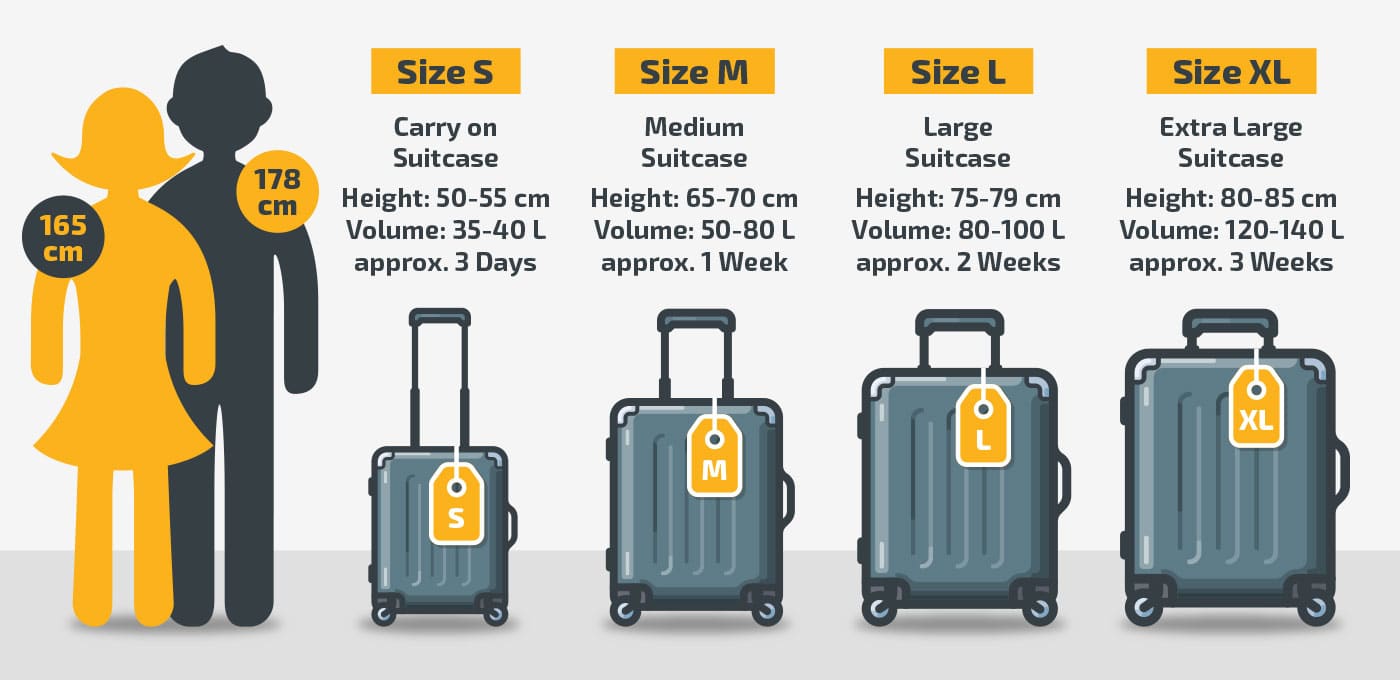
Checked suitcase sizes
Checked suitcases commonly come in 24, 26, 28, 30, and 32 inches. For many travelers, a 24- to 28-inch suitcase offers the best balance between capacity and handling.
Most U.S. airlines use a checked-bag size limit based on linear inches:
Linear inches = height + width + depth
A common limit is 62 linear inches. For example:
- 28 x 18 x 16 inches = 62 linear inches
- 27 x 19 x 16 inches = 62 linear inches
- 26 x 18 x 18 inches = 62 linear inches
The measurement normally includes wheels and handles. A suitcase that appears to be 28 inches tall may exceed the limit if its full outside dimensions are larger.
Medium checked luggage: 24 to 26 inches
A 24- to 26-inch suitcase often suits trips of about five to 10 days. It can hold several outfits without becoming as hard to lift as a larger case.
This size is useful for:
- One person traveling for a week
- Cooler-weather trips with heavier clothes
- Travelers who want to avoid overpacking
- People who prefer a lighter checked bag
A medium case may be easier to keep below an airline’s weight limit than a large case.
Large checked luggage: 27 to 29 inches
A 27- to 29-inch suitcase gives you more room for long trips, multiple shoes, jackets, or shared clothing. It is one of the most common choices for travelers who need to check a bag.
The main trade-off is weight. A large suitcase can become heavy before it is full. Many airlines set a standard checked-bag weight limit of 50 pounds, but the exact limit, fees, and exceptions vary by airline, ticket, route, and frequent-flyer status.
Extra-large luggage: 30 to 32 inches
A 30- to 32-inch suitcase offers high capacity. It may help with long stays, family packing, sports clothing, or bulky items.
It also has greater risk:
- It may exceed 62 linear inches.
- It can become difficult to lift.
- It may exceed the airline’s weight limit.
- Its frame and wheels face more stress.
- It can be awkward on stairs, curbs, and public transit.
A large case is not automatically better. More empty space often encourages overpacking.
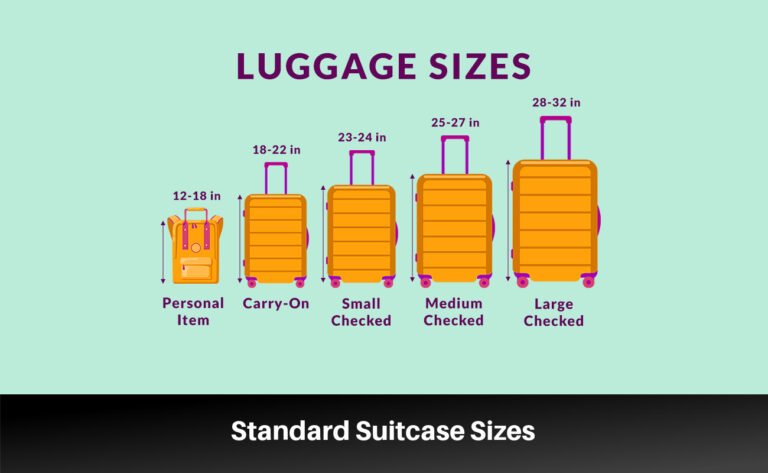
Suitcase sizes by trip length
Trip length gives you a starting point, but clothing type matters just as much. A 10-day summer trip may need less space than a three-day winter trip.
| Trip type | Suggested luggage | Why |
|---|---|---|
| Overnight trip | Personal item or small carry-on | Few clothes and toiletries |
| Weekend trip | Carry-on suitcase | Enough room for basic outfits |
| Three to seven days | Carry-on or medium checked bag | Depends on laundry and clothing bulk |
| One to two weeks | Medium or large checked bag | More clothes, shoes, and toiletries |
| Several weeks | Large checked bag or multiple bags | Better for bulky items and laundry gaps |
| Family travel | Several medium bags | Easier to lift and divide by traveler |
These are planning guidelines, not airline rules. A traveler who packs light may use a carry-on for a week. A traveler carrying formal clothing may need a checked bag for a shorter trip.
A useful rule is to choose the smallest suitcase that holds what you need without exceeding its weight limit. Smaller bags are often easier to move and less tempting to fill with unnecessary items.

How to choose the right suitcase size
Choose a suitcase by checking airline limits first, then matching capacity to your trip.
Step 1: Check your airline’s exact limits
Look at the baggage policy for every airline on your itinerary. Confirm:
- Carry-on dimensions
- Personal-item dimensions
- Checked-bag dimensions
- Checked-bag weight
- Number of bags included
- Fees for extra or oversized luggage
Use the airline’s published rules rather than a store label. Policies can differ even on the same route.
Step 2: Measure the suitcase from the outside
Measure the case when it is closed. Include:
- Wheels
- Fixed handles
- Retractable handle housing
- Side handles
- Exterior pockets
Do not measure only the fabric or hard shell. Airlines usually care about the suitcase’s full outside footprint.
Step 3: Calculate linear inches for checked bags
Add the three outside measurements:
Height + width + depth = linear inches
For example, a suitcase measuring 29 x 19 x 14 inches has:
29 + 19 + 14 = 62 linear inches
If the result is higher than the airline’s limit, the bag may count as oversized. Oversize fees and acceptance rules differ, so check before buying.
Step 4: Weigh the empty suitcase
A heavy suitcase leaves less weight for clothing. This matters when an airline has a 50-pound checked-bag limit.
For example, if a suitcase weighs 12 pounds empty, you have about 38 pounds left under a 50-pound limit. A lighter 7-pound suitcase gives you about 43 pounds for your belongings.
Step 5: Test the packed bag at home
Pack the items you expect to take. Then check:
- Does the zipper close without force?
- Can you lift the bag safely?
- Does it stay under the weight limit?
- Can you roll it without wobbling?
- Does the case remain stable when upright?
A suitcase that is hard to lift at home may be much harder to manage at an airport.

Suitcase size and capacity
Suitcase capacity is often listed in liters, but the number is only useful when comparing similar shapes. A deep case may hold more than a narrow case with the same height.
Capacity can be affected by:
- Hard-shell wall thickness
- Frame construction
- Wheel housings
- Interior dividers
- Compression panels
- Expandable zippers
- Tapered sides
An expandable suitcase may fit more, but expansion can make it too large for a carry-on or checked-bag limit. Use the expanded depth only when the airline allows it.
Soft-sided luggage may offer more flexible packing space. Hard-sided luggage may provide more structure and protection for some items. Neither style has a universal size advantage.

Suitcase size limits for major U.S. airlines
Airline limits change, and some fares have different baggage rules. The following figures describe common industry limits, not a guarantee for every ticket.
Many U.S. airlines use a carry-on limit close to 22 x 14 x 9 inches. Many also use a checked-bag limit of 62 linear inches and a standard checked weight limit of 50 pounds.